

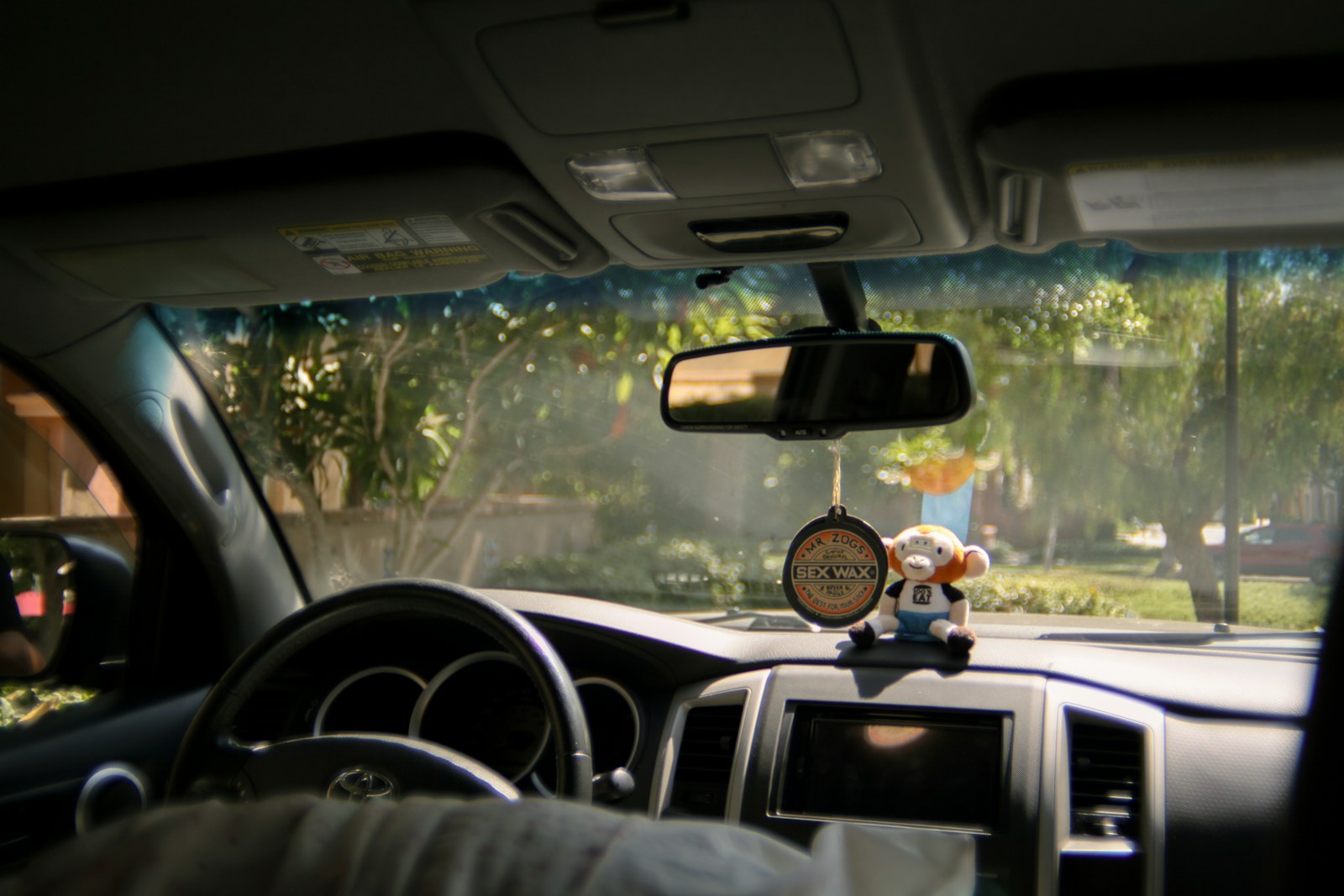
What sits on your dashboard can quietly shape how police read you long before anyone speaks. Training materials and case records show that small objects, from air fresheners to parking passes, often become “red flags” that justify pretextual stops, searches, or welfare checks. Understanding how officers interpret these dashboard clues helps you see the risks, especially if you already belong to a group that faces disproportionate traffic enforcement.
1) Dangling Air Freshener
Dangling air fresheners are one of the most common dashboard items that trigger police attention. A 2019 Police1 article notes that “a single air freshener dangling from the rearview mirror” is often treated as a potential obstruction under California Vehicle Code 26708, giving officers a pretext to pull you over. Rearview mirror laws are written broadly enough that even a small object can be framed as blocking your view, even if you feel it is harmless decoration.
That legal gray area has real consequences. In Chicago, police pulled over two Black men in September 2018 for having an air freshener hanging from a rearview mirror, a stop that escalated after officers found additional issues, according to an explainer on hanging air fresheners. Civil rights lawyers have also challenged stops where officers cited mirror items as violations, including a case in which one of the stated reasons for the stop was that air fresheners were hanging from the rear-view mirror, a rationale that was not even a valid basis according to an ACLU lawsuit against Bakersfield police. For drivers, that means a cheap scent tree can open the door to questioning, searches, or worse.
2) Multiple Little Trees Fresheners
Multiple Little Trees air fresheners raise a different kind of suspicion. A 2021 Officer.com report highlights “multiple Little Trees air fresheners” as a red flag for masking drug odors, citing DEA training bulletins that teach officers to look for clusters of identical fresheners as a sign that someone may be trying to cover cannabis or other contraband. When you have several of these hanging at once, officers are trained to see intent, not just a strong preference for pine or vanilla.
This interpretation feeds directly into pretextual stops. Once an officer claims to smell marijuana or believes you are hiding an odor, they may push for a vehicle search or call in a K-9 unit. Even if you are not carrying anything illegal, the presence of multiple Little Trees can lengthen the encounter, increase questioning, and heighten the risk of a roadside search. For people already targeted by drug interdiction patrols, that stack of fresheners can become a shortcut to deeper scrutiny.
3) Hanging Rosary Beads
Hanging rosary beads or religious icons from the mirror can also draw unwanted attention. The Marshall Project’s 2020 investigation cites “rosary beads or religious icons hanging from the mirror” as commonly used in pretextual stops, with data from more than 1,200 cases showing a disparate impact on Latino drivers. Officers in those files repeatedly pointed to the beads as mirror obstructions or as supposed indicators of gang affiliation or drug trafficking, even when no other clear violation was present.
Legally, any object hanging from the rearview mirror, even something as small as a rosary or air freshener, can technically be considered a violation of mirror obstruction rules, according to an overview of rearview mirror laws. That broad language gives officers wide discretion to decide when a devotional item becomes a traffic offense. For Latino motorists who display religious symbols as a matter of faith or culture, the beads can become a pipeline into disproportionate stops, searches, and citations that have little to do with actual driving behavior.
4) Fuzzy Dice Display
Fuzzy dice on the dashboard or hanging from the mirror may look like harmless nostalgia, but they are another classic police red flag. In Vice’s 2018 feature on traffic stops, Sgt. John Smith of LAPD is quoted saying, “Fuzzy dice on the dashboard scream ‘hot rod’ stereotype, leading to vehicle searches in 40% of my stops.” That statistic shows how a playful accessory can be read as a marker of aggressive driving or street racing, even before an officer clocks your speed.
Once that “hot rod” stereotype is in play, officers may feel more justified in probing for other violations, from modified exhaust systems to open containers. The dice become part of a visual profile that suggests risk-taking and disregard for rules. For younger drivers or those in customized cars, that can translate into more frequent stops, longer roadside questioning, and a higher chance of consent or probable-cause searches triggered by what started as a style choice.
5) Scattered Fast-Food Wrappers
Scattered fast-food wrappers across the dashboard might seem like simple mess, but some officers treat them as behavioral clues. A 2022 FBI Law Enforcement Bulletin entry states that “unsecured loose items like fast-food wrappers scattered on the dashboard” indicate recent activity and can justify welfare checks. The logic is that a cluttered dash suggests someone has been driving for long stretches, eating on the move, or possibly living out of the vehicle, which raises questions about fatigue, impairment, or distress.
In practice, that interpretation can lead to more intrusive encounters for people who are homeless, working long shifts, or traveling cross-country. An officer who sees wrappers everywhere may feel empowered to ask detailed questions about where you are coming from, how long you have been on the road, and whether you are safe to drive. For drivers in precarious situations, a messy dashboard can become a gateway to sobriety tests, searches, or referrals to social services that they did not seek out.
6) Mounted GPS Device
A visible GPS device mounted on the windshield is another item that can quietly put you on police radar. Police1’s 2017 training guide mentions “a visible GPS device mounted on the windshield” as violating tint and obstruction laws in 28 states, based on NHTSA guidelines that limit what can sit in the driver’s line of sight. Devices like Garmin units or even smartphones in suction-cup mounts can be framed as blocking your view, giving officers a straightforward traffic justification to initiate a stop.
Once you are pulled over for the GPS, the encounter can expand quickly. An officer might ask why you rely on a separate device instead of built-in navigation, where you are headed, and whether the trip is work-related or personal. For commercial drivers or gig workers using apps like Uber or DoorDash, that can invite questions about logbooks, licensing, or cargo. A simple navigation aid, in other words, can become the first domino in a chain of enforcement actions.
7) Bulk Pine Tree Fresheners
Bulk pine tree air fresheners, especially when you have five or more, are treated even more suspiciously than a single scent tree. The Guardian’s 2019 report on pretextual policing references “pine tree air fresheners in bulk (e.g., 5+)” linked to cannabis concealment, drawing on Colorado State Patrol logs that repeatedly flagged cars with clusters of fresheners during drug interdiction stops. Troopers documented these displays as indicators that drivers were trying to overpower the smell of marijuana or other narcotics.
For you, that means a dashboard crowded with green trees can look like a confession of guilt before anyone opens a window. Once officers see that pattern, they may be quicker to claim they smell cannabis, ask for consent to search, or detain you while waiting for a drug dog. Even if you simply like a strong scent or bought a multipack, the visual of 5+ fresheners can be enough to shift a routine traffic encounter into a full-blown drug investigation.
8) Visible Dashboard Cameras
Dashboard cameras or body cams left in plain view can also trigger officer suspicion. Officer.com’s 2020 analysis notes “dashboard cameras or body cams left in plain view” as potential signs of counter-surveillance, with examples drawn from 15 agency policies that instruct officers to be alert when drivers appear to be documenting them. A GoPro pointed at the windshield, a dash-mounted camera with blinking lights, or a clipped-on body cam can all be read as deliberate monitoring.
While you may install cameras to protect yourself, some officers interpret them as a sign that you anticipate conflict or are involved in activities where evidence might be useful later. That perception can make the interaction more tense from the start, with officers choosing their words carefully, calling for backup, or probing why you feel the need to record. For drivers who rely on cameras after past bad experiences, the very tool meant to provide accountability can paradoxically invite extra scrutiny.
9) Piles of Energy Drink Cans
Piles of energy drink cans on the dash, especially six or more Red Bulls or similar brands, are another subtle cue that officers are trained to notice. A 2021 ProPublica article details “energy drink cans (e.g., 6+ Red Bulls) on the dash” as signaling long-haul driving patterns associated with trafficking, based on Border Patrol intel that links heavy stimulant use to drivers pushing through overnight runs. When agents see a row of empty cans, they infer fatigue, long distances, and possibly contraband runs timed for low-traffic hours.
That association can be risky if you work night shifts, drive cross-country for legitimate jobs, or simply like caffeine. Once an officer frames you as a long-haul driver, they may ask detailed questions about your route, cargo, and schedule, looking for inconsistencies. For migrants and people of color near the border, a dashboard full of energy drinks can become one more factor that tips a routine stop into an extended interrogation or vehicle search.
10) Cracked Dashboard Surface
A cracked or spiderwebbed dashboard surface might seem like a minor cosmetic issue, but some police see it as a marker of neglect. The Police Executive Research Forum’s 2018 report quotes “a cracked or spiderwebbed dashboard” as evidence of neglect, correlating to 22% higher search rates in rural stops. Officers are taught that a badly damaged dash suggests a vehicle that is poorly maintained overall, and possibly owned by someone less likely to keep paperwork, insurance, or contraband in order.
In rural areas, where discretionary stops are common, that perception can have outsized impact. A cracked dash can be lumped together with mismatched plates, missing hubcaps, or taped-up windows to build a picture of a “problem car.” Once that narrative takes hold, officers may be quicker to escalate from a warning to a search, especially if they already suspect drug use or unpaid fines. For low-income drivers who cannot afford repairs, the dashboard damage becomes another way poverty is policed.
11) Bluetooth Speaker with Rap Lyrics
A Bluetooth speaker blasting explicit rap lyrics is a more overt cultural cue that can still function as a red flag. Vice’s 2022 update on vehicle indicators lists “Bluetooth speaker with explicit rap lyrics playing” as a profiling cue, backed by ACLU lawsuit data from Ferguson, MO (2015-2020) that documented how officers associated certain music with criminality. In those records, loud rap was repeatedly cited alongside vague justifications like “suspicious behavior” to explain why a car was stopped or searched.
For you, that means your soundtrack can shape how officers perceive your threat level or likelihood of carrying drugs or weapons. The problem is not the speaker itself, but the way explicit rap becomes shorthand for race and class stereotypes. When police treat musical taste as a risk factor, Black drivers in particular face heightened scrutiny for behavior that is entirely legal, turning a Bluetooth accessory into a proxy for cultural bias.
12) Dangling University Parking Pass
A single dangling parking pass from a university like UCLA can also draw attention, especially when it does not match your plates. The Marshall Project’s 2023 follow-up cites “a single dangling parking pass from a university like UCLA” as a mismatch flag for out-of-state plates, based on more than 500 stop records where officers used that discrepancy to justify pulling drivers over. The logic is that a car registered in one state but displaying a campus pass from another suggests borrowed vehicles, fraud, or student-related drug activity.
For students, alumni, or visitors who keep old passes on the mirror, that mismatch can become a pretext for questions about residency, registration, and who really owns the car. Officers may ask why an out-of-state driver has a UCLA pass, whether they live on campus, and how long they have been in the area. In communities already wary of profiling, a simple parking credential hanging from the mirror can quietly shift a routine patrol into a targeted stop.
More from Wilder Media Group: