

Pull a 1969 Dodge Charger R/T into any gas station in America and watch what happens. Conversations stop. Phone cameras come out. A guy in a pickup rolls down his window just to listen to the idle. Classic American muscle still has that effect, decades after the last one left the factory floor.
Not every old performance car commands that kind of reaction. The ones that do share a specific combination: styling that photographs from every angle, engines that announce themselves before the car is visible, and production numbers low enough to make a sighting feel like an event. These four muscle cars are the ones most likely to turn a routine fuel stop into an impromptu car show.
1968-1970 Dodge Charger R/T 426 Hemi
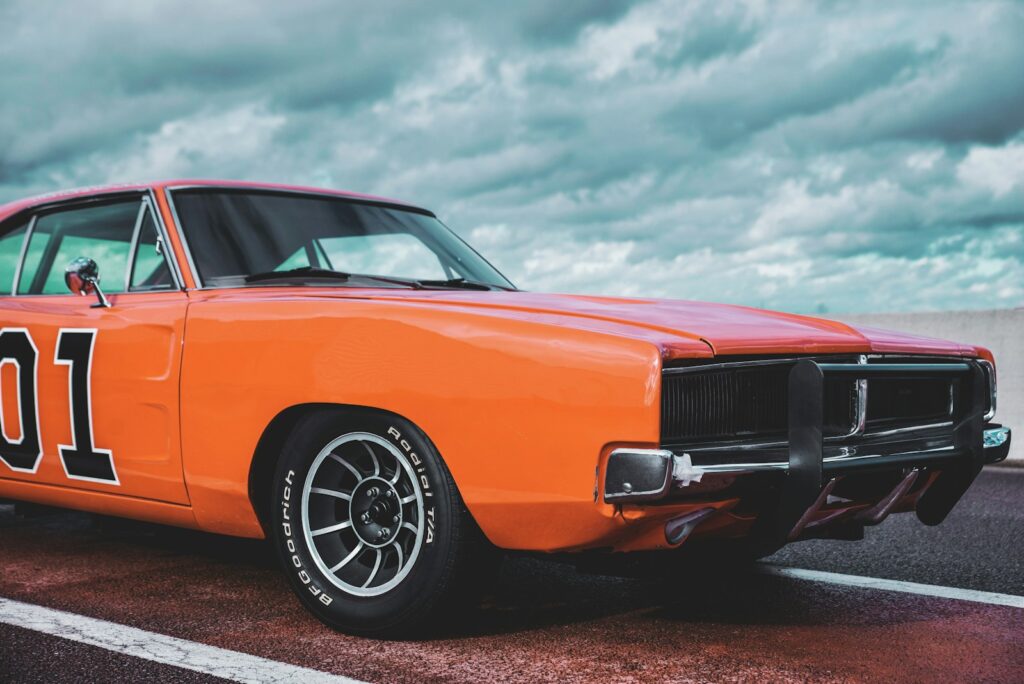
The second-generation Charger is one of the most recognizable shapes in automotive history. Its long hood, recessed grille and fastback roofline created a profile so distinctive that even people with no interest in cars can identify it, largely thanks to its decades of film and television appearances, from Bullitt to The Dukes of Hazzard.
But the version that truly freezes a gas station is the R/T equipped with the 426 Hemi V8. Originally developed for NASCAR competition, the Hemi was Chrysler’s most fearsome street engine: 425 horsepower (conservatively rated), dual four-barrel carburetors, and hemispherical combustion chambers that gave the motor its name. At idle, it produces a choppy, uneven lope that sounds nothing like a modern V8. At full throttle, it sounds like a purpose-built race car, because in many ways it is.
The Charger R/T’s cultural footprint is enormous. Hagerty’s valuation data shows strong, sustained demand for Hemi-equipped Chargers, with concours-quality examples commanding six figures. That collector-market heat reflects what happens at street level: a clean Charger R/T doesn’t just attract gearheads. It pulls in parents who remember the car from a movie and kids seeing the shape for the first time.
The Plymouth Superbird and Dodge Charger Daytona
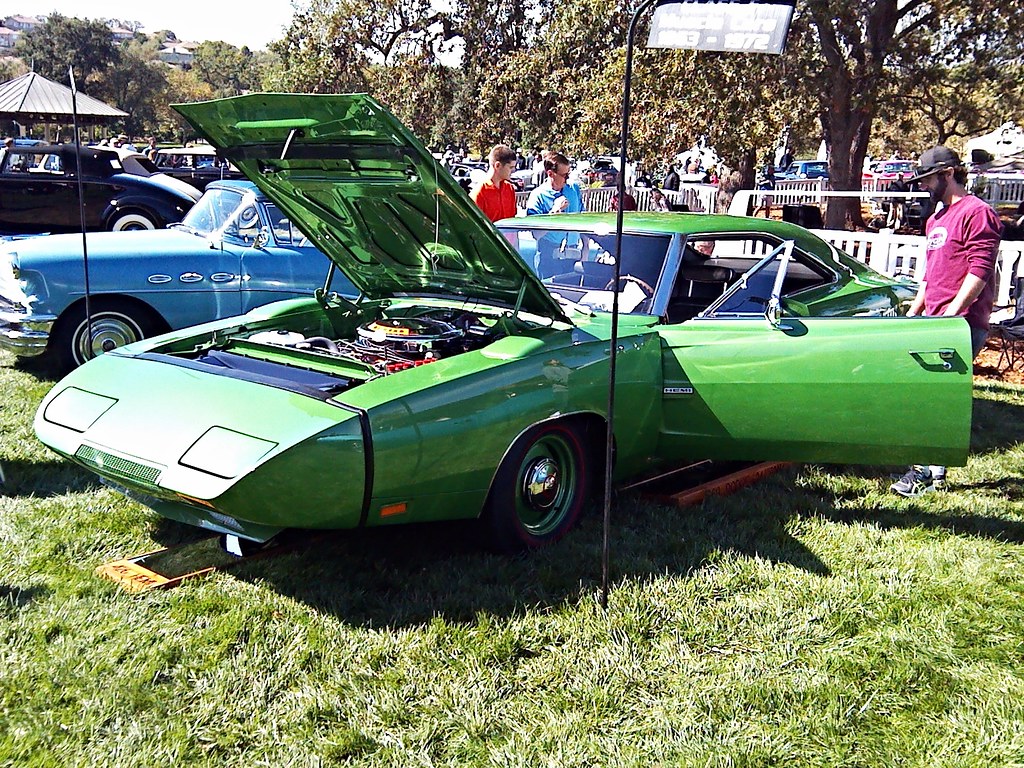
If the Charger R/T trades on menace, the aero warriors trade on pure shock value. The 1969 Dodge Charger Daytona and the 1970 Plymouth Superbird were built for one reason: to win on NASCAR superspeedways. Their towering rear wings and extended nose cones were functional aerodynamic devices, engineered to keep these cars stable above 200 mph on the Talladega banking. Homologation rules required Chrysler to build street versions, and the result was two of the most visually extreme factory cars ever sold to the public.
The Daytona came first, produced only for the 1969 model year, with approximately 503 units built. The Superbird followed for 1970, with roughly 1,920 produced. Both were available with the 426 Hemi, though most buyers opted for the less expensive (and more insurable) 440 Super Commando. Hemi-equipped examples are now among the most valuable muscle cars in existence, with Superbirds regularly crossing the $500,000 mark at major auctions like Mecum and Barrett-Jackson.
At a gas station, the aero nose and that wing do all the work before the key is even turned. People familiar with racing history recognize the NASCAR connection. Everyone else simply sees a factory car that looks like nothing else on the road, then or now. Owners of these cars report that fuel stops routinely stretch to 30 minutes because strangers want to know if the wing is real and why any manufacturer would build something that looks like this.
The Pontiac GTO Judge
The Pontiac GTO is widely credited as the car that ignited the muscle car era when it debuted as a performance package on the 1964 Tempest. By stuffing a 389-cubic-inch V8 into an intermediate body, Pontiac engineer John DeLorean and his team created a formula that every Detroit manufacturer would rush to copy.
Within that lineage, the GTO Judge is the extrovert. Introduced in 1969 as a response to Plymouth’s budget-muscle Road Runner, the Judge combined the GTO’s mechanical credibility with bold graphics, “The Judge” decals, a rear spoiler, and Rally II wheels. Under the hood, the standard engine was the 366-horsepower Ram Air III 400, with the wilder Ram Air IV available as an option. For 1970, GM relaxed its internal displacement limits, and the Judge gained access to a 455-cubic-inch V8 rated at 360 horsepower and a pavement-warping 500 lb-ft of torque.
Production numbers explain why a Judge draws a crowd. Of the 40,149 GTOs Pontiac built for 1969, only 6,725 were Judges. By 1971, the final year, just 374 Judges were produced as the muscle car market contracted under rising insurance costs and tightening emissions rules. Convertible Judges are especially scarce: only 108 were built across all three model years, according to Pontiac Historical Services documentation. When one of these appears at a fuel island, the rarity is as much a talking point as the sound.
The 1971 Plymouth Hemi ‘Cuda Convertible
Some muscle cars attract attention because of styling. Others because of performance. The 1971 Plymouth Hemi ‘Cuda convertible delivers both, then layers in a level of scarcity that puts it in a class by itself.
Plymouth built just 11 Hemi ‘Cuda convertibles for 1971, the final year of the first-generation Barracuda. That number is not a typo. Eleven cars, each equipped with the 426 Hemi, a four-speed manual or TorqueFlite automatic, and a power-folding top. The combination of Chrysler’s most powerful engine in an open-top E-body made these cars the most sought-after muscle cars in collector history. When one sold at Mecum Auctions in 2014 for $3.5 million, it confirmed what the hobby had long believed: this is the holy grail.
The ‘Cuda’s proportions help explain the visual impact. The E-body platform was Plymouth’s shortest wheelbase, giving the car a compact, aggressive stance. The shaker hood scoop, which protruded through a hole in the hood and vibrated with the engine, was both functional and theatrical. Muscular rear fenders, a low beltline, and available “High Impact” colors like Curious Yellow, In-Violet, and Tor-Red made the car impossible to ignore even in a crowded parking lot.
For collectors who follow the market, spotting a Hemi ‘Cuda convertible in the wild is not a routine event. It is the kind of sighting people talk about for years. The car’s auction record, extreme rarity, and unmistakable silhouette combine to create a reaction that goes beyond admiration into genuine disbelief.
Why These Four Still Stop Traffic
A pattern connects these cars. The Charger R/T Hemi, the Superbird and Daytona, the GTO Judge, and the Hemi ‘Cuda convertible all share dramatic design, serious horsepower, and production numbers low enough to make each sighting feel significant. They appear consistently at the top of collector rankings, from Robb Report’s list of the greatest muscle cars to Hagerty’s valuation indexes, and their cultural presence extends well beyond the enthusiast community.
As of early 2026, values for all four continue to climb, driven by a collector base that skews older and a supply that only shrinks. Restorations are expensive, original-spec survivors are increasingly rare, and no manufacturer is building anything like them today. That scarcity is part of what makes a gas station sighting so electric. These are not cars you see on a commute. They are cars you remember seeing, and the story usually starts the same way: “I was getting gas, and this thing pulled in…”
More from Wilder Media Group: