

A handful of classic cars have earned a reputation that has nothing to do with speed or style. They just refuse to die. Mechanics who have spent decades under hoods tend to agree on a short list of models that were engineered with such simple, overbuilt hardware that they routinely outlast vehicles half their age. Here are five classics that keep surfacing in shop conversations and enthusiast garages whenever the subject turns to cars that seem built to run forever.
Mercedes-Benz W123: The Million-Kilometer Taxi
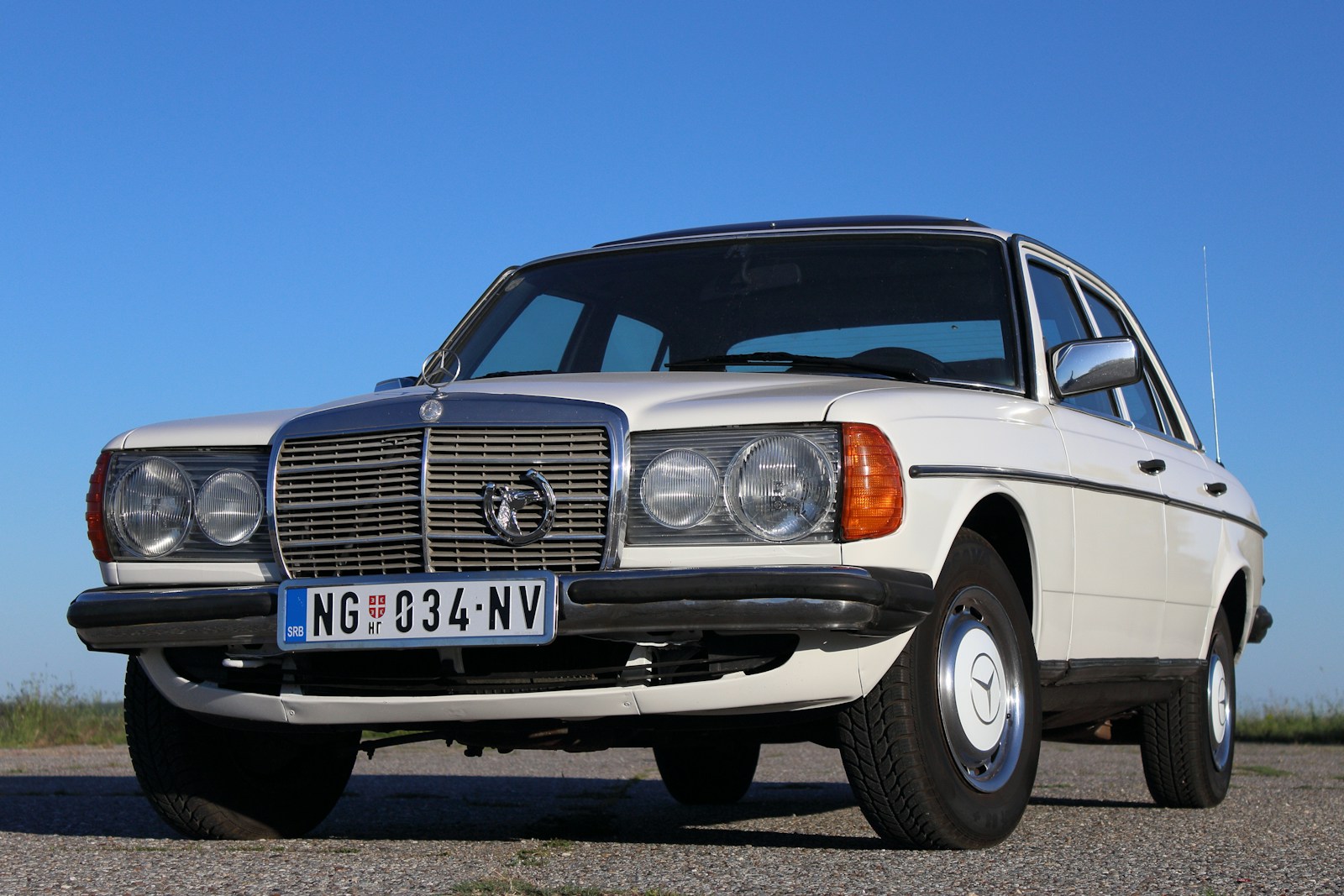
Ask a diesel mechanic to name the most durable sedan ever mass-produced, and the Mercedes-Benz W123 will almost certainly come up. Built from 1976 to 1985 (with wagon and coupe variants continuing into 1986), the W123 paired heavy-gauge steel bodywork with understressed inline-four and inline-five engines that Mercedes tuned for longevity rather than outright power. Thousands of these cars served as taxis across Europe, North Africa, and the Middle East, where six-figure kilometer totals were routine and seven-figure odometers were not unheard of. A well-documented 1976 240D, now displayed at Mercedes-Benz’s Stuttgart museum, accumulated 4.6 million kilometers in taxi service in Greece before retirement.
The diesel variants, particularly the OM615, OM616, and OM617 engines, are the ones mechanics talk about most. These are indirect-injection units with mechanical fuel delivery, meaning there are no electronic engine management systems to fail with age. The suspension geometry is straightforward, the braking system uses simple single-piston calipers, and the automatic transmissions (typically the 4-speed 722.3 or 722.4) are well understood by independent shops worldwide.
For buyers in 2026, the W123 remains surprisingly practical. Parts availability is strong through specialists like PeachParts and Mercedes heritage suppliers. The main enemy is rust, especially in northern climates. A solid-bodied diesel W123 with service records can still handle a daily commute in a way that few other cars from the late 1970s can match, and prices for clean examples have climbed steadily, reflecting that reputation.
Volkswagen Beetle (Type 1): Simple, Air-Cooled, Nearly Indestructible
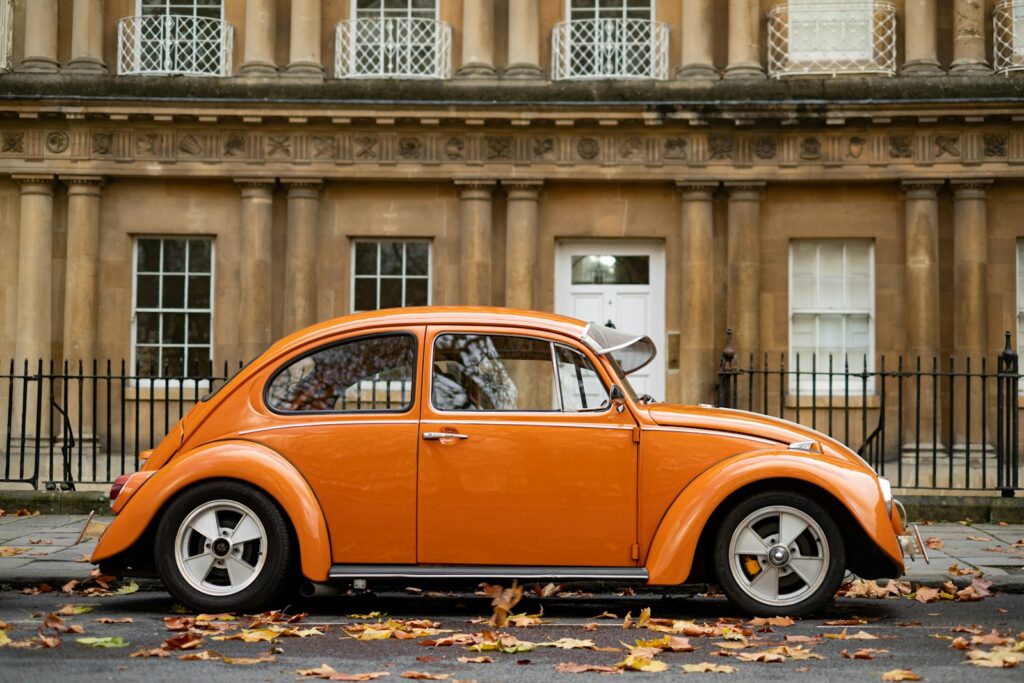
The original Volkswagen Beetle is the benchmark for mechanical simplicity in a passenger car. More than 21.5 million were produced between 1938 and 2003 (with Mexican production running until July 2003), and a staggering number remain on the road, particularly in Latin America and Southeast Asia, where the car’s tolerance for rough conditions and scarce parts infrastructure made it indispensable.
The Beetle’s air-cooled flat-four engine eliminates the radiator, water pump, and coolant hoses that cause headaches in most aging cars. Valve adjustments, points-and-condenser ignition service, and simple carburetor tuning make up the bulk of routine maintenance, and all of it can be done with hand tools in a driveway. That accessibility spawned a DIY culture supported by resources like John Muir’s How to Keep Your Volkswagen Alive, first published in 1969 and still in print. The aftermarket parts catalog is one of the deepest in the classic car world, with suppliers like JBugs and TheSamba keeping everything from engine tins to complete longblocks available.
The tradeoff is obvious: the Beetle is slow, noisy, and offers minimal crash protection by modern standards. But for a buyer who wants a classic that can be driven hard, fixed cheaply, and understood completely, the Type 1 remains difficult to beat. Its most common failures (worn valve guides, tired generator brushes, aging fuel lines) are predictable and inexpensive to address.
Toyota Land Cruiser 80 Series: Overbuilt for the World’s Worst Roads
The 1990-to-1997 Toyota Land Cruiser 80 Series was designed for markets where a breakdown could mean being stranded hundreds of kilometers from the nearest town. Toyota built it on a boxed ladder frame with solid axles front and rear, powered by either the 1FZ-FE 4.5-liter inline-six (gasoline) or the 1HD-T/1HD-FT 4.2-liter inline-six (diesel, outside North America). Both engines were engineered with wide bearing journals, conservative power outputs, and heavy-duty cooling systems sized for sustained low-speed work in extreme heat.
Data from iSeeCars, which has tracked vehicles that reach 200,000 miles and beyond, consistently places the Land Cruiser lineup among the longest-lasting vehicles on American roads. The 80 Series specifically has developed a cult following among overlanders and expedition outfitters, with well-maintained examples regularly passing 300,000 miles on original drivetrains.
The catch for 2026 buyers is cost. Clean, rust-free 80 Series Land Cruisers now routinely sell for $25,000 to $50,000 or more, driven by demand from the overlanding community. Fuel economy hovers around 12 to 15 mpg. But mechanics who work on these trucks argue that a stock or lightly modified example, kept on Toyota’s recommended service intervals, will outlast multiple generations of modern crossovers. The chassis was built to absorb punishment that most owners will never inflict.
Volvo 240: The Brick That Refuses to Quit
Produced from 1974 to 1993, the Volvo 240 earned the nickname “the brick” for its slab-sided styling, but that boxy shape also made it one of the most practical and repairable sedans of its era. Flat body panels are easy to source and align after a fender bender, and the car’s reputation for occupant safety (Volvo used the 240 platform to pioneer crumple-zone research and three-point seatbelt standards) gave it a loyal following among families.
Under the hood, most 240s from 1975 onward run the “redblock” B21 or B23 four-cylinder engine (later the B230), a cast-iron unit with a reputation for surviving well past 300,000 miles on nothing more than regular oil changes and timing belt replacements every 50,000 miles. The fuel-injected versions (Bosch K-Jetronic or LH-Jetronic) are more refined than the earlier carbureted models and remain straightforward to diagnose. Electrical systems are simpler than those in many 1980s European competitors, which reduces the age-related wiring gremlins that plague cars like the BMW E28 or Saab 900.
For buyers shopping in March or April 2026, the Volvo 240 offers one of the lowest barriers to entry on this list. Decent-running examples can still be found for $3,000 to $8,000, and the community around the car, anchored by forums like TurboBricks, is active and generous with knowledge. The 240 lacks the luxury of a Mercedes or the go-anywhere capability of a Land Cruiser, but its combination of safety, comfort, and mechanical honesty has made it a quiet cult favorite among people who just want a car that works.
American Small-Block V8s: The Engines That Outlive Their Cars
Durability in the classic car world is not exclusively a European or Japanese story. American V8-powered cars, particularly those built around the Chevrolet small-block (first introduced in 1955) and the Ford Windsor family, have logged millions of collective road miles thanks to engines that were designed with generous tolerances and supported by the largest aftermarket parts ecosystem in automotive history.
The Chevrolet 350 (5.7L) small-block, for example, powered everything from Camaros to C10 pickups to Corvettes across three decades. Its two-bolt and four-bolt main bearing caps, simple pushrod valvetrain, and widespread availability of rebuild components mean that a worn engine can be returned to service for a fraction of what a European engine rebuild costs. Ford’s 302 and 351 Windsor engines share a similar reputation. Enthusiast insurer Hagerty has noted that affordable American classics built around these drivetrains remain among the most actively driven collector vehicles in the United States, precisely because they are inexpensive to maintain and easy to upgrade with modern fuel injection or overdrive transmissions.
The broader point mechanics make about American muscle and pony cars is that the drivetrain architecture (a longitudinal V8, a simple automatic or manual transmission, and a solid rear axle) is about as mechanically straightforward as a car can get. When something breaks, the fix is usually cheap, fast, and well-documented. For a buyer who wants a classic with presence and a rumble, a well-sorted small-block-powered coupe or sedan can be a genuinely practical long-term ownership proposition.
The Mechanic’s Wild Card: Jeep 4.0 Inline-Six
Beyond the usual suspects, one powertrain comes up in nearly every shop-floor conversation about unkillable engines: the AMC/Jeep 4.0-liter inline-six. Produced from 1987 to 2006 and found in the Cherokee XJ, Grand Cherokee ZJ/WJ, and Wrangler TJ, the 4.0 earned a reputation for running well past 300,000 miles with little more than oil changes and cooling system maintenance. Paired with the Aisin-Warner AW4 four-speed automatic transmission, it formed a drivetrain combination that mechanics frequently describe as “nearly unkillable.”
The 4.0’s durability comes from its long-stroke, low-revving design and a cast-iron block that dissipates heat effectively. Its most common failure points (cracked exhaust manifolds, worn-out cooling system components) are well-known and inexpensive to address. The Cherokee XJ, in particular, has become a favorite among budget-minded enthusiasts who want a capable off-road vehicle that can also serve as a daily driver.
For buyers in spring 2026, clean XJs are getting harder to find as rust claims examples in northern states, and prices for solid ones have risen accordingly. But the mechanical case for the 4.0 inline-six remains as strong as ever. It is one of the last American engines designed with simplicity and repairability as core priorities, and shops that work on Jeeps tend to speak about it with genuine affection.
More from Wilder Media Group: