

The military aviation landscape is shifting toward powerful aircraft designed to dominate the skies rather than focus solely on precision targeting. This trend affects various branches of the armed forces and highlights a growing emphasis on raw power and versatility in military operations. Understanding the capabilities of these planes is crucial for assessing future military strategies and defense spending priorities.
1. Boeing B-52 Stratofortress
Originally introduced in 1955, the Boeing B-52 Stratofortress is a long-range bomber known for its immense payload capacity. With the ability to carry up to 70,000 pounds of bombs, the B-52 can deliver a variety of munitions over vast distances, making it a cornerstone of the U.S. Air Force’s strategic bombing capabilities. Its design prioritizes endurance and firepower, allowing it to operate in contested environments without relying on precision alone.
2. Lockheed Martin F-22 Raptor
The F-22 Raptor, which entered service in 2005, represents a leap in air dominance capabilities. Unlike traditional fighters that optimize for precision strikes, the F-22 is built for speed, agility, and overall air superiority. With a top speed of over Mach 2, this stealth fighter can outmaneuver opponents while delivering powerful air-to-air and air-to-ground strikes, reinforcing the military’s focus on power.
3. Northrop Grumman B-21 Raider
Set to be the next generation of stealth bombers, the B-21 Raider is designed to project power with a focus on penetrating advanced air defenses. Expected to enter service in the mid-2020s, this aircraft will complement the B-52 and B-2 bombers, emphasizing long-range strike capabilities. The Raider aims to deliver a diverse array of munitions, from conventional to nuclear, showcasing the military’s shift toward overwhelming firepower.
4. Boeing KC-46 Pegasus
The KC-46 Pegasus, a modern aerial refueling tanker, plays a critical role in extending the range and effectiveness of military aircraft. Introduced in 2019, it can refuel multiple aircraft simultaneously, thereby amplifying the operational scope of fighters and bombers. While not a combat aircraft, its ability to project power through sustained air operations is key to modern military strategy.
5. Lockheed Martin F-35 Lightning II
The F-35 Lightning II is another example of a military aircraft built with power in mind. Entering service in 2011, the F-35 family includes variants for the Air Force, Navy, and Marine Corps, all designed to dominate the battlefield with advanced sensor fusion and multirole capabilities. While it also offers precision strike capabilities, its design focuses on ensuring air superiority through advanced stealth and situational awareness.
6. McDonnell Douglas AV-8B Harrier II
The AV-8B Harrier II has been a vital asset for the U.S. Marine Corps since its introduction in the 1980s. This vertical takeoff and landing (VTOL) aircraft is capable of operating from austere environments, projecting power in situations where traditional runways are unavailable. Its unique capabilities allow it to deliver fire support and conduct ground-attack missions without relying solely on precision munitions.
7. Airbus A400M Atlas
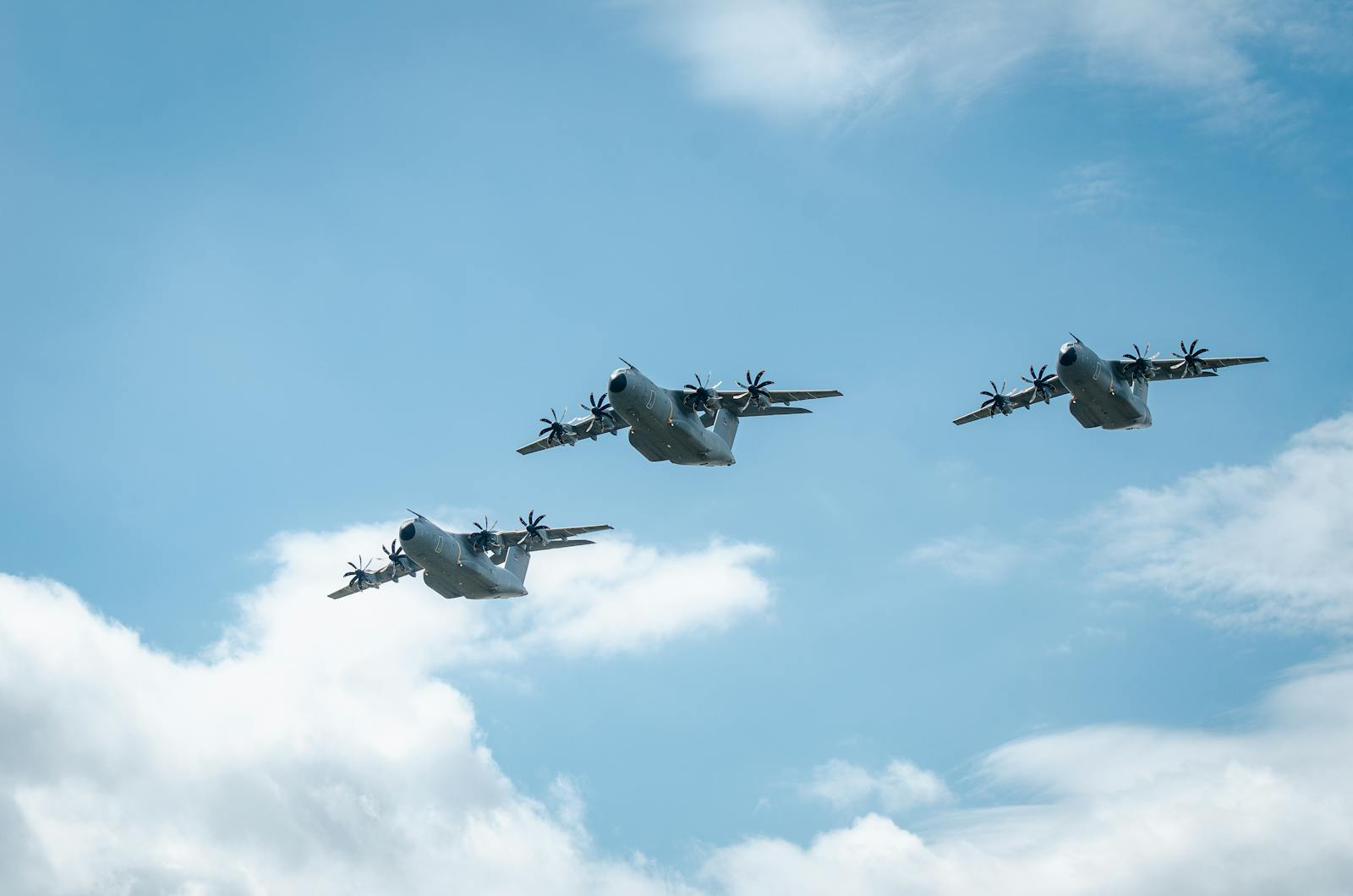
The A400M Atlas, a military transport aircraft introduced in 2013, can carry heavy cargo over long distances while operating in austere conditions. With a payload capacity of up to 37 tons, it can transport troops and equipment, ensuring logistical power in deployment scenarios. Its versatile design allows for rapid airlift capabilities, supporting ground forces without the need for precision targeting.
8. Boeing P-8 Poseidon
The P-8 Poseidon, introduced in 2013, is primarily designed for anti-submarine warfare and maritime surveillance. While its precision targeting capabilities are significant, its real strength lies in its ability to conduct broad-area maritime reconnaissance. With advanced sensors and weapons systems, the P-8 empowers naval forces to project power over vast ocean areas, making it a vital asset in modern naval strategy.
9. Lockheed C-130 Hercules
The C-130 Hercules, a military transport aircraft that first flew in 1954, has been adapted for numerous roles, emphasizing versatility and power. With the ability to perform tactical airlift missions, it can carry heavy loads and deliver them to remote locations.