

Tesla’s latest Full Self-Driving software, FSD v14.2, has completed a 1,285 mile journey across the United States without the human behind the wheel needing to intervene, a milestone that sharpens the debate over how close consumer vehicles are to true autonomy. The coast-to-coast run, documented in detail by early users, showcases a system that can now handle long stretches of highway, complex interchanges, and urban traffic with a level of consistency that earlier versions struggled to maintain.
The drive also lands at a pivotal moment for Tesla, which is racing to prove that its camera-only, “vision” based approach can scale safely while regulators and competitors push alternative paths to automated driving. The result is a real world stress test of both the technology and the company’s long standing claims about turning its fleet into a software defined robotaxi platform.
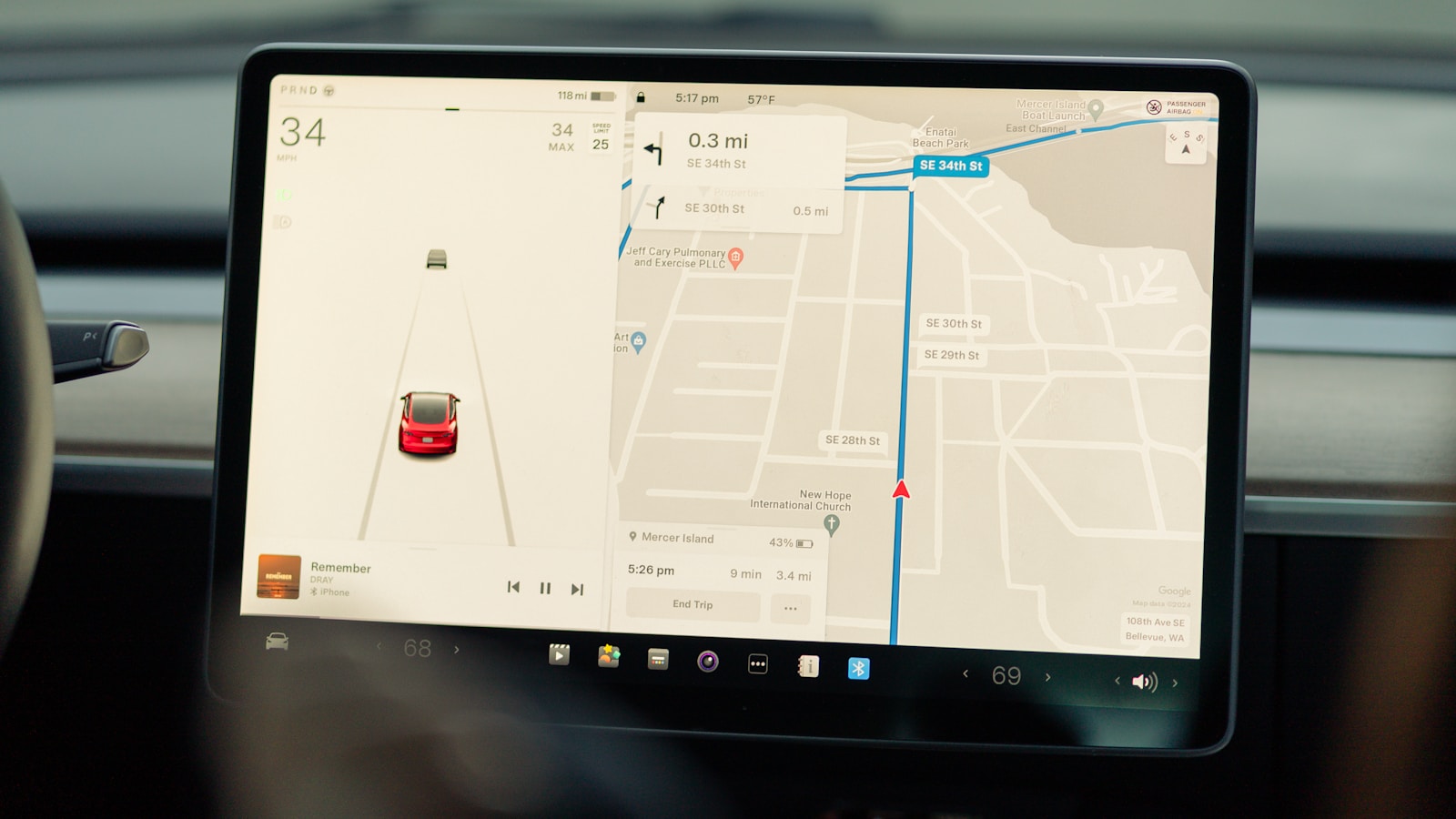
Inside the 1,285 mile FSD v14.2 cross country run
The 1,285 mile trip was completed in a Tesla running FSD v14.2 from the East Coast to the West with the driver keeping hands off the controls and reporting zero disengagements over the full distance. Video logs and telemetry shared by the owner show the system managing lane changes, merges, and speed adjustments continuously, including through construction zones and variable traffic, without the driver needing to override the software even once, a marked contrast with earlier FSD builds that often required frequent corrections on long journeys, as seen in prior cross country tests.
What stands out in the footage is not a single dramatic maneuver but the accumulation of routine decisions that FSD v14.2 now appears to handle with fewer visible hesitations. The car maintains appropriate following distances, anticipates slowdowns, and executes highway interchanges that previously triggered disengagements in v12 era drives documented by independent testers in earlier runs. In dense traffic segments, the system negotiates lane selection and cut ins with smoother acceleration and braking profiles, behavior that aligns with Tesla’s shift to an end to end neural network stack that directly maps camera input to driving actions, as described in technical breakdowns of the v12 architecture in engineering presentations.
How v14.2 builds on Tesla’s end to end FSD strategy
FSD v14.2 is the latest iteration of Tesla’s end to end approach, where a large neural network is trained on millions of human driving examples to output steering, acceleration, and braking commands directly, instead of relying on a hand coded rules engine. Earlier this year, Tesla detailed how v12 replaced much of the legacy stack with a single network that predicts the next driving action at 10 hertz, a design that was later refined and expanded in subsequent releases, according to technical overviews shared in developer briefings. The 1,285 mile intervention free drive suggests that v14.2 benefits from additional training data and tuning, particularly in how it handles edge cases like sudden lane closures and erratic drivers.
At the same time, the company continues to rely solely on cameras and on board compute, without lidar or high definition maps, a choice that has drawn scrutiny from safety advocates and some competitors. Tesla has argued in multiple public forums that a vision only system is more scalable and closer to how humans drive, a position reiterated in its autonomy day materials and in more recent FSD demonstrations. The apparent stability of v14.2 over a multi day, multi state route gives that argument fresh support, although it does not resolve questions about how the system performs in adverse weather or in regions underrepresented in its training data, issues that independent reviewers have flagged in prior road tests.
Safety, regulation, and what an intervention free trip really means
An uninterrupted 1,285 mile drive is a powerful proof point, but it does not by itself establish that FSD v14.2 is ready for unsupervised operation or for commercial robotaxi service. The run was conducted with a licensed driver in the seat, prepared to take over at any moment, which is still a core requirement of Tesla’s current FSD terms of use and a condition echoed in prior regulatory discussions captured in public briefings. Safety experts have long cautioned that a small number of successful long distance drives can coexist with rare but severe failures, and that statistical validation across billions of miles is needed before removing human oversight.
Regulators are watching closely as Tesla pushes software updates that materially change vehicle behavior over the air. Previous investigations into Autopilot and FSD incidents, referenced in independent analyses of Tesla’s automated driving history in archived reviews, have focused on how drivers understand the system’s limits and whether the branding encourages overtrust. An intervention free cross country trip may strengthen Tesla’s case that its technology is improving rapidly, but it also raises pressure on agencies to define clearer performance benchmarks and reporting standards for advanced driver assistance systems, particularly as other automakers roll out competing offerings that blend hands free highway driving with stricter operational constraints, a contrast highlighted in comparative testing seen in multi system evaluations.
More from Steel Horse Rides: