

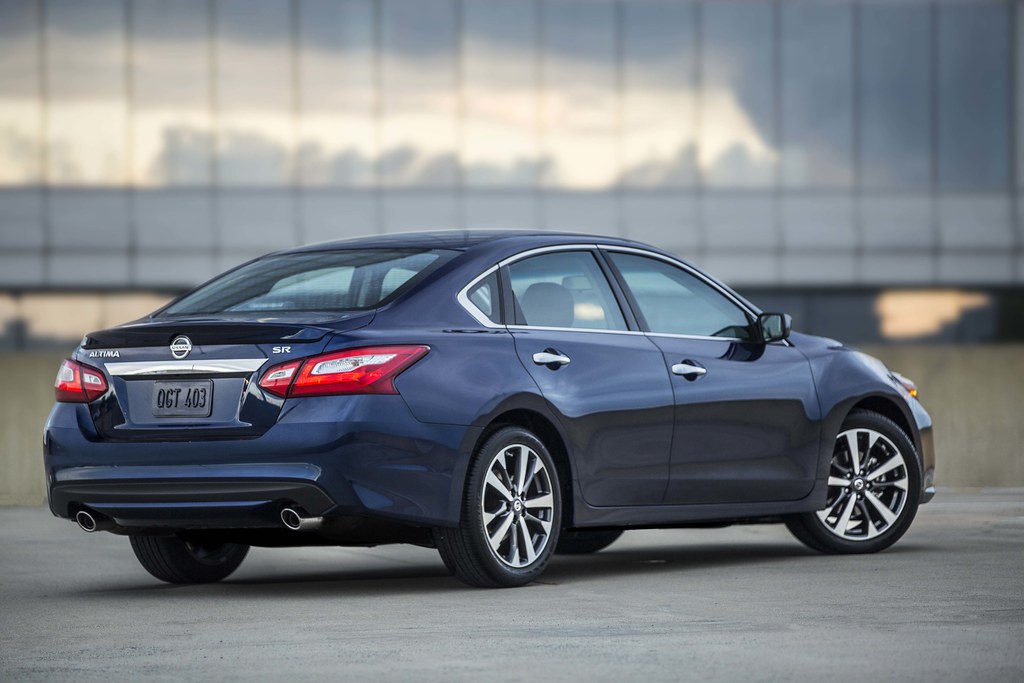
Continuously variable transmissions can feel smooth and efficient, but some models have developed a reputation for failing long before 100,000 miles. If you are shopping used, or already own one of these cars, you need to know which CVT-equipped vehicles struggle to make it past roughly 80,000 miles and why. The models below all show documented patterns of early transmission trouble that can turn a seemingly affordable car into an expensive gamble.
1) 2013-2016 Nissan Altima
The 2013-2016 Nissan Altima uses a Jatco CVT that, according to a 2017 Consumer Reports survey, left 45% of owners dealing with transmission issues by 80,000 miles, often tied to overheating. That pattern fits real-world stories, such as one owner whose Nissan Altima failed at 70,000 miles and now sits at 76,000 miles with a dead CVT. When a unit overheats, you can see warning lights, sudden loss of power, or the car slipping out of gear.
For you as a buyer, that means any 2013-2016 Altima near 60,000 miles should be inspected for shuddering, delayed engagement, or whining noises. Proactive fluid changes and installing an auxiliary cooler may help, but once the belt and pulleys are damaged, replacement is usually the only fix. Because CVT replacement can approach the value of an older Altima, many owners end up walking away from the car entirely.
2) 2014-2017 Nissan Rogue
The 2014-2017 Nissan Rogue also relies on a Jatco CVT, and NHTSA complaint data from a 2018 investigation shows over 1,200 reports of belt slippage, translating into a roughly 30% failure rate before 80,000 miles. Drivers often describe a sudden loss of acceleration, engine revs flaring without corresponding speed, or the transmission dropping into a limp mode. These symptoms typically appear after extended highway driving or climbing grades, where heat and load stress the belt.
If you are considering a used Rogue from these years, a thorough road test is essential. Pay attention to how the CVT behaves after 20 to 30 minutes of driving, when fluid temperatures rise. Any hesitation pulling away from a stop or surging at steady throttle can signal internal wear. Because failures often occur just outside basic powertrain coverage, ownership costs can spike quickly if you are not protected by an extended warranty.
3) 2007-2012 Subaru Forester
The 2007-2012 Subaru Forester with Lineartronic CVT became the focus of a 2015 California Superior Court class-action lawsuit that cited “premature wear” from pulley bearing failures averaging around 70,000 miles. Owners reported grinding noises, harsh engagement, and eventually complete loss of drive as the bearings deteriorated and contaminated the fluid. Once metal debris circulates through the CVT, it can damage the belt and pulleys, making repair far more complex than a simple bearing swap.
For you, that history means any Forester in this range should be checked for whining or rumbling that changes with speed, especially under light throttle. Service records showing frequent fluid changes are a plus, but they do not erase the underlying design vulnerability highlighted in the lawsuit. Because these cars are popular in snowbelt regions, repeated cold starts and steep climbs can further stress already marginal components.
4) 2015-2018 Nissan Sentra
The 2015-2018 Nissan Sentra uses a CVT that a 2019 RepairPal reliability report links to shuddering and outright failure between 50,000 and 80,000 miles, with average repair costs around $3,500. Many owners echo the sentiment that The CVT Transmissions on the Sentra “suck,” describing early slipping and jerking. A separate analysis of Common Sentra CVT issues notes overheating, shuddering, and complete failure that can leave you facing expensive repairs with little warning.
Legal filings about Sentras and their CVTs describe cars that begin to shudder or jerk, then sometimes lose power completely. Even newer examples are not immune, as data on Nissan Sentra CVT failure shows an Average repair cost of $440 listed in one summary, with other owners reporting much higher bills. For you, that means budgeting for a potential transmission replacement long before 100,000 miles, or avoiding these model years unless a robust extended warranty is in place.
5) 2013-2017 Honda Civic
The 2013-2017 Honda Civic adopted the Earth Dreams CVT, and internal data led to Honda TSB 16-056, which addressed torque converter issues in about 1.5 million vehicles. Failures typically surface around 75,000 miles, when drivers notice juddering at low speeds, slipping on gentle acceleration, or a vibration that feels like driving over rumble strips. The bulletin outlines updated software and, in some cases, component replacement to prevent premature wear inside the converter and CVT.
For Civic shoppers, that service bulletin is a double-edged sword. On one hand, it confirms a widespread problem that can shorten transmission life well before 100,000 miles. On the other, a documented TSB repair on a specific car can be a positive sign that the known weakness was addressed. When test-driving, focus on smoothness from a stop and during light throttle cruising, because subtle judder is often the first warning sign.
6) 2014-2019 Jeep Cherokee
The 2014-2019 Jeep Cherokee uses a 9-speed automatic that is often misclassified but behaves in a CVT-like way, and it earned an “avoid” rating in a 2020 Consumer Reports reliability survey after a 28% transmission failure rate before 80,000 miles. Owners describe hesitation when pulling into traffic, abrupt gear changes, and episodes where the transmission seems to hunt endlessly for the right ratio. Those drivability issues can mask deeper internal wear that eventually leads to costly repairs.
Even though the Cherokee’s unit is technically a stepped automatic, its behavior and failure patterns matter if you are trying to steer clear of transmissions that rarely last past 80,000 miles. For you, the risk is not only breakdowns but also safety concerns when the vehicle hesitates merging or crossing intersections. Any used Cherokee from these years deserves a long test drive that includes stop-and-go traffic and highway speeds to expose potential problems.
7) 2009-2014 Toyota Corolla
The 2009-2014 Toyota Corolla equipped with the K110 CVT variant was the subject of Toyota TSB T-SB-0150-15, which documented chain elongation failures between 65,000 and 80,000 miles affecting about 500,000 units. As the chain stretches, you may feel slipping, hear a metallic rattle, or notice the engine revving higher than normal for a given speed. Some owners learned of the risk only after independent coverage of Toyota CVT issues on Corollas and Im highlighted how quietly the defect was handled.
For you, that means a seemingly bulletproof Corolla can hide a transmission that is already nearing the end of its life by 70,000 miles. Verifying whether the TSB work was completed is crucial, as updated parts and software can reduce the chance of repeat failure. Even then, any unusual noises or surging under steady throttle should be treated as a serious warning, not a quirk to ignore.
8) 2016-2020 Mitsubishi Outlander
The 2016-2020 Mitsubishi Outlander uses the INVECS-III CVT, and aggregated owner data on CarComplaints.com shows about 850 complaints centered on overheating failures averaging 72,000 miles. Drivers report warning lights, sudden loss of power, and situations where the transmission will not accelerate beyond a certain speed. Overheating can trigger limp mode repeatedly, and each episode accelerates internal wear on the belt and pulleys.
If you are evaluating an Outlander from these years, pay attention to how it behaves on long highway drives or steep climbs, where heat builds quickly. Frequent fluid changes and careful driving can help, but the complaint pattern suggests a design that struggles under normal use. Because Mitsubishi resale values are already modest, a failed CVT can easily exceed the car’s remaining market value, leaving you with a difficult repair-versus-replace decision.
9) 2012-2016 Ford Focus
The 2012-2016 Ford Focus uses the PowerShift dual-clutch transmission, a wet-clutch design that many owners experience as a CVT-equivalent because of its automated behavior and chronic failures before 80,000 miles. Clutch pack wear leads to shuddering from a stop, harsh shifts, and eventual loss of drive, issues serious enough to trigger a $35 million class-action settlement in 2017. Drivers often describe the car as feeling like it has a slipping manual clutch, even though there is no clutch pedal.
For you, the takeaway is that not all problem units are traditional CVTs, but they can still deliver the same early-life headaches. Any Focus from these years should be approached with caution, especially if service records show repeated transmission control module updates or clutch replacements. Even after repairs, some owners report recurring problems, which can make long-term ownership unpredictable and expensive.
10) 2011-2015 Nissan Versa
The 2011-2015 Nissan Versa uses a Jatco CVT that developed such a severe defect pattern that Nissan extended warranties to 84 months or 100,000 miles in 2014. NHTSA recall 14V-349 and internal data pointed to a roughly 40% defect rate, with CVT belts breaking at around 68,000 miles on average. When the belt fails, the car can suddenly lose all ability to move, sometimes with little prior warning beyond minor slipping or a faint whine.
For Versa owners and shoppers, that history means any car outside the extended warranty window is a significant risk once it approaches 60,000 miles. A pre-purchase inspection should include scanning for transmission codes and a long test drive to check for hesitation or surging. Because the Versa is often bought as a budget commuter, an unexpected CVT replacement can easily wipe out the savings that drew you to the car in the first place.
More from Wilder Media Group: