

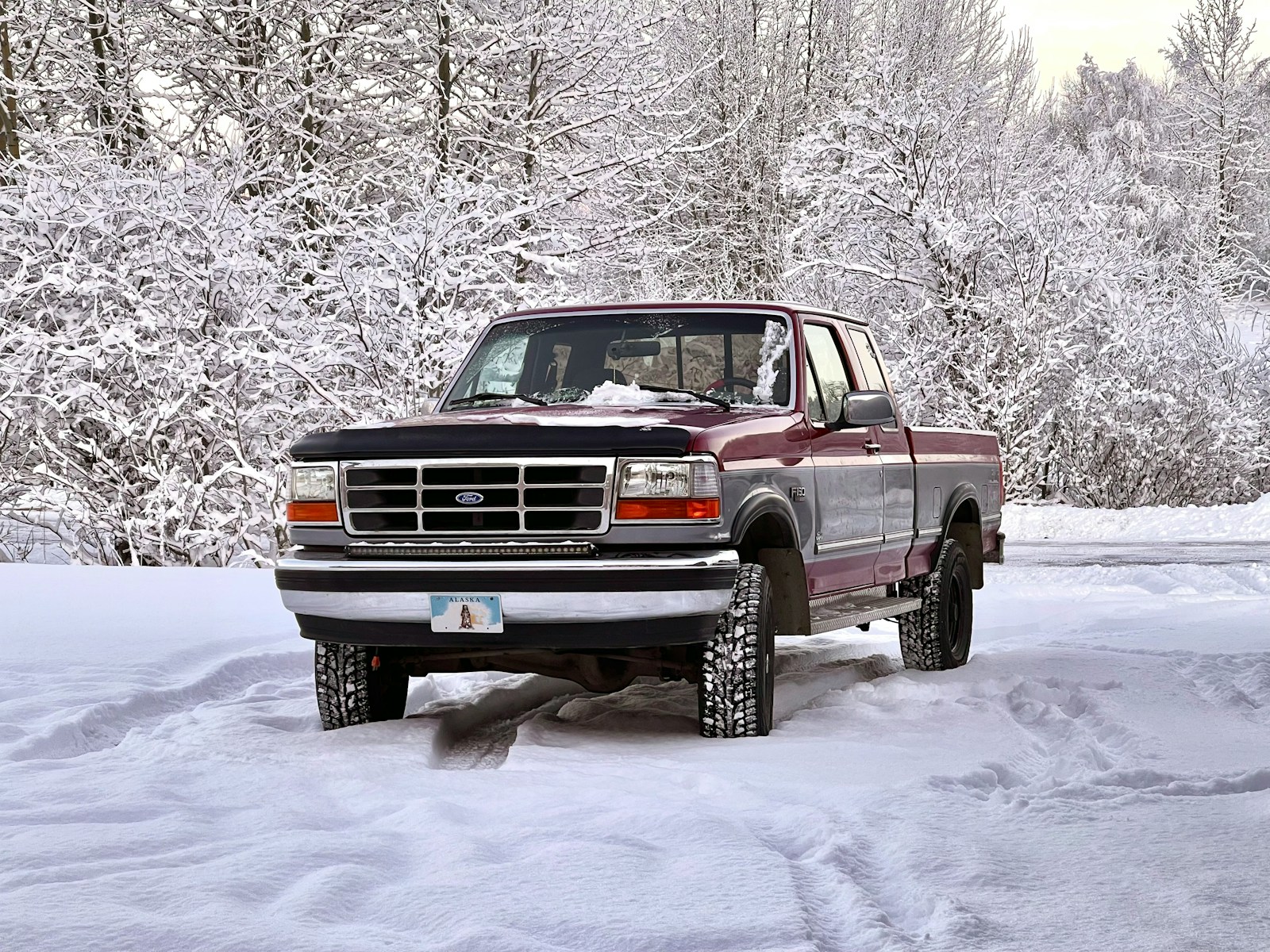
Shopping used trucks and SUVs can save you thousands, but some models have frames that rust out long before you would reasonably expect. When a frame or unibody corrodes, it is not just cosmetic, it can quietly turn a solid-looking vehicle into a structural liability. The 14 vehicles below all have documented frame or chassis rust problems that you should factor into any purchase decision.
1) 1980-1996 Ford F-Series Trucks
The 1980-1996 Ford F-Series trucks are workhorses, but their frames have a reputation for rusting from the inside out in harsh climates. Sourced reporting attributes the problem to poor galvanization on some frames, which left bare steel vulnerable where road salt and moisture could collect. In-depth truck rust inspections comparing Chevy, Ford, Ram and Toyota products show how quickly exposed steel on older pickups can pit and flake, especially around rear axle housings and spring mounts.
For you as a buyer, the stakes are high because frame perforation can lead to failed safety inspections or even frame replacement that costs more than the truck is worth. When evaluating an older F-Series, you should pay close attention to the inside of the frame rails, crossmembers, and the area around the fuel tank straps. Any deep scaling, soft spots, or visible holes are red flags that the truck’s remaining life may be very limited.
2) 1997-2003 Chevy Silverado
The 1997-2003 Chevy Silverado is another popular full-size pickup with a documented tendency toward premature frame rust, particularly in the Midwest and Northeast. Safety bulletins and rust-focused testing have highlighted how road salt can accumulate inside boxed frame sections, accelerating corrosion from the inside where you cannot easily see it. In some cases, owners only discover the problem when a mechanic pokes through a seemingly solid frame rail during an inspection.
Used-truck guides that flag rust problems you can’t ignore point out that even trucks without decades of winter exposure can show advanced corrosion if they were not regularly washed underneath. For you, that means a clean body on a Silverado of this era does not guarantee a healthy chassis. You should insist on lifting the truck, tapping along the frame with a hammer, and checking around rear spring hangers, steering box mounts, and cab mounts for structural weakness.
3) 2004-2008 Toyota Tacoma
The 2004-2008 Toyota Tacoma, especially in rust-belt states, is infamous for rear frames that corroded so severely that some trucks were ultimately bought back or had frames replaced. Owners reported that the boxed frame rails could rot near the rear spring shackles and spare tire area, sometimes to the point where chunks of metal fell away. One Tacoma driver with a 99 Tacoma described frame rust and rot so bad “Near the” front of the spring shackles that they could push metal through by hand.
For you, the implication is clear, a Tacoma from this generation demands a meticulous underbody inspection, even if the truck looks immaculate from above. Focus on the inside of the frame rails near the rear axle, the front lower control arm mounts, and any factory drain holes where moisture can sit. Because these trucks hold their value, you should be especially cautious about paying a premium price for one that has not had documented frame inspections or repairs.
4) 1999-2006 Jeep Grand Cherokee
The 1999-2006 Jeep Grand Cherokee uses a unibody structure rather than a separate frame, but that does not make it immune to structural rust. Testing in northern states found that some unibody rails and suspension mounting points failed rust inspections, particularly in vehicles that spent their lives on salted roads. When corrosion attacks a unibody, it can compromise critical areas like rear control arm mounts or front subframe attachment points.
For you as a shopper, the danger is that unibody rust can be harder to spot and more expensive to repair than a traditional frame. You should look closely at the seams along the floorpan, the rear wheel wells, and the front subframe where it meets the body. If you see bubbling seams, flaking metal, or previous patchwork near suspension mounts, that Grand Cherokee may no longer provide the crash protection and towing stability you expect.
5) 1988-1998 GMC Sierra
The 1988-1998 GMC Sierra shares much of its architecture with Chevy pickups of the same era, and its frames have their own rust trouble spots. Reporting on long-term reliability noted that cabs could rust at frame welds, especially where moisture and debris collected between the cab mounts and the frame rails. Over time, this corrosion can spread along the welds and into the surrounding metal, weakening the connection between body and chassis.
For buyers in snowy or coastal regions, that means a Sierra that still runs well might hide serious structural decay underneath. You should inspect the cab mounts, the frame around the steering box, and the rear frame kick-up over the axle. Any separation at welds or visible distortion around mounting points suggests the truck has seen enough corrosion that future repairs could be extensive and costly.
6) 2007-2013 Nissan Frontier
The 2007-2013 Nissan Frontier has been flagged for frames that can show perforation after only about five years in salty climates. Owner surveys and rust investigations describe boxed frame sections that trap brine and mud, leading to rust from the inside that eventually breaks through. Once perforation starts, the corrosion often spreads quickly along the rails and crossmembers, undermining the truck’s ability to safely carry loads or tow.
If you are considering a Frontier from this generation, you should treat underbody inspection as non-negotiable. Pay particular attention to the frame near the rear leaf spring mounts, the front lower control arm pockets, and the spare tire area. Because these trucks are often used for work and off-road driving, any sign of deep scaling or holes should make you question whether the remaining frame strength is adequate for your needs.
7) 1995-2004 Dodge Ram 1500
The 1995-2004 Dodge Ram 1500 is well known among truck enthusiasts for frame rust that can progress to cracking, especially in regions that use heavy road salt. Reports describe frames that rust along the side rails and crossmembers until structural integrity is compromised, prompting a frame replacement program for affected trucks. Owners on dedicated Ram forums warn that while some components may last, “It will take a hundred years to rust through, probably longer. It is the sheet metal and frame you should be worried about,” as one Dodge Ram 1500 rust issues discussion puts it.
For you, that means a clean-looking Ram can still hide serious frame decay that threatens towing safety and crash performance. Inspect the frame near the rear spring hangers, the steering box, and the transmission crossmember, and look for any cracks radiating from rusty areas. If the frame has already been patched multiple times, you should factor in the likelihood of future failures before committing to a purchase.
8) 2001-2006 Ford Explorer
The 2001-2006 Ford Explorer, particularly in SUV duty where it sees family use and towing, has been cited for frame rust near the exhaust system. Heat, moisture, and road salt combine around the exhaust and rear subframe mounts, accelerating corrosion in those localized areas. Over time, that rust can spread into the surrounding frame rails and crossmembers, potentially affecting how the suspension and rear differential are supported.
For a used Explorer, the implication is that you cannot just glance at the rocker panels and call it good. You should have the vehicle lifted and inspect the frame rails adjacent to the exhaust, the rear subframe attachment points, and the tow hitch mounting area. If rust has eaten deeply into these sections, repairs may require extensive welding or replacement parts that quickly exceed the value of an older SUV.
9) 1990-1997 Chevy Blazer SUV
The 1990-1997 Chevy Blazer SUV has a body-on-frame design that, in theory, should be durable, yet it has a history of frames corroding prematurely in the Northeast United States. Environmental reporting on vehicle corrosion in that region highlighted how salt-laden slush can pack into frame channels and sit there for months, attacking the steel. On the Blazer, the rear frame rails and the area around the fuel tank straps are particularly vulnerable.
For you, this means that a Blazer that has spent its life in a rust-prone state deserves extra scrutiny underneath. Look for heavy scaling, delamination, or holes near the rear bumper mounts and along the inside of the frame rails. Because these SUVs are often inexpensive on the used market, a severely rusted frame can turn what seems like a bargain into a short-lived and unsafe purchase.
10) 2009-2014 Toyota 4Runner
The 2009-2014 Toyota 4Runner, especially in Canada and northern states, has been associated with undercarriage rust that can affect frame components. Reports of corrosion on frame rails, suspension mounts, and skid plate attachment points show that even relatively modern SUVs are not immune when exposed to heavy salt. In some cases, owners discovered advanced rust while performing routine maintenance like brake or exhaust work.
If you are shopping for a 4Runner from this generation, you should not assume that Toyota’s reputation for durability automatically extends to the frame in harsh climates. Inspect the boxed frame sections near the rear lower control arms, the front crossmember, and any factory welds that show bubbling or flaking. For off-road users, weakened frame sections can be especially dangerous when tackling rough terrain or towing near the vehicle’s limits.
11) 1985-1995 Ford Ranger Pickup
The 1985-1995 Ford Ranger pickup is a compact truck favorite, yet its frames are known to rust at crossmembers and other structural junctions. Long-term reviews and used-truck warnings have pointed out that the crossmembers supporting the transmission and fuel tank can corrode until they detach from the side rails. Once that happens, the truck may sag, develop alignment issues, or fail safety inspections outright.
For you, the key takeaway is that a Ranger of this age needs more than a quick look at the outer frame rails. You should check every crossmember, especially those under the cab and bed, for perforation or separation at the welds. Because these trucks are often used as inexpensive work vehicles, many have seen years of neglect, making a thorough underbody inspection essential before you rely on one for daily driving or hauling.
12) 1998-2005 Isuzu Rodeo
The 1998-2005 Isuzu Rodeo has one of the more notorious frame rust reputations among compact SUVs, with failures tied to inadequate rust-proofing. Investigations documented frames that rusted so severely around the rear suspension mounts that control arms could detach, posing an obvious safety risk. In some markets, regulators scrutinized these vehicles after reports of structural failures during routine driving.
For a prospective buyer, that history means you should treat any Rodeo from this era with extreme caution. Inspect the rear frame rails near the trailing arm mounts, the area around the fuel tank, and the front subframe attachment points. If you see extensive rust or previous patchwork in these critical zones, it is often safer to walk away than to gamble on a vehicle whose frame may already be compromised beyond economical repair.
13) 2000-2007 Suzuki Grand Vitara
The 2000-2007 Suzuki Grand Vitara, a compact SUV with off-road aspirations, has been linked to chassis rust problems in humid and coastal areas. Reports describe corrosion starting on the ladder frame and spreading to suspension mounts and body attachment points, particularly where mud and moisture collect. Over time, this can lead to weakened control arm brackets and compromised crash protection.
For you, the risk is that a Grand Vitara that has spent years near the ocean or in a damp climate may look fine up top while its chassis quietly deteriorates. You should inspect the frame rails, especially near the front and rear suspension mounts, and look for rust around body mounts under the floor. If the vehicle has been used off-road, check skid plate mounts and any areas where rocks and debris may have chipped away protective coatings.
14) 1987-1994 Mazda B-Series Trucks
The 1987-1994 Mazda B-Series trucks, which share much of their design with Ford’s compact pickups, are also known for frame rot in coastal regions. Salt air and occasional beach driving can accelerate corrosion on the open C-channel frame rails, particularly near the rear spring hangers and fuel tank straps. Once rust takes hold in these thin sections, it can quickly progress to perforation and structural weakness.
For used-truck shoppers, that means any B-Series from this era that has lived near the coast deserves a very careful look underneath. Focus on the rear frame kick-up, the front crossmember, and the cab mounts, and be wary of heavy scaling or previous weld repairs. Because these trucks are often bought as budget haulers, a severely rusted frame can turn into a safety hazard long before the engine or drivetrain wears out.
More from Wilder Media Group: