

You are watching a new kind of car war unfold, where software, sensors, and fleets matter more than chrome. In 2025, five automakers and tech-backed brands are racing to control autonomous ride-hailing and premium electric vehicles, a segment that could reshape how you move through cities. Each is betting billions that you will choose their robotaxi or software-defined EV as your default way to get around.
1. Tesla’s Cybercab Unveil
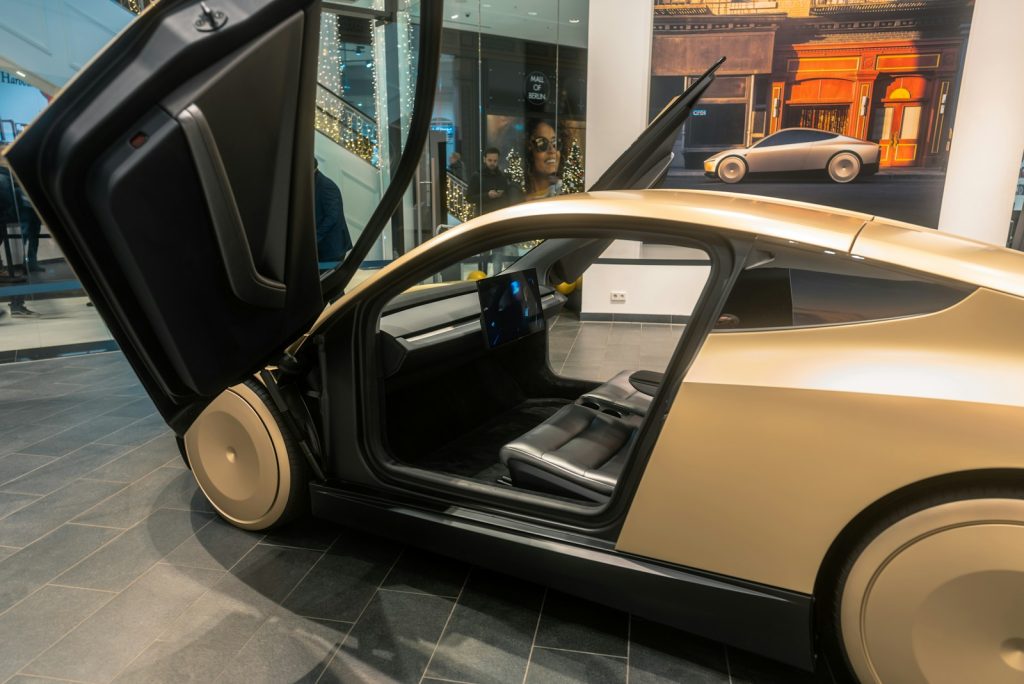
Tesla is using its planned purpose-built robotaxi, the Cybercab, to push for dominance in autonomous ride-hailing. The company has said it will unveil the dedicated robotaxi on October 10, 2024, with production targeted for 2026, positioning the Cybercab as a mass-market alternative to human-driven ride-hailing. By designing a vehicle specifically for autonomy rather than adapting a consumer car, Tesla is signaling that it wants to control both the hardware and the software stack that power your future rides.
This strategy puts Tesla directly up against established robotaxi players in the autonomous ride-hailing segment, including Waymo and Cruise, which are already operating services on public roads. If Tesla can deliver a reliable Cybercab fleet at scale by 2026, it could leverage its existing customer base, charging network, and over-the-air software updates to undercut traditional ride-hailing prices. For you, that could mean cheaper, more predictable urban trips, but also a deeper dependence on Tesla’s ecosystem.
2. Waymo’s Austin Expansion
Waymo, a unit of Alphabet, is using Austin, Texas, as a template for how a national robotaxi network might work. In March 2024, the company expanded its robotaxi service to Austin and began offering fully driverless rides to the public, with no human safety driver behind the wheel. The company has framed Austin as a key step toward scaling its Waymo One service across the United States by 2025, turning autonomous mobility from a novelty into a daily option.
By targeting nationwide scaling by 2025, Waymo is effectively challenging automakers that are only now preparing their own robotaxi fleets. Its vehicles already navigate complex urban environments, and the Austin rollout shows how quickly the company can adapt to a new city’s traffic patterns and regulations. For riders, that means you could soon open an app and hail a driverless car in multiple cities, long before some traditional automakers have their first purpose-built robotaxi on the road.
3. Cruise’s Phoenix Restart
General Motors’ Cruise division is fighting to regain its footing after regulatory setbacks. The company resumed supervised testing in Phoenix, Arizona, on April 9, 2024, following a California DMV suspension that forced it to pause driverless operations. In Phoenix, Cruise is operating with human supervisors in the loop, using the city as a proving ground to validate safety improvements and rebuild confidence with regulators and riders.
Cruise has outlined plans to expand to other U.S. cities by late 2024, signaling that it still sees a path to a large-scale robotaxi business. For you, the supervised restart means Cruise vehicles may return to your streets more cautiously, with additional oversight and transparency about how they handle edge cases. The company’s ability to show safer performance in Phoenix will heavily influence whether it can again compete head-to-head with Tesla and Waymo in the robotaxi market.
4. Zoox’s Las Vegas Debut
Zoox, owned by Amazon, is using Las Vegas to showcase a radically different robotaxi design. The company began public robotaxi rides in Las Vegas, Nevada, on October 17, 2024, using bidirectional autonomous vehicles that have no steering wheels and can drive equally well in either direction. Zoox has said it is targeting commercial deployment across multiple cities by 2025, turning its compact, shuttle-like vehicles into a familiar sight in dense urban cores.
The Las Vegas launch has since evolved into a broader public rollout, with Amazon, Inc’s autonomous unit offering rides to the public in the city and marking a first in the United States for a purpose-built robotaxi service, as detailed in coverage of Amazon’s Zoox in Las Vegas. Additional reporting notes that Amazon-owned Zoox is running limited public service with its toaster-shaped shuttles, described in a profile of Zoox’s public service, and that the company is offering free rides from select locations around Las Vegas, according to reporting on Zoox’s Las Vegas launch. Firsthand accounts from The Vegas service describe free rides along a fixed loop on and around the Strip, with riders noting details like stars on the ceiling and curated music, as captured in a ride-along in Zoox’s robotaxi on the Strip, underscoring how Zoox is competing not just on autonomy but on the in-cabin experience you feel as a passenger.
5. Volkswagen’s Rivian Alliance
Volkswagen is taking a different route to this crucial segment by teaming up with an American EV specialist. Its Cariad software unit is partnering with Rivian on next-gen EV platforms that will start arriving in 2026, with Volkswagen committing $5.8 billion to the alliance. The goal is to accelerate development of software-defined vehicles and advanced driver-assistance features that can eventually support higher levels of autonomy.
This investment is central to Volkswagen’s 2025 push to control more of the premium EV segment, where buyers expect seamless digital features and frequent software upgrades. By combining Rivian’s electric skateboard platforms with Cariad’s software ambitions, Volkswagen is trying to close the gap with Tesla and other tech-forward rivals. For you, that could translate into premium EVs that feel more like constantly improving devices than static hardware, with autonomy features that evolve over the life of the car.
More from Wilder Media Group: