

Lucid’s push into the premium EV market in 2025 did more than move a few luxury sedans. It reshuffled loyalties among early adopters, pulling in defectors from both Tesla and Rivian as trade-in data started to hint at a changing competitive map. Yet even as Lucid logged “quite a few” Rivian owners switching sides, the bulk of its conquest business still came from Tesla drivers, underscoring how dominant Tesla remains as the source of high-end EV customers.
The pattern that emerged over the year was not a simple story of one brand replacing another, but of a maturing market where incentives, pricing resets, and shifting brand perceptions all nudged owners to reconsider their next move. Lucid’s strategy of aggressive discounts and targeted trade-in bonuses helped it punch above its weight, while Tesla’s huge installed base and entrenched ecosystem ensured it remained the primary donor brand for rivals.
Lucid’s 2025 trade-in mix: Rivian shows up, Tesla still dominates
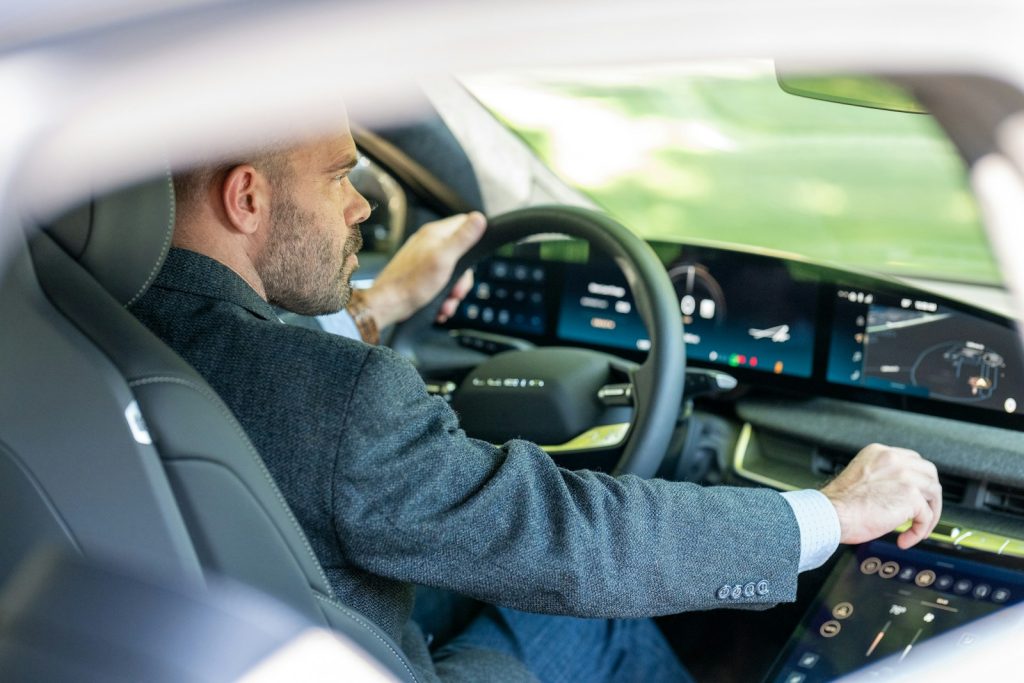
Lucid’s internal view of its 2025 trade-in mix captured the nuance of this transition. Company communications chief Nick Twork described the flow of used vehicles coming in as including “quite a few” Rivian models, a sign that Rivian’s early adopters were willing to experiment with another premium EV brand. Yet Twork also made clear that the overwhelming majority of trade-ins were still Teslas, reflecting how many high-income EV buyers started with Tesla before looking elsewhere. That balance, with Rivian present but Tesla dominant, framed Lucid’s conquest story for the year.
The detail matters because it shows Lucid is not just nibbling at Tesla’s edges, but also tapping into the newer cohort of adventure-focused EV owners who originally chose Rivian. Twork’s comments, shared in coverage of Lucid’s 2025 performance, emphasized that although the company saw a noticeable uptick in Rivian trade-ins, they were still dwarfed by the many more Tesla drivers handing over their keys. For Lucid, that mix validated its positioning as a step-up option for tech-forward EV owners, while also highlighting how central Tesla remains to the entire premium EV funnel.
Price cuts and Tesla-focused incentives supercharged Lucid’s appeal
Lucid’s ability to attract those trade-ins did not happen in a vacuum. The company slashed prices on its 2025 Air models by more than $31,000, a dramatic reset that immediately changed the value equation for shoppers cross-shopping high-end EVs. Those cuts brought configurations of the Lucid Air into closer competition with Tesla’s upper trims, making it easier for Tesla owners to justify a switch without feeling like they were paying a steep premium for novelty. The repositioning also signaled that Lucid was willing to sacrifice margin to build scale and visibility in a crowded market.
On top of the headline price reductions, Lucid layered in targeted bonuses that specifically went after Tesla’s base. Drivers trading in a Tesla vehicle were offered up to $4,000 in additional savings, an incentive that was recently doubled to sweeten the deal for those willing to move their loyalty. By explicitly rewarding Drivers who arrived in a Tesla, Lucid sharpened its conquest strategy and made clear that Tesla owners were the primary target audience for its 2025 push, even as it welcomed Rivian trade-ins as a valuable secondary stream.
Lucid’s leadership openly courts Tesla’s customer base
Lucid’s pricing tactics were backed by a vocal leadership stance that framed Tesla owners as prime candidates for defection. The company’s CEO leaned into this narrative in public comments, arguing that Lucid had been “stealing” customers from its larger rival and positioning the Air as a more refined evolution of the premium EV concept. That rhetoric was not just bravado, it was a deliberate attempt to speak directly to Tesla drivers who might be feeling fatigue with software quirks, build quality complaints, or shifting brand politics, and who were now looking for a different kind of status symbol.
In one widely shared clip, the CEO of Lucid appeared in an Oct interview and made the case that his company had “done” what many thought impossible by pulling buyers away from Tesla. The tone was confident and at times combative, but it aligned with the company’s broader strategy: use bold messaging to signal that Lucid belongs in the same conversation as Tesla at the top of the EV market. For Tesla owners, hearing a challenger speak so directly to their experience may have reinforced the idea that switching brands was not a downgrade, but a lateral move into a different flavor of cutting-edge electric luxury.
Rivian owners enter the Lucid orbit for different reasons
While Tesla drivers were the main source of Lucid’s trade-ins, the arrival of “quite a few” Rivian vehicles in Lucid showrooms hinted at a distinct migration pattern. Rivian’s early customers tend to be outdoor-oriented buyers drawn to the R1T and R1S, vehicles that emphasize adventure and utility. When some of those owners chose to trade into a Lucid Air, they were not just swapping brands, they were moving from rugged trucks and SUVs into a low-slung luxury sedan. That suggests a subset of Rivian’s base was less attached to the off-road image and more interested in the latest EV technology and comfort.
Reporting on Lucid’s 2025 trade-in activity noted that Lucid Motors, often abbreviated as LCID, saw a meaningful rise in requests from Rivian owners looking to explore the Air lineup. Coverage by Peter Johnson highlighted that Lucid Motors (LCID) had logged this uptick and that the company’s sales teams were fielding more inquiries from Rivian drivers curious about range, charging, and interior tech. The same reporting, attributed to Peter Johnson, noted that the story drew 0 Comments despite the attention, a reminder that online chatter does not always mirror the quiet but real shifts happening in dealership trade-in data.
Tesla’s massive installed base keeps it the top donor brand
The reason Tesla still dominates Lucid’s trade-in mix is straightforward: scale. After more than a decade of volume growth, Tesla has placed hundreds of thousands of vehicles in the hands of early adopters who are now on their second or third EV. When those owners decide to move on, they are far more likely to be trading out of a Tesla than any other brand, which naturally makes Tesla the leading donor for Lucid’s used inventory. Even when Tesla’s own sales growth slows, its installed base continues to feed rivals’ conquest pipelines.
Community data from EV forums reinforces this picture. In one discussion thread tracking Tesla trade-ins, a user labeled post number 107 cited a Hugf Post article and noted that a striking share of trade-ins at certain EV dealers were Teslas. The commenter, andrewgrhogg, summarized the situation by pointing out that As Tesla CEO Elon Musk urged employees not to sell their own cars, a growing portion of trade-ins on the retail side were still Teslas. That anecdotal snapshot aligns with Lucid’s experience, where most of the keys being handed over at delivery time still carry a Tesla logo, even as Rivian and other brands begin to appear more often.
Rivian’s 2025 performance shapes its vulnerability to defections
Rivian’s own sales trajectory in 2025 helps explain why some of its owners might be open to switching. The company finished the year with 42,284 vehicles produced and 42,247 delivered, solid numbers for a young automaker but ones that came alongside a reported 18 percent drop in sales compared with the prior year. That decline contrasted with Tesla’s smaller 9 percent drop, suggesting that Rivian was feeling more acute pressure as the EV market cooled and incentives became more aggressive. In that environment, any perception of slower software updates, service challenges, or product delays can nudge owners to consider alternatives.
One Reddit user, posting under the name ChunkyThePotato, reacted to Rivian’s year-end figures with a blunt “Huh?” and pointed out that Rivian’s sales fell 18 percent in 2025 while Tesla’s fell only 9 percent. The same comment argued that calling Tesla’s performance “plummeting” was misleading when Rivian’s decline was steeper, and noted that Tesla still outsold Rivian several times over. That perspective, shared in a discussion of how Rivian finishes 2025 with 42284 produced and 42247 delivered, underscores why Rivian may be more exposed to defections: it has a smaller, more concentrated customer base and less room for error as rivals like Lucid court its owners.
Why Tesla owners are still the easiest to pry loose
Even with Tesla’s relative resilience, its customers remain the most accessible pool for competitors like Lucid. Many of Tesla’s earliest buyers have lived through multiple software redesigns, shifting driver-assistance branding, and a sometimes chaotic service experience. For some, the novelty of being first has worn off, and the appeal of a quieter, more traditional luxury experience is growing. Lucid’s Air, with its focus on ride comfort, interior materials, and long-range efficiency, offers a clear alternative for those who want cutting-edge EV performance without the baggage of Tesla’s constant experimentation.
Lucid’s targeted incentives amplify that pull. By explicitly offering extra savings to Tesla owners and publicly celebrating each conquest, Lucid signals that it understands the pain points that might push a Tesla driver to switch. The company’s communications, from Nick Twork’s acknowledgment of the many Tesla trade-ins to the CEO’s confident talk about “stealing” customers, are calibrated to make Tesla owners feel courted rather than merely tolerated. That approach helps explain why, even as Lucid begins to see more Rivian and other brands in its trade-in mix, Tesla still leads the pack by a wide margin.
How trade-in patterns reveal a maturing EV market
The emerging pattern of Lucid taking in both Tesla and Rivian trade-ins is a window into a maturing EV ecosystem. In the early days, most EV buyers were locked into a single brand simply because there were few alternatives. By 2025, the landscape had shifted: premium buyers could choose between Tesla’s tech-forward minimalism, Rivian’s adventure-first trucks and SUVs, and Lucid’s luxury sedans. Trade-in data showing Tesla as the primary donor, with Rivian starting to appear in “quite a few” cases, reflects that buyers now see EVs as interchangeable choices within a broader segment rather than as one-off experiments.
These flows also highlight how quickly brand loyalty can be tested when new products and incentives arrive. Lucid’s decision to cut prices by over $31,000 and to offer up to $4,000 in extra savings for Tesla trade-ins was not just about short-term volume, it was about accelerating the churn that naturally occurs as first-generation EVs age. Rivian’s presence in Lucid’s trade-in pool, though smaller, shows that even relatively new brands are not immune to this churn. As more models launch and more companies chase the same affluent buyers, the kind of cross-brand movement Lucid saw in 2025 is likely to become the norm rather than the exception.
What Lucid’s 2025 trade-ins signal for the next EV cycle
Lucid’s 2025 experience, with Tesla still the dominant trade-in and Rivian emerging as a meaningful but secondary source, sets the stage for the next phase of EV competition. It suggests that the battle for premium buyers will be fought less over first-time EV adopters and more over convincing existing EV owners to switch allegiances. In that contest, Tesla’s vast installed base is both its greatest strength and its biggest vulnerability, providing a deep reservoir of potential defectors for every rival that can offer a compelling alternative.
For Lucid, the challenge now is to convert a year of aggressive conquest into lasting loyalty. The company will need to prove that its price cuts, incentives, and bold rhetoric are backed by reliable products, strong service, and a clear roadmap. Rivian, facing its own sales pressures, must shore up its relationship with owners so that “quite a few” trade-ins do not become a larger trend. And Tesla, still leading the pack in absolute numbers and in trade-in share, will have to decide how much it is willing to adjust its own pricing and customer experience to keep drivers from drifting toward rivals like Lucid that have learned how to turn trade-in data into a strategic weapon.
More from Wilder Media Group: