
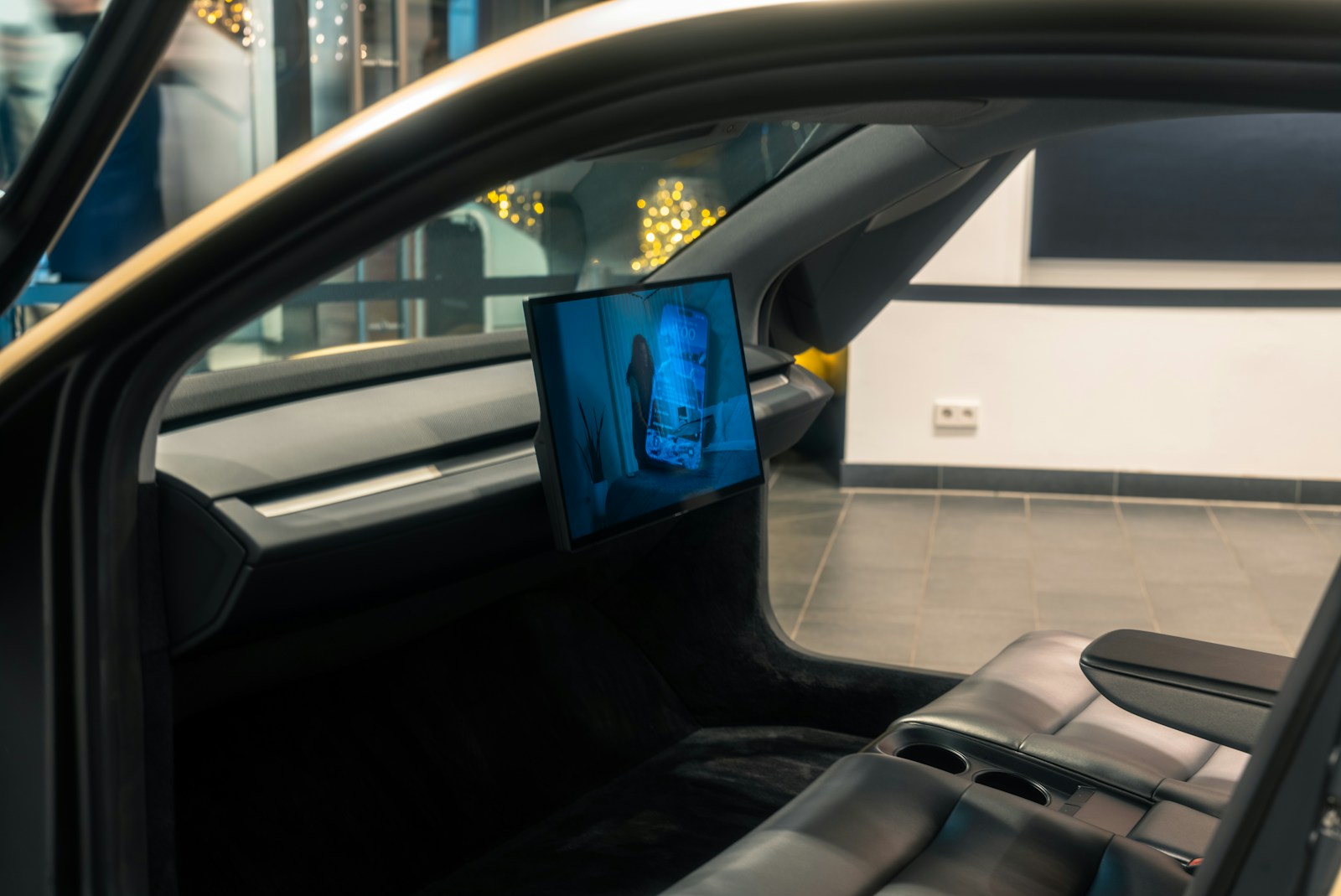

Tesla’s long promised driverless robotaxi is no longer just a slide on an investor deck. Over the past several weeks, multiple Cybercab test vehicles have been filmed weaving through downtown Austin traffic, and each one is equipped with a very conventional steering wheel. The sightings cut against earlier claims that the purpose built robotaxi would ship without traditional controls, and they raise fresh questions about how fully autonomous the first production Cybercabs will really be.
From wheel free vision to wheel equipped reality
When Tesla first teased its dedicated robotaxi, executives framed the Cybercab as a clean break from the past, a capsule with no mirrors, no pedals and no steering wheel that would rely entirely on software. That vision helped set expectations that the company would skip the transitional phase other automakers have accepted, where human controls remain in place even as automated systems take over more of the driving. The Austin prototypes now circulating with full driver interfaces suggest Tesla is instead converging on the same compromise, at least for the early production run.
Footage of the latest test vehicles shows a steering wheel clearly visible through the windshield, along with a driver seated up front, even as the cars move in regular city traffic. One detailed account of the new sighting notes that, at the original unveiling, the company said there would be “no mirrors, no pedals, no steering wheel,” yet the current Cybercabs are running with a wheel so that a human can take over if the autonomous system fails, a shift that undercuts the absolutist tone of the earlier promise but aligns with how other advanced driver assistance systems are deployed in practice, as reflected in the description of the Cybercabs spotted testing.
Austin becomes Cybercab’s open air lab
The choice of Austin, Texas as the proving ground is not accidental. Tesla Inc has its headquarters and a major manufacturing footprint in the region, and the city’s mix of dense downtown streets, fast moving highways and sprawling suburbs offers a varied test environment for a robotaxi that is supposed to handle everything from bar rushes to airport runs. Over recent weeks, residents have repeatedly captured Cybercabs threading through downtown Austin traffic, treating the city as an open air lab for the company’s next big bet.
One early clip shows a single Tesla Cybercab gliding along public roads in downtown Austin, a sight that signaled a shift from closed track demos to real world testing and hinted at the company’s move toward a commercial driverless service in its home market. The post describes how the Tesla Cybercab was spotted in the city center and frames it as evidence that Tesla’s driverless robotaxi service appears to be edging closer to an anticipated autonomous ride hailing rollout, a narrative that matches the details shared in the Austin street sighting.
Multiple Cybercabs, one clear design choice

What began as a curiosity has turned into a pattern. Instead of a lone prototype, Austin drivers are now encountering multiple Cybercabs in the wild, each one wearing the same angular bodywork and the same unmistakable steering wheel inside. The repetition matters, because it suggests this is not a one off engineering mule but a consistent configuration that Tesla’s team is comfortable putting on public roads.
In one widely shared clip, multiple Tesla Cybercabs are seen circulating in downtown Austin, Texas, with the company’s chief designer, Franz, cited as the creative force behind the distinctive look. The video makes clear that the vehicles are not stripped down pods but fully equipped cars with steering wheels, a detail that stands out precisely because of the earlier promise to delete such hardware, and the description of these multiple Tesla Cybercabs in Austin, Texas with a visible wheel is captured in the downtown test reel.
Prototypes with drivers, not empty robotaxis
For all the talk of a driverless future, the Cybercabs currently roaming Austin are not empty shuttles. Each prototype that has been filmed so far shows a human in the front seat, hands near the wheel, ready to intervene. That setup underscores that Tesla is still in the development phase, gathering data and validating its Full Self Driving stack rather than running a commercial service where passengers ride alone.
Several clips explicitly describe the vehicles as prototypes, emphasizing that these are early builds of Tesla Inc’s new Cybercab, the Austin EV maker’s purpose built robotaxi. One report notes that apparent prototypes of Tesla Inc’s Cybercab have been spotted on public roads in Austin with a driver in the front seat, reinforcing that the company is still relying on human supervision even as it readies a ramp in production in 2026, a detail laid out in the account of Cybercab prototypes in Austin.
Two car convoys and repeated Austin runs
Another striking pattern in the Austin footage is the appearance of Cybercabs in pairs. Instead of a single car making a lonely loop, residents have filmed two vehicle convoys, suggesting coordinated testing runs that may be designed to compare software builds, sensor calibrations or different interior layouts. The twin sightings also make the vehicles harder to dismiss as one off stunts staged for social media.
One video shows two Tesla Cybercab prototypes traveling together on public roads in Austin, Texas, both with visible steering wheels and traditional controls. The clip explicitly labels them as prototypes and highlights that they are being used for testing, not for paying rides, a framing that matches the description of two Tesla Cybercab prototypes in Austin, Texas with steering wheels in the paired prototype reel.
Back on the streets, still with a wheel
The Cybercab’s presence in Austin has not been a one day cameo. After the first clips circulated, additional footage showed the same distinctive silhouette back on the streets, reinforcing that public road testing is now a routine part of Tesla’s development cycle. Each new appearance has been scrutinized for changes, but one element has remained constant, the steering wheel is still there.
One detailed report describes how the Tesla Cybercab has been spotted testing once again on public roads in Austin, TX, characterizing the vehicle as a production Cybercab that has hit public roads again and noting that it still has a steering wheel despite earlier talk of a control free cabin. The account emphasizes that the car is back on the streets in Austin, TX and that the wheel remains in place, a combination that underscores how far Tesla still has to go before it can credibly remove human controls, as outlined in the summary of the production Cybercab on public roads.
Regulatory pressure and design debate
The persistence of the steering wheel is not just a technical footnote, it sits at the center of a broader debate over how aggressively Tesla should push toward full autonomy. The company has faced ongoing criticism over its self driving technology, with federal regulators opening multiple probes into how its systems perform in real traffic and how drivers use them. In that context, keeping a wheel and pedals in the Cybercab may be less a retreat from ambition and more a concession to regulators who expect a clear fallback if the software misbehaves.
One analysis notes that Tesla does have driverless robotaxis operating in Austin after recently expanding its service, but it also stresses that the new Cybercab sightings have fueled a debate over the vehicle’s design, especially the practicality and safety of a vehicle without a steering wheel or foot pedals. The same report points out that, shortly after an investor call in October, some company officials discussed how the Cybercab might need to appeal to a broader range of customers, a tension that helps explain why the prototypes now on Austin streets still carry traditional controls, as described in the overview of Cybercab prototypes and design debate.
New Year’s Day runs and FSD data gathering
The testing has continued right through the holiday period, underscoring how urgent the Cybercab program has become for Tesla’s broader strategy. On New Year’s Day, Austin residents again spotted pairs of Cybercabs circulating on public roads, a sign that the company is using every available window to log miles and refine its Full Self Driving software. The timing also ensured that the vehicles would encounter a mix of light traffic and unpredictable holiday driving behavior, a useful stress test for any autonomous system.
One clip from that day shows two Tesla Cybercab prototypes on public roads in Austin, Texas, again with visible steering wheels and a driver in the front seat. The description notes that these runs appear to be tied to Full Self Driving development rather than to a live commercial service, reinforcing that Tesla is still in the data gathering phase and that the Cybercab is functioning as a rolling testbed for its autonomy stack, as detailed in the account of two Cybercab prototypes on New Year’s Day.
What the steering wheel means for Tesla’s robotaxi ambitions
For riders who were expecting a sci fi pod with no obvious way to take control, the sight of a conventional steering wheel in the Cybercab may feel like a letdown. Yet it also hints at a more pragmatic rollout, where Tesla can launch a fully electric taxi service that still allows a safety driver or even a conventional driver to operate the vehicle when needed. That hybrid approach could help the company start generating revenue from the Cybercab platform while it continues to chase the longer term goal of a truly driverless fleet.
Context from the broader robotaxi effort helps explain the stakes. One overview of the program notes that another American company called Tesla is taking the game to the next level with the Cybercab, described as a fully autonomous EV taxi service that is supposed to move beyond today’s ride hailing apps. The same analysis frames the Cybercab as central to Tesla’s plan to dominate autonomous mobility, but the Austin sightings show that, at least for now, the path to that future still runs through very familiar hardware, including the steering wheel that was once slated for removal, a contrast that underscores how the company’s bold vision is being tempered by real world constraints as it builds out its Cybercab robotaxi service.
More from Wilder Media Group: