

Autonomous military vehicles have moved from experimental labs into active arsenals, reshaping how forces see, decide, and strike across land, sea, and air. From extra-large underwater drones to algorithmic swarms in the sky, these systems already operate alongside human units, extending reach while raising new strategic and ethical questions. The following ten platforms illustrate how autonomy is being fielded today, and how it is quietly redefining modern warfare.
1) BAE Systems Autonomous Submarine
The BAE Systems Autonomous Submarine, built around the Herne Extra Large Autonomous Underwater Vehicle, is one of the clearest signs that underwater combat is entering an algorithmic era. Reporting on the Herne Extra Large Autonomous Underwater Vehicle describes it as a new tool for anti-submarine warfare, with the size and endurance to patrol contested seas without a crew. Earlier coverage of how BAE Systems surfaces an autonomous submarine for military use shows that this platform is not a distant concept but a tested machine already demonstrating long-duration, independent operation beneath the waves.
BAE Systems has configured Herne to give militaries a cost-effective option to conduct various missions, including anti-submarine warfare, seabed surveillance, and payload delivery, according to a detailed account of the successful trial of the UK’s first autonomous military submarine. By removing the crew, navies can send Herne into high-risk areas, from chokepoints to mined waters, while operators supervise from shore. The system’s autonomy also hints at future undersea networks where multiple vehicles coordinate, complicating adversary detection and forcing new thinking about deterrence and escalation under the surface.
2) Long-Endurance Unmanned Aerial Surveillance Drone

Long-endurance unmanned aerial surveillance drones are now routine fixtures over battlefields, providing persistent eyes in the sky without risking pilots. A comprehensive study of the use of unmanned aerial vehicles for military purposes notes that AI is an integral part of autonomous systems such as unmanned aerial vehicles and drones, enabling them to navigate, classify targets, and adapt flight paths with limited human input. These aircraft can loiter for many hours over a single area, stitching together high-resolution imagery and signals intelligence that would be impossible to gather with manned sorties alone.
In practice, such drones give commanders near real-time awareness of troop movements, infrastructure, and emerging threats, which can be fed directly into targeting and planning tools. Their autonomy reduces operator workload, allowing a small crew to supervise multiple aircraft at once, and it also supports operations in GPS-denied or jammed environments. As more air forces integrate these systems, the balance of advantage increasingly favors those who can fuse autonomous surveillance with rapid decision-making, raising concerns about accelerated kill chains and the risk of miscalculation.
3) Armed Unmanned Combat Aerial Vehicle
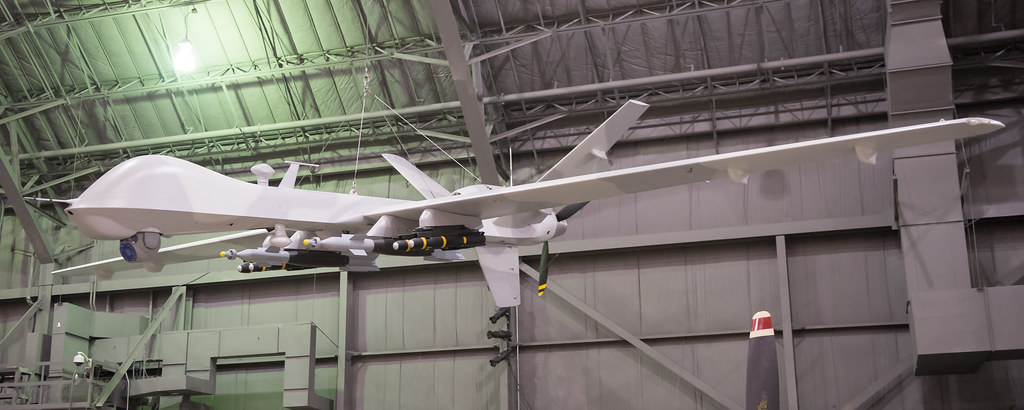
Armed Unmanned Combat Aerial Vehicles represent the next step, combining autonomous flight with the ability to carry and release weapons. A technology survey on war algorithms explains that unmanned aerial vehicles can span roles from surveillance and reconnaissance to military attacks, and identifies Unmanned Combat Aerial Vehicles as a distinct subset designed for strike missions. These platforms can autonomously follow preplanned routes, manage fuel and altitude, and maintain safe separation from other aircraft while human operators focus on authorizing or aborting weapons release.
By shifting routine piloting tasks to onboard systems, Unmanned Combat Aerial Vehicles can operate in coordinated packages, saturating defenses or striking multiple targets in quick succession. Their reduced size and lack of life-support systems also make them cheaper to build and easier to risk in heavily defended airspace. At the same time, their growing autonomy intensifies debates over human control of lethal force, especially as algorithms begin to assist with target selection and threat prioritization in complex, fast-moving environments.
4) Ground-Based Robotic Reconnaissance Vehicle
Ground-based robotic reconnaissance vehicles are increasingly used to scout urban streets, tunnels, and contested terrain before human troops move in. Research examining unmanned aerial vehicle development, concerns, and prospects underscores that the same autonomy enabling drones is being adapted to unmanned land platforms, which can navigate, sense, and relay information with limited direct control. These tracked or wheeled robots carry cameras, thermal imagers, and chemical sensors, creeping ahead of infantry to map hazards and identify ambushes without exposing soldiers to the first burst of fire.
Such systems already support bomb-disposal teams and special operations units, and their software is steadily improving at obstacle avoidance and route planning. As autonomy matures, these reconnaissance vehicles can maintain continuous patrols, automatically revisiting key intersections or buildings and flagging changes that might indicate enemy activity. For commanders, that means a richer, more dynamic picture of the ground fight, but it also demands new tactics for protecting and interpreting a constant stream of machine-generated data.
5) Loitering Munition for Precision Strikes
Loitering munitions, sometimes called “suicide drones,” blur the line between missile and robot by circling over a target area before diving in for a strike. Analytical work on contemporary unmanned systems notes that autonomy allows such platforms to search, track, and home in on designated signatures with minimal guidance once launched. Operators can program a patrol box, altitude, and engagement rules, then monitor the feed while the munition independently manages its flight profile and endurance.
These weapons give ground units and small naval vessels a precision-strike option that previously required fast jets or large cruise missiles. Their ability to linger over suspected enemy positions, waiting for confirmation of a high-value target, makes them tactically flexible but also controversial, especially in dense urban environments. As loitering munitions proliferate, militaries must adapt air defenses to detect small, low-flying threats and refine doctrine to ensure that human judgment remains central in deciding when and where to attack.
6) Autonomous Surface Vessel for Maritime Patrol
Autonomous surface vessels are transforming maritime patrol by putting sensors and processing power on crewless ships that can stay at sea for extended periods. A detailed discussion of how The Navy is moving away from optionally manned surface vehicles describes a shift toward designs that are conceived from the start as unmanned, optimized for autonomy rather than human habitability. These vessels can follow complex patrol patterns, classify contacts, and relay data back to command centers while consuming far fewer resources than crewed warships.
Parallel advances in control software, such as the Autonomous Ocean Core system that brings new autonomous capability to naval vessels, show how existing platforms can be upgraded with standardized autonomy “brains.” For coastal states, this combination promises wider coverage of exclusive economic zones and critical sea lanes, improving detection of submarines, smugglers, and hostile ships. However, it also raises questions about how autonomous vessels should behave in crowded waterways and how international maritime law applies when no crew is on board.
7) Legged Robot for Expeditionary Support
Legged robots designed for expeditionary support are already accompanying troops as mechanical porters and scouts. Presentations on designing autonomous systems for military use describe how algorithms can help a surveillance system decide whether to Flag a vessel as following a normal shipping channel or not, Break out the details of the vessel’s AIS data, and perform similar pattern-recognition tasks on land. The same principles guide legged robots as they interpret terrain, avoid obstacles, and follow human teammates across rubble, stairs, and steep slopes.
These machines can carry ammunition, water, and communications gear, reducing the physical burden on soldiers and enabling longer, faster patrols. Their sensors also provide an extra layer of situational awareness, spotting movement or hazards that humans might miss. As autonomy improves, legged robots may take on more independent tasks, such as establishing relay nodes or marking safe routes, but commanders will need to balance their utility against logistical demands and the risk of overreliance on fragile hardware in harsh environments.
8) Drone Swarm for Tactical Air Dominance
Drone swarms, in which many small unmanned aircraft coordinate their actions, are emerging as a powerful tool for tactical air dominance. A war-algorithm accountability report explains that Their functions can span from surveillance and reconnaissance to military attacks, and that Unmanned Combat Aerial Vehicles are only one part of a broader ecosystem of networked systems. In a swarm, each drone uses simple rules and shared data to maintain formation, distribute targets, and adapt when individual units are lost or jammed.
For air defenders, this creates a daunting problem, since traditional systems are optimized to track and engage a limited number of high-value aircraft, not dozens of cheap, expendable drones. Swarms can saturate radars, probe for weak spots, and overwhelm point defenses, clearing the way for larger crewed or uncrewed platforms. Their reliance on autonomy and machine-to-machine communication also highlights vulnerabilities, from electronic warfare to cyberattacks, that will shape how militaries design and protect these networks.
9) Autonomous Underwater Glider for Ocean Monitoring
Autonomous underwater gliders, originally developed for scientific research, now play a growing role in military ocean monitoring. Studies of AI in autonomous systems emphasize that unmanned vessels and unmanned land platforms share core technologies with underwater vehicles, which can adjust buoyancy and wings to glide silently through the water column. These gliders collect temperature, salinity, and acoustic data, building detailed maps that help navies understand how sound travels in specific regions, a crucial factor in anti-submarine warfare.
Because they move slowly and use little power, gliders can remain at sea for weeks or months, surfacing periodically to transmit data and receive new instructions. Their low acoustic and radar signatures make them hard to detect, allowing discreet monitoring of chokepoints and strategic straits. As fleets integrate glider data with information from larger platforms like Herne, they gain a multi-layered picture of the undersea environment that can improve submarine tracking and inform the deployment of other autonomous assets.
10) Hybrid Air-Ground System for Versatile Deployment
Hybrid air-ground systems, which can both fly and drive, offer militaries unusual flexibility in how they deploy sensors and payloads. Academic work on unmanned systems, summarized in an Abstract that examines development, use, and concerns, notes that designers increasingly blend capabilities across domains to exploit AI-enabled autonomy. A hybrid platform might launch as a quadcopter to clear obstacles and survey rooftops, then land and continue as a wheeled robot to enter buildings or tunnels that are too confined for flight.
Such versatility is valuable in dense urban terrain, where line-of-sight is limited and threats can appear from any direction. By shifting modes, hybrid systems can maintain contact with human operators, preserve battery life, and adapt to changing mission needs without requiring multiple specialized robots. Their deployment underscores a broader trend: as autonomy matures, the most effective military vehicles will not just replace humans in single roles, they will fluidly cross boundaries between air, land, and sea to give commanders more options in complex operations.
More from Wilder Media Group: