


The teenager behind the wheel of a Ford Mustang probably thought he was starring in his own action movie when the speedometer climbed past 150 on a wet stretch of Interstate 4. What he learned instead was that the trooper behind him had a Mustang of his own and a brand‑new Florida law ready to turn that joyride into a criminal case. The chase ended with handcuffs, a trip to jail, and a very modern lesson in how fast cars and tougher statutes now collide.
The run up to 154 miles per hour was wild enough on its own, but the real twist came afterward, when Florida’s “Super Speeder” rules kicked in and treated the stunt not as a dumb ticket but as a serious offense. In a state that has quietly armed its patrol cars and its penal code at the same time, this teen found out the hard way that the cops are just as quick as the street racers, and the penalties are catching up too.
Rain, a red Mustang, and a trooper who could keep up
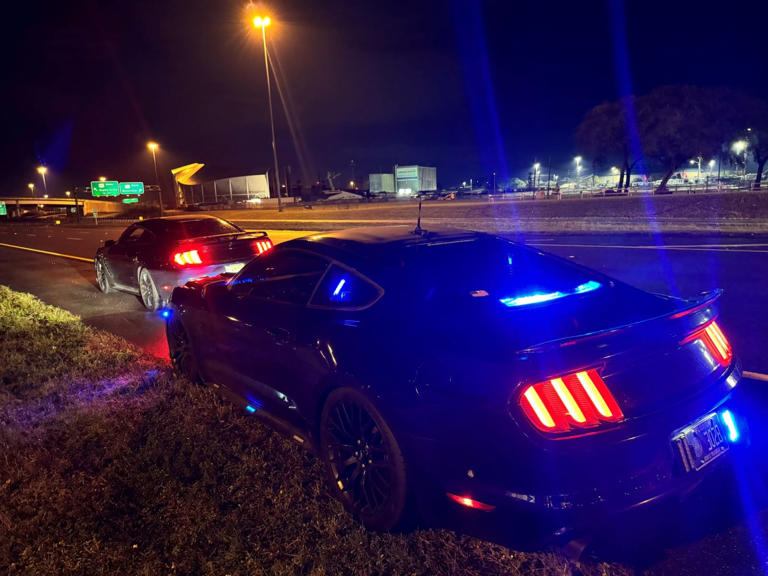
The sprint started in the early hours on a rain‑slicked section of Interstate 4 in Hillsborough County, where a red Mustang punched through the darkness and the posted limit as if both were optional. According to reports, the car surged to 154 mph despite the wet pavement, a choice that turned a lonely highway into a potential crash scene for anyone unlucky enough to be nearby. The Florida Highway Patrol later described how the driver blew past traffic in the westbound lanes, treating the interstate like a private drag strip while the weather and common sense both said slow down.
What the teen did not count on was that the pursuing trooper was driving a Ford Mustang GT of his own, a detail that adds a bit of mechanical irony to the story. The patrol car’s V8 and modern electronics meant the officer could match the fleeing coupe’s pace long enough to clock the speed and build a case, something highlighted in coverage of the Ford Mustang chase. When the teen finally backed off and exited, troopers moved in, ending the run not with a crash but with an arrest that would soon test the limits of Florida’s newest traffic crackdown.
From “The Brief” to the booking desk: how the case unfolded
Once the blue lights were off and the adrenaline faded, the numbers on the radar gun became the center of the story. In official summaries, The Brief from Florida Highway Patrol noted that the teen was clocked at more than 150 m on the interstate before troopers finally got him stopped on a ramp. Another account of the stop on westbound I‑4 described how the trooper tried to pull the car over at around 150 mph, only to watch the Mustang keep going before it finally slowed and yielded. No injuries were reported, which is a small miracle given the speed, the rain, and the number of exits and merges along that stretch of road.
Troopers identified the driver as 19‑year‑old Cirilo Rayo Callejas, who, according to one report, was taken to the Hillsborough County Jail after the stop. Another account spelled his name as Rayo and Callejas, reflecting the way arrest reports sometimes mangle spelling even when the speeds are precise. Either way, the teen now faces misdemeanor charges tied to that triple‑digit sprint, and the case has become a clean example of how Florida’s new rules treat extreme speeding as something closer to a crime than a traffic oops.
Florida’s “Super Speeder” era and why this case hits harder
What really elevates this story is the legal backdrop that was waiting for the teen once the engine cooled. Florida has rolled out a Super Speeder Charges framework that treats driving 50 or more MPH over the limit as a distinct crime. Under House Bill 351, that “Super Speeder Law” in Florida turns what used to be a hefty ticket into a Crimin level problem, complete with the possibility of jail time, steep fines, and a record that does not vanish with traffic school. A recent analysis of the Mustang case framed it as a real‑world test of that Super Speeder crackdown, showing how far the state has moved from the old days when a judge might shrug and issue a fine.
Florida has already been flexing that new muscle in other corners of the map. On the Panhandle’s Pensacola Bay Bridge, All three drivers caught at more than 100 miles per hour were hit with second‑degree misdemeanor counts for dangerous excessive speeding under the new Florida law, facing potential jail time even as first‑time offenders. A separate review of arrest reports by Channel 9 found drivers sobbing over speeds like 116 in 65 zones, only to discover that being 50 over the limit now triggers a very different conversation in court. Against that backdrop, the teen who pushed his Mustang to 154 m is not just another speeder, he is a cautionary tale for anyone who still thinks the worst outcome of a 150‑plus run is a bragging‑rights screenshot.
More from Wilder Media Group: