


For decades, turning right at a red light has been treated as a time saver baked into American driving culture. Now a growing safety backlash is pushing that habit to the brink, as lawmakers in several states weigh whether the convenience is worth the rising toll on people walking and biking. The debate is no longer confined to a few big cities, and proposals in at least five states could reshape how drivers approach intersections nationwide.
The safety crisis putting right-on-red under scrutiny
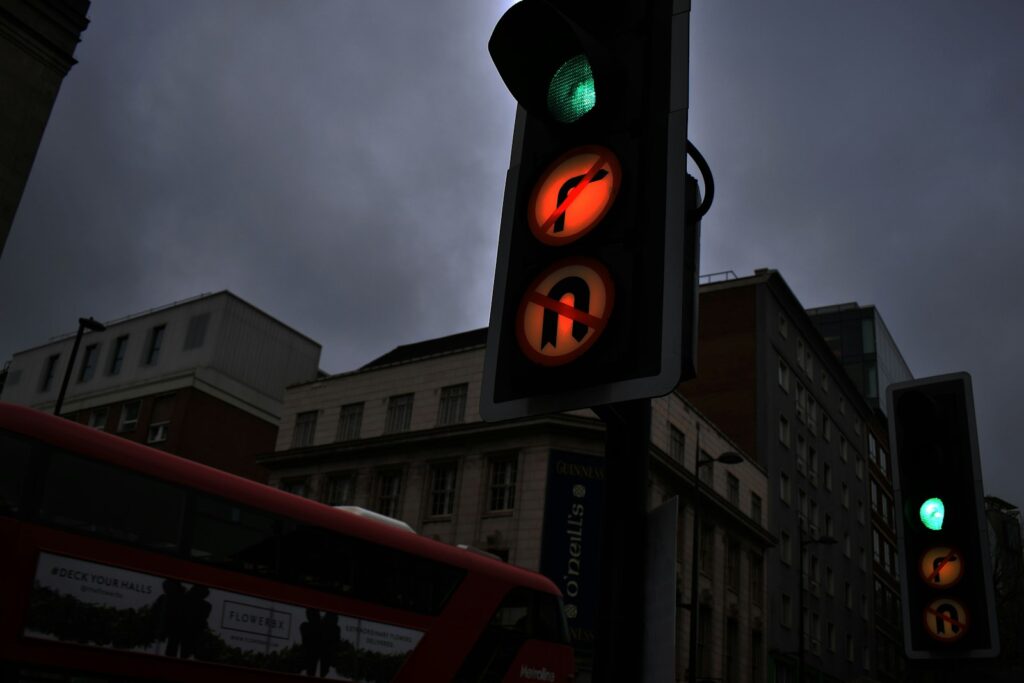
Traffic engineers originally framed right turns on red as a low risk tradeoff, a way to keep cars moving while signals cycled. That assumption is being reexamined amid a dramatic rise in crashes that kill or injure pedestrians and cyclists, a trend that has prompted a wave of policy and street design changes across the country. Recent reporting links that surge in deaths to larger, heavier vehicles and to intersections where drivers inch into crosswalks while scanning for gaps in traffic, a pattern that has made advocates question whether the maneuver is compatible with modern safety goals backed by federal agencies such as NHTSA.
Advocates of tighter rules argue that the original research used to justify right-on-red is now outdated, noting that it predates the era when sport utility vehicles and pickups came to dominate the fleet and became, in their words, “much larger and more lethal.” In interviews, Advocates of a ban describe how people on foot now routinely hesitate at corners, worried that a driver will roll through the crosswalk while watching for oncoming traffic instead of for them. That fear is echoed in local television coverage, where But Beeber and other safety campaigners describe right-on-red as a symbol of a car-first mindset they say no longer fits crowded urban streets.
How right-on-red became the American default
To understand why rolling to a stop and turning right at a red light feels so ingrained, it helps to remember that it was not always legal. The practice spread in the 1970s as states rewrote traffic codes to conserve fuel and reduce delays, eventually making right turn on red, often shortened to RTOR, the norm across most of the country. The few broad exceptions that survived, such as New York City, where right turns on red have long been prohibited, were treated as outliers rather than models.
That history still shapes driver expectations. In an online discussion about driving anxiety, one commenter insisted that “The only place in 50 states you can’t turn right on red is NYC,” using the figure 50 to underscore how unusual a full ban still seems. That same thread, which framed proposed repeals as having “NOTHING” to do with crashes, shows how deeply some drivers see RTOR as a right rather than a conditional privilege that can be limited with simple “No Turn on Red” signs. The new wave of state-level debates is starting to challenge that assumption.
Washington, D.C.: the capital’s phased crackdown
In the nation’s capital, the shift away from right-on-red is already written into law. The DC Council used its Safer Streets Amendment 2022 to call for an end to right turns on red across most of the city, a policy that was scheduled to take effect at the start of 2025. That move built on earlier reporting that Washington, D.C., would end most right-on-red turns by 2025 to give people more time to cross streets safely. Local coverage has since described the rollout as a “kinda-sorta” ban, noting that transportation officials carved out exceptions at some intersections, but the direction of travel is clear.
National outlets have highlighted how Washington, D.C. became an early adopter of a broad restriction, with one report noting that the City Council approved a right-on-red ban that takes effect in 2025 and that other cities have looked into similar measures. Another segment on pedestrian deaths pointed out that Washington is part of a wider pattern in which local governments are rethinking long standing traffic rules in response to public pressure. For drivers who commute into the capital from surrounding suburbs, the change will effectively create a patchwork where the same maneuver is legal on one side of the border and banned on the other.
Georgia: Atlanta’s 2026 deadline and a broader Southern test
In the Southeast, the most aggressive move so far has come from the In February vote by the Atlanta City Council. With a 10 to 3 majority, the council approved legislation that will prohibit right turns at red lights at signalized intersections in the city starting in 2026, a sweeping rule that goes beyond the intersection by intersection bans used elsewhere. The same report notes that the measure is part of a broader push to reduce traffic deaths and serious injuries, and that it will require a significant public education campaign before it takes effect.
Local television coverage captured the political stakes as the Atlanta City Council debated the plan, describing it as a big step closer to becoming law and emphasizing the 2026 implementation date. Legal analysts in the state have pointed out that both supporters and critics of banning right turns at red lights have valid points, and that it will ultimately be up to local governments in places like Atlanta and Savannah to decide how far to go, a perspective laid out in a Georgia focused explainer that notes how Both sides frame the issue. Against that backdrop, statewide leaders in Georgia are watching whether Atlanta’s move triggers calls for a uniform rule, a question that could eventually put the state alongside others considering broader bans.
Washington State: Seattle’s influence and a Pacific Northwest pivot
On the West Coast, officials in Washington State are facing similar pressure as pedestrian deaths climb in urban corridors. In Seattle, local coverage has detailed how advocates are pressing the city to restrict right turns on red at more intersections, tying the push to national research that links the maneuver to conflicts with people in crosswalks. One report on rising fatalities noted that Advocates of a ban there echo the national argument that the original safety studies no longer reflect the reality of modern vehicles.
Seattle’s role as the largest city in Seattle and a hub for progressive transportation policy means its decisions often ripple outward. A national overview of right-on-red debates cited Seattle alongside other cities that are considering bans, framing them as part of a broader movement that could eventually reach state capitols. If lawmakers in Washington State decide to standardize rules, they will be doing so in a context where federal guidance on automated driving systems already urges each State to coordinate closely with ADS regulators at The National Highway Traffic Sa when pursuing performance related rules, a reminder that any change to intersection behavior will also affect emerging vehicle technologies.
California: San Francisco, Berkeley and a statewide signal
In California, the debate is playing out in some of the country’s most walkable and transit oriented cities. Reporting from the Bay Area describes how San Francisco could soon ban right hand turns on red lights, a move that would make it the second major city in the state to adopt such a rule. Photographs of cars driving on California Street in San Francisco accompany accounts of how local leaders see the change as a way to reduce serious injuries in car crashes, with one official arguing that allowing turns on red results in drivers focusing on vehicle traffic instead of people in the crosswalk.
The Bay Area is already home to another early adopter. The college town of Berkeley has moved ahead with its own restrictions, and statewide coverage notes that San Francisco would be the second city in California to adopt the traffic rule if its proposal is finalized. A national legal explainer on cities considering bans lists several U.S. jurisdictions that are contemplating right turn on red restrictions and highlights how West Coast hubs are often at the forefront of such changes, a trend that could eventually prompt lawmakers in California to consider whether a patchwork of local rules is enough. For now, the state’s role is mostly indirect, but the concentration of bans in its urban centers gives it outsized influence in the national conversation.
Midwestern momentum: Illinois, Michigan and Chicago’s debate
The Midwest is emerging as another front in the right-on-red fight, with attention focused on large metro areas that have struggled with pedestrian safety. In Illinois, new Chicago Mayor Brandon Johnson has publicly signaled interest in a right-on-red ban, and national coverage notes that he has asked transportation officials to study the idea as part of a broader safety agenda. One report on pedestrian deaths pointed out that New Chicago Mayor is part of a wave of local leaders who are looking into bans as a response to rising fatalities.
Those discussions are unfolding in a region where states like Illinois and Michigan already face complex traffic safety challenges tied to aging infrastructure and wide arterial roads. A national overview of right-on-red bans notes that some major cities, including Washington, D.C., have already adopted broad restrictions and that others are weighing similar steps starting in 2025, a trend that could influence lawmakers in Midwestern capitals. While there is not yet a statewide prohibition in Michigan or Illinois, the fact that Chicago is openly debating the issue suggests that state legislators could eventually be drawn into the conversation if city level rules create pressure for uniformity.
Texas and other states watching from the sidelines
Even in states where lawmakers have not yet introduced sweeping bans, the idea is gaining traction. A Texas based legal analysis framed the spread of local restrictions as a sign that “Cities Across the U.S. Are Banning Right Turn on Red,” and asked bluntly, “Is Texas Next?” That piece noted that established RTOR bans already exist in some jurisdictions and cited specific corridors, such as West Loop 323 in Tyler, as examples of how local governments can act on their own, using Established RTOR bans to show that the concept is not foreign even in car centric regions.
National roundups of right-on-red debates emphasize that several U.S. cities are currently contemplating bans, and that the movement is not confined to any one region. One legal explainer on Cities Considering Banning on Red notes that Several jurisdictions are weighing the idea as part of broader Vision Zero style plans to eliminate traffic deaths. Another Texas focused blog asks whether the current wave “Could” mark the beginning of the end of going right on red, a question that underscores how quickly a once obscure policy debate has entered mainstream driving conversations in states that have not yet moved to change their laws.
Public opinion, polls and the politics of change
Lawmakers considering statewide bans are not just reading crash data, they are also watching how voters react. A national television segment on the possibility of ending right turns on red described how some cities are already moving in that direction and referenced a poll that gauged public support for stricter rules. Another clip, shared through a separate link to the same coverage, opened with the observation that there were “no right turns on red lights if you were driving to the polls” in some jurisdictions, before noting that “today perhaps running errands or commuting chances are you turned right on red,” a contrast that highlights how uneven the rules have become.
Those mixed experiences shape how drivers respond when they hear that their state might follow places like Already Hawaii, which has prohibited right-on-red on a tourist dense street, or Washington, D.C., which is ending most such turns by 2025. A national overview of bans across the U.S. notes that Right-on-red bans have grown in popularity in recent years, with some major cities, like Washing, adopting broad restrictions starting in 2025, a trend that suggests public opinion is at least open to change in places where safety concerns are acute. At the same time, online forums where drivers insist that cities considering a repeal have “NOTHING” to do with crashes show that resistance remains strong among those who see the maneuver as harmless when used carefully.
More from Wilder Media Group: