

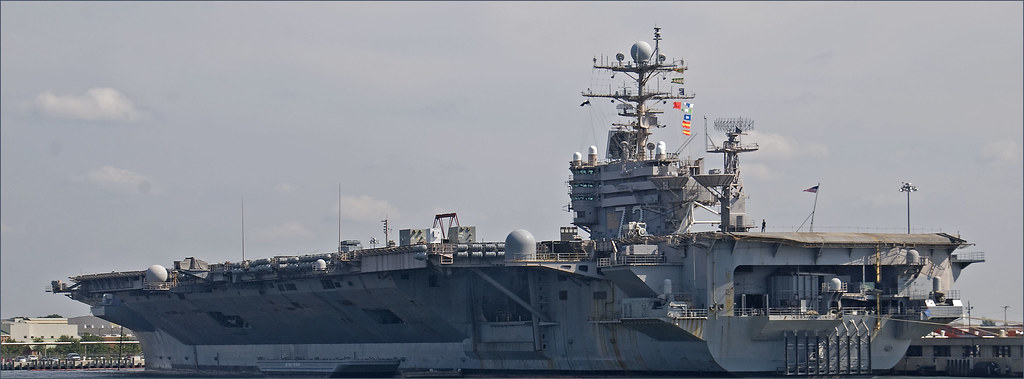
The USS Abraham Lincoln has quietly slipped through one of the world’s busiest maritime chokepoints, heading west at a moment when regional nerves are already frayed. Its transit through the Strait of Malacca signals more than just a change of scenery for a single carrier, it marks a shift in where American sea power is being positioned as tensions rise from the South China Sea to the Gulf of Oman. With the ship’s movements now confirmed by official trackers and the White House, the question is not whether the Lincoln is on the move, but what its new route says about the next phase of U.S. strategy.
The nuclear powered flattop is not sailing alone, and it is not sailing into a vacuum. The USS Abraham Lincoln Carrier Strike Group is threading a path from the Indo Pacific toward the Middle East, and every waypoint along that journey, from Guam to the Andaman Sea, hints at the missions Washington expects it to shoulder. For regional players watching the map, the carrier’s wake is starting to look like a message.
From South China Sea Exit To Indian Ocean Gateway
The latest chapter in the Lincoln’s deployment really starts with its departure from the South China Sea, a body of water that has become shorthand for contested reefs, air intercepts, and gray zone pressure. After operating in those crowded waters, the nuclear powered aircraft carrier USS Abraham Lincoln left the area bound for the Middle East, a move that effectively traded one tense neighborhood for another. That shift, described as a departure from the South China Sea toward the Indian Ocean, underlines how the same ship is being asked to reassure allies in one theater while preparing to deter adversaries in another.
Routing a carrier from the western Pacific toward the Middle East is not unusual, but the timing matters. The Lincoln’s pivot comes as maritime flashpoints stack up, from contested shipping lanes near the Strait of Hormuz to missile and drone threats that have turned routine transits into high risk runs. By steering the carrier out of the South China Sea and into the broader Indian Ocean, U.S. planners are effectively rebalancing where a floating airfield and its escorts can be brought to bear, signaling that the next set of priorities lies west of Singapore rather than east of Taiwan.
USNI Tracker Confirms Malacca Transit
The clearest public sign of that shift came when a fleet tracker confirmed that the aircraft carrier USS Abraham Lincoln, designated CVN 72, had moved through the Strait of Malacca heading west. That narrow corridor between the Malay Peninsula and the Indonesian island of Sumatra is the main maritime bridge between the Pacific and the Indian Ocean, so a carrier group slipping through it is a strong tell about where it is going next. The tracker placed the ship in that chokepoint and noted that the aircraft carrier USS was transiting westbound, effectively locking in the narrative that the Pacific phase of this cruise is over.
For naval watchers, that single line about the Strait of Malacca carries a lot of weight. It means the Lincoln has left behind the relatively enclosed seas of East Asia and is now pointed toward the open reaches of the Indian Ocean and beyond. The Strait itself is a vulnerability for any large warship, crowded with commercial traffic and hemmed in by shorelines, which is why a smooth passage is always a small but meaningful milestone. Once a carrier clears that bottleneck, it has far more room to maneuver, and its air wing can start thinking in terms of longer range missions rather than tight coastal patrols.
Andaman Sea And The Westward March
After clearing the strait, the Lincoln’s next waypoint was the Andaman Sea, a stretch of water that often gets less attention than the South China Sea but is just as important for anyone heading toward the Arabian Sea. The carrier was reported in that area with its full designation as an aircraft carrier USS Abraham Lincoln CVN 72, a reminder that this is not a small presence quietly slipping by. Being Andaman Sea puts the group on a natural glide path toward the Bay of Bengal and then the wider Indian Ocean, a route that has become a standard highway for U.S. carriers shifting between theaters.
Geographically, the Andaman Sea is a kind of staging lane, tucked between India’s Andaman and Nicobar Islands and the coasts of Myanmar and Thailand. For a carrier strike group, it offers a bit more breathing room than the Strait of Malacca but still keeps the ship within reach of key partners and potential flashpoints. Operating there lets the Lincoln’s air wing stretch its legs, test long range sorties, and rehearse the kind of missions it might be called on to fly if the group is tasked with operations closer to the Middle East. It is a quiet but crucial step in the westward march.
White House Signals: A Carrier On A Mission
The Lincoln’s movement is not just a matter of ship spotting, it has been framed directly by the White House as part of a broader response to rising friction in the region. Officials have confirmed that the USS Abraham Lincoln CVN 72 Carrier Strike Group is transiting in the context of escalating regional tensions, tying the ship’s route to a deliberate political message. By publicly acknowledging that the USS Abraham Lincoln is on the move, the administration is using the carrier’s location as a kind of floating press release about U.S. resolve.
That framing matters because it turns a routine deployment into a visible signal. When the White House talks about regional tensions in the same breath as a carrier strike group, it is effectively telling allies and rivals alike that this is not just a training cruise. The Lincoln’s air wing, escorts, and command staff are being positioned as tools to manage crises, whether that means deterring a state adversary, protecting commercial shipping, or standing by for potential strikes. In a world where satellite imagery and open source tracking already reveal a lot, the decision to speak openly about the group’s transit is a way of shaping the narrative rather than letting others define it.
Strike Group Muscle: Destroyers And Air Wing
Behind the big deck carrier, the rest of the strike group brings its own punch and flexibility. Earlier in the deployment, when the Abraham Lincoln Carrier Strike Group pulled into Guam, it did so alongside Arleigh Burke class guided missile destroyers that highlight the layered nature of U.S. naval power. Alongside Abraham Lincoln, ships like USS Spruance, designated DDG 111, and USS Michael Murphy, designated DDG 112, showed how much firepower and sensor coverage can be packed into a single formation. Those Arleigh Burke USS deployments around the carrier underscored that this is not a lone ship cruising through contested waters.
Those destroyers bring Aegis air defense systems, anti submarine capabilities, and long range strike options that complement the Lincoln’s air wing. Together, the group can defend itself against aircraft, missiles, and submarines while also projecting power ashore if ordered. The air wing, based out of Naval Air Station Lemoore before deploying, adds layers of fighters, electronic warfare jets, and helicopters that turn the carrier into a mobile airbase. When that package sails through places like the Strait of Malacca or the Andaman Sea, it is not just passing through, it is advertising that a full spectrum toolkit is now within reach of any emerging hotspot along its route.
Open Water Ahead: Gulf Of Oman And Beyond
All of this movement is building toward a more exposed operating environment as the Lincoln approaches the Gulf of Oman and the waters that feed into the Arabian Sea. Reporting has already framed the carrier and her strike group as facing open water in that region, a phrase that captures both the literal geography and the strategic uncertainty that comes with it. Once the USS Abraham Lincoln and its escorts push into that space, they are operating in a zone where shipping lanes, regional militaries, and non state threats all intersect. The description of the USS Abraham Lincoln in the Gulf of Oman hints at the kind of wide open chessboard the group is sailing into.
Strategically, the Gulf of Oman is a gateway to both the Strait of Hormuz and the broader Arabian Sea, which means any carrier there is within reach of some of the most sensitive energy routes on the planet. It is also a place where Iranian forces, regional navies, and international coalitions all operate in close proximity, raising the stakes for any miscalculation. For the Lincoln, entering that arena after a long transit from the Pacific is like stepping from a crowded hallway into a vast, dimly lit room, there is more space to maneuver, but also more angles from which trouble can emerge.
Online Hype And Nuclear War Rhetoric
As the Lincoln edges closer to the Middle East, the online conversation around its deployment has taken on a life of its own, with some commentators leaning into dramatic language about nuclear brinkmanship. One widely shared video framed the situation as “US Vs Iran NUCLEAR WAR in 48 Hrs,” tying the carrier’s movements to a countdown narrative and branding it as Trump’s nuclear USS Abraham Lincoln going dark. That clip, which described how the Vs Iran NUCLEAR Abraham Lincoln is supposedly central to an imminent clash, reflects how quickly a complex deployment can be boiled down into a sensational storyline.
That kind of rhetoric plays on real anxieties about U.S. Iran tensions, but it also blurs the line between what is verifiable and what is speculative. The carrier is nuclear powered, and it is moving into a region where Washington and Tehran have a long history of confrontation, yet there is no sourced confirmation of an actual 48 hour countdown to war. Unverified based on available sources. The gap between the measured language of official trackers and the breathless tone of viral clips is a reminder that not every dramatic headline about a carrier’s location reflects the actual orders sitting on the captain’s desk.
Carrier Diplomacy In A Crowded Indo Pacific
Before the Lincoln pointed its bow firmly west, its time in the Indo Pacific was as much about diplomacy as deterrence. The earlier stop in Guam, where the Abraham Lincoln Carrier Strike Group arrived with its escorts, was framed as a chance for sailors to engage with partners and underscore a commitment to a free and open Indo Pacific region. That visit, which highlighted how alongside Abraham Lincoln class destroyers were operating in concert, showed the softer side of carrier power, port calls, joint drills, and photo ops that reassure allies even as they send a message to competitors.
Those engagements matter because they build the political capital that Washington draws on when it later repositions the same assets toward more volatile theaters. A carrier that has just wrapped up exercises with partners in the western Pacific carries that goodwill with it when it sails toward the Indian Ocean and the Gulf of Oman. The Lincoln’s journey from Guam to the South China Sea, then through Malacca and into the Andaman Sea, is not just a line on a map, it is a trail of interactions that shape how regional governments interpret its presence when it finally shows up near their own waters.
More from Wilder Media Group: