

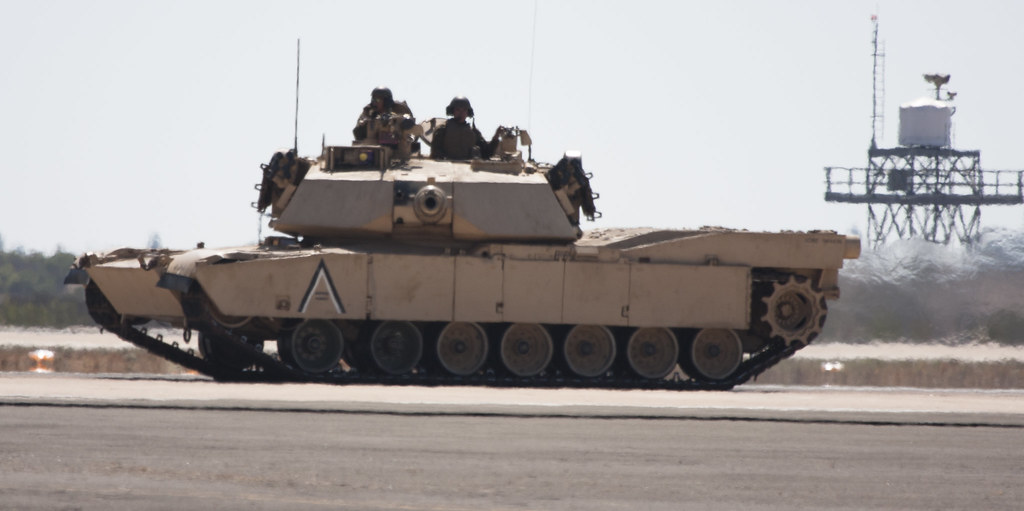
The U.S. Army is rolling out the M1E3 Abrams as a very public signal that its flagship tank is getting a ground‑up rethink, not just a fresh coat of paint. Instead of more armor piled on an aging frame, the service is leaning into a lighter, faster, more digital machine with a cockpit that looks closer to a Formula One car or a gaming rig than a Cold War steel box. The bet is simple but bold: if the next big fight is packed with drones, sensors, and fast‑moving threats, crews will need a tank that feels intuitive to drive and easy to upgrade, not a museum piece with extra gadgets bolted on.
That shift is showing up everywhere from the way soldiers sit in the hull to how the vehicle talks to nearby robots. The M1E3 Abrams is being treated as a prototype family rather than a single frozen design, with Army leaders openly talking about Detroit auto engineering, Formula One ergonomics, and video game‑style controls as core ingredients instead of gimmicks. Underneath the buzzwords is a serious attempt to keep heavy armor relevant in an era when a cheap quadcopter can ruin a very expensive day.
From Detroit Show Floor to Future Battlefield
The first public glimpse of the M1E3 Abrams was not on a dusty training range but under bright lights in Detroit, a choice that says a lot about how the Army wants people to see this tank. Instead of hiding the prototype behind barbed wire, the service parked it at Huntington Place in downtown Detroit and talked openly about tapping local automotive engineering and Formula expertise to shape the design. That debut framed the M1E3 as a machine that borrows as much from modern performance cars and racing culture as it does from traditional armored doctrine, with Jan marking the moment the Army tried to sell a tank to both soldiers and gearheads at the same time.
Officials have been explicit that the M1E3 is meant to pull in Detroit know‑how on things like weight reduction, powertrains, and human‑machine interfaces, rather than reinventing those wheels inside the Pentagon. By showing off the updated Abrams in a city built on assembly lines and performance tuning, the Army signaled it wants the tank to evolve more like a high‑end truck platform than a one‑off science project, with recurring upgrades instead of once‑in‑a‑generation leaps. That is why the early demonstrator in Detroit was framed as a starting point, not a finished product.
Inside the “Formula One” Cockpit
The headline feature that grabbed attention is the so‑called Formula One cockpit, a layout that trades cramped, analog controls for a cleaner, more ergonomic driving position. Army leaders describe a driver station that looks closer to a race car tub than a traditional tank hull, with screens and controls arranged so crews can keep their heads up and eyes out instead of buried in dials. The idea is that if a Formula One driver can manage insane speeds and data loads with a streamlined interface, a tank crew should not be stuck wrestling with 1980s‑era switches while drones and missiles close in.
That race‑inspired layout is not just about aesthetics, it is tied directly to how the driver actually steers and manages the vehicle. The Formula One cockpit contains a driver interface that, as Gen. Randy George has put it, looks like an X‑Box controller, a deliberate nod to the way younger soldiers already interact with complex systems. By leaning into a control scheme that feels familiar to anyone who has spent time on a console, the Army is betting that new recruits will need less time to get comfortable behind the controls and can focus more on tactics than on learning to drive. The description of the M1E3’s Formula One cockpit as something that should come naturally to a generation raised on controllers is not an offhand line, it is a design brief.
Digital Brains and Open Architecture
Under the sleek cockpit, the M1E3 Abrams is being built around a digital nervous system that is meant to be far more flexible than past tank electronics. Instead of locking every sensor and radio into proprietary hardware, the Army is pushing a government‑owned open systems architecture that lets new components plug in without ripping the vehicle apart. That approach mirrors how smartphones and modern cars accept new apps or modules over time, and it is central to the claim that this Abrams can keep up with an ever‑changing world of threats and tech.
Program officials say years of work on digital vehicle controls and modular electronics have shaped the early Abrams prototype that appeared at the North American International Auto Show. The open architecture is designed so that new sights, jammers, or autonomy packages can be added as software and line‑replaceable units instead of full redesigns, which is crucial if the tank is going to stay relevant across decades of upgrades. The Army has been clear that these efforts have shaped its advanced digital vehicle controls and that the government‑owned architecture is what will let the M1E3 adapt in an ever‑changing world, rather than becoming a locked‑in relic.
AI, Drones, and the New Crew Workload
Beyond the cockpit and wiring, the M1E3 Abrams is being pitched as a tank that treats artificial intelligence and unmanned systems as standard kit, not bolt‑on extras. The prototype is packed with AI assisted targeting that helps crews sort threats faster, along with drone control systems that let them operate robots from inside the armor. That means a crew could launch a small quadcopter to scout a street, or send a ground robot ahead to check for mines, without ever cracking a hatch, shifting the job from “see and shoot what is in front of you” to managing a small team of machines.
Those same systems are paired with counter drone protection, a recognition that the battlefield is now crowded with cheap flying sensors and loitering munitions. Soldiers are expected to use the M1 E3 to operate robots and manage those threats while the tank’s own defenses try to keep hostile drones at bay, a workload that would be impossible without the AI tools baked into the design. The Army has highlighted that the M1 E3 is packed with these capabilities and that they are central to cutting fuel needs by 50 percent and reshaping how soldiers fight from inside the vehicle.
Lighter, Faster, and Built for Mobility
One of the most striking shifts with the M1E3 Abrams is the move away from simply stacking on more armor and weight. The Army has been blunt that it wants a significantly lighter design that can move faster, burn less fuel, and still survive on a battlefield full of precision weapons. That is a sharp turn from the original M1, which grew heavier with each variant, and it reflects a belief that mobility and smart protection will matter more than sheer mass when drones and top‑attack missiles are hunting tanks.
Reporting on the program describes the M1E3 as a radical new tank prototype that is lighter, faster, and AI‑enabled, with the service prioritizing mobility and teaming over sheer armor thickness. The same coverage notes that the Army is deliberately trading some of the old “just add more steel” mindset for a design that can reposition quickly and work alongside other platforms instead of trying to tank every hit alone. In that sense, the M1E3 is less about building the biggest brawler on the field and more about creating a nimble heavyweight that can survive by moving, sensing, and coordinating, a shift that Showcased how the Army is rethinking heavy armor.
How It Stacks Up Against Russia’s T‑14 Armata
Any time the U.S. rolls out a new tank concept, the obvious comparison is Russia’s T‑14 Armata, which Moscow has hyped as the “Best in the World.” The M1E3 Abrams is being framed less as a direct copycat and more as a different answer to the same problem, with American planners leaning into crew survivability, digital integration, and mobility rather than chasing every exotic feature on the Russian side. The question is not just whose gun or armor is thicker, but which design can actually be produced, maintained, and upgraded at scale while still giving crews an edge.
Analysts looking at the New Army M1E3 Tank versus Russia’s T‑14 have boiled the comparison down to mobility as a decisive factor, arguing that the U.S. design’s focus on speed and digital awareness could let it outmaneuver a heavier, more complex rival. The M1E3 tech demonstrator has been described as capable of moving the tank at significant speeds while still managing its advanced systems, a combination that matters when artillery, drones, and anti‑tank missiles are all in play. In that matchup, the New Army approach is less about winning a spec sheet contest and more about building a tank that can actually survive and fight in the messy reality of modern war.
From Auto Show Prototype to Fielded Fleet
For now, the M1E3 Abrams exists as a prototype, and the Army is being unusually open about that status. A demonstrator was displayed at the North American International Auto Show, complete with signage and imagery that made clear this is an early look rather than a final production model. With the M1E3 Abrams beginning to move through this public prototyping phase, the service is trying to balance transparency about what is still in flux with confidence that the core ideas, from the cockpit to the digital backbone, are locked in.
Images of the prototype at the North American International Auto Show, credited to the Army, underline how much the service wants people to see this as a living project rather than a static reveal. The fact that a prototype of the M1E3 Abrams was parked among civilian vehicles and concept cars, with an Image clearly labeled as Army material, reinforces that this is a research‑driven effort still open to tweaks. That public staging, captured in coverage that notes how a prototype of the Abrams was shown at the show, is part of a broader push to gather feedback from both soldiers and engineers before locking in the production configuration.
Racing the Clock: Fielding Five Years Early
Behind the glossy displays, the Army is moving on an aggressive schedule to get M1E3 Abrams prototypes into the hands of troops. Leaders have said they plan to push early vehicles to soldiers this summer, a timeline that is five years ahead of the original schedule. That acceleration reflects both urgency about keeping up with evolving threats and a desire to let units start experimenting with the new cockpit, AI tools, and mobility package while there is still time to adjust the design based on real‑world feedback.
Program officials have hinted at other new features that will show up as the prototypes roll out, including refinements that Howell’s team has not fully detailed in public. What they have emphasized is that the tank’s sensors and digital systems are being tuned for extremely fast reaction times, with some functions measured in a tenth of a second to help crews survive in high‑tempo fights. The plan to push M1E3 prototypes to soldiers this summer, along with those Other rapid‑response features, shows how determined the Army is to get real user data instead of waiting for a perfect paper design.
Why the Cockpit Looks Like a Game Controller
The choice to make the driver interface look like a game controller is not just a clever sound bite, it is a direct response to who is actually joining the Army. Recruits who grew up on consoles are used to managing complex inputs with their thumbs and fingers, and they expect screens, menus, and haptic feedback rather than rows of unlabeled switches. By giving the M1E3 a control scheme that resembles an X‑Box controller, designers are trying to flatten the learning curve so that new drivers can focus on tactics, communication, and threat recognition instead of wrestling with unfamiliar hardware.
More from Wilder Media Group: