

The clip starts the way so many commutes do: a calm wait at a red, a quick glance at the crosswalk, a hand hovering over the turn signal. Then the light flips green, the driver eases off the brake, and a blur of metal slices across the dashcam frame, blowing through the intersection at highway speed. In a split second, the routine moment everyone takes for granted turns into a near miss that could have changed lives.
That jolt of adrenaline is exactly why dashcam videos keep going viral, and why drivers keep replaying them in their heads long after the footage stops. The camera does not just capture a scare, it exposes how fragile the social contract at every intersection really is, and how much depends on strangers honoring a red light they could easily ignore.
The split second between “green” and “go”
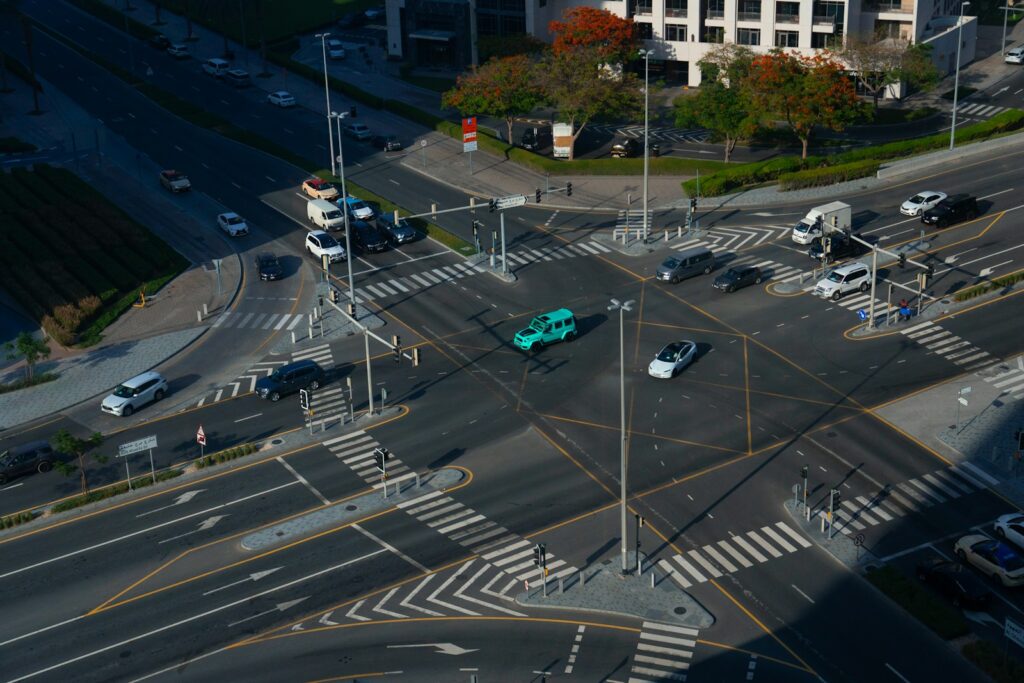
On paper, a green signal is supposed to be the safest moment in a drive. Traffic rules spell out that a driver facing a solid green has the right to proceed, yet they also quietly add a crucial caveat: that right comes with a duty to watch for anyone still in the intersection. In California, for example, the official handbook explains that at a solid green a driver should still be ready to stop for a vehicle, bicyclist, or pedestrian that has not cleared the lanes. That tiny bit of hesitation, the half second of scanning left and right, is often the only thing standing between a normal commute and a crash report.
Dashcam communities are full of drivers who learned that lesson the hard way, or almost did. In one widely shared clip, a member describes how the light turned green and a UPS truck barreled through the cross street so fast that a collision felt inevitable. Commenters like Chris Madison point out that such situations happen all the time, and that in this case UPS may have dodged a massive lawsuit only because the other driver hesitated instead of trusting the green. The camera turns that instinctive pause into evidence, a frame by frame record of how close the call really was.
When a near miss becomes a case file
That same dynamic shows up in a reel shared in Jan, where a driver posts “for awareness” after someone ran a red and nearly T boned a car carrying an entire family. The clip, which the poster says ended with everyone walking away, is a reminder that “Thankfully everybody is OK” is not a traffic strategy, it is luck. The decision to share the video on Instagram is not just about internet points, it is a way of warning other drivers that the next green might hide a similar gamble from the cross street.
Lawyers have noticed the shift. In California, firms now openly tell clients that dash cam footage is admissible and can be the clearest proof of who actually had the light. One legal explainer puts it bluntly: the short answer is Yes, video can decide fault when witness memories blur or police reports do not capture the full sequence. That is why drivers involved in crashes are increasingly asking around for footage, as one plea in a local group shows when a woman explains that She was leaving the exit ramp from 196 West, crossing College Ave to continue west on Hastings St at 9:50 am, and begs anyone with a camera pointed at that intersection to come forward. In that post, every detail, from “196” to “50,” is a breadcrumb that might lead to the one clip that shows what really happened on West.
Red lights, real stakes
Police departments are not waiting for viral clips to tell them red light running is out of control. In Murfreesboro, officers recently spent a single day focused on signal violations and found that dash cameras caught 29 drivers blasting through reds in just a few hours. Local officials described it as one of the most dangerous moving violations on the road, and the Jan enforcement push was meant to send a message that the habit will not be shrugged off as a minor slip. When nearly thirty people treat a red as a suggestion in one city on one day, the odds that your next green hides a problem start to feel uncomfortably high.
The cost of getting it wrong shows up in far grimmer footage. In Las Vegas, investigators say One person is dead and another is critically injured after an overnight crash in the southwest part of the city, with early reports pointing to a driver who failed to stop and possible charges pending. The Las Vegas case is a brutal reminder that the same behavior that produces a “close call” clip in one town can produce a homicide investigation in another. For families on the receiving end, there is no meaningful difference between a driver who gambled on a stale yellow and one who simply never looked up at the signal.
More from Wilder Media Group: