

Ford’s big electric dream just turned into one of the most expensive reality checks in modern auto history. After years of hyping battery-powered trucks and pouring money into new plants, the company is now swallowing a massive $19.5 billion hit and publicly conceding that its EV push went sideways. The bet was supposed to future proof Ford, but instead it exposed how brutally fast the market, the technology, and the competition moved.
What makes this moment stand out is not just the size of the write down, but the tone from the top. The Ford CEO is no longer pretending the strategy simply needs “more time.” He is effectively admitting that the company misread demand, misjudged rivals, and misallocated capital on a scale that is hard to overstate.
How a bold EV gamble turned into a $19.5 billion mess
Ford spent the past few years pitching investors on a sweeping electric transformation, only to end up with what is now being described as $19.5 billion in write downs tied to that push. The company poured money into new EV plants in and around Detroit, betting that a wave of demand would justify the buildout and turn the electric division into a growth engine. Instead, those investments are now being marked down as some of the largest impairments in the auto industry, a sign that the expected profits never materialized and the assets are worth far less than Ford once assumed.
The scale of the damage becomes clearer when looking at the EV unit’s performance. Ford has acknowledged that division lost US$5.1 in a single year, and executives have warned that losses could be even worse as the unwind plays out. In parallel, the company has told investors it will take $19.5 billion in charges tied to a sweeping EV write down, a move that effectively resets the value of its electric ambitions and hands rival automakers a clearer opening in the market.
The Lightning that fizzled instead of striking
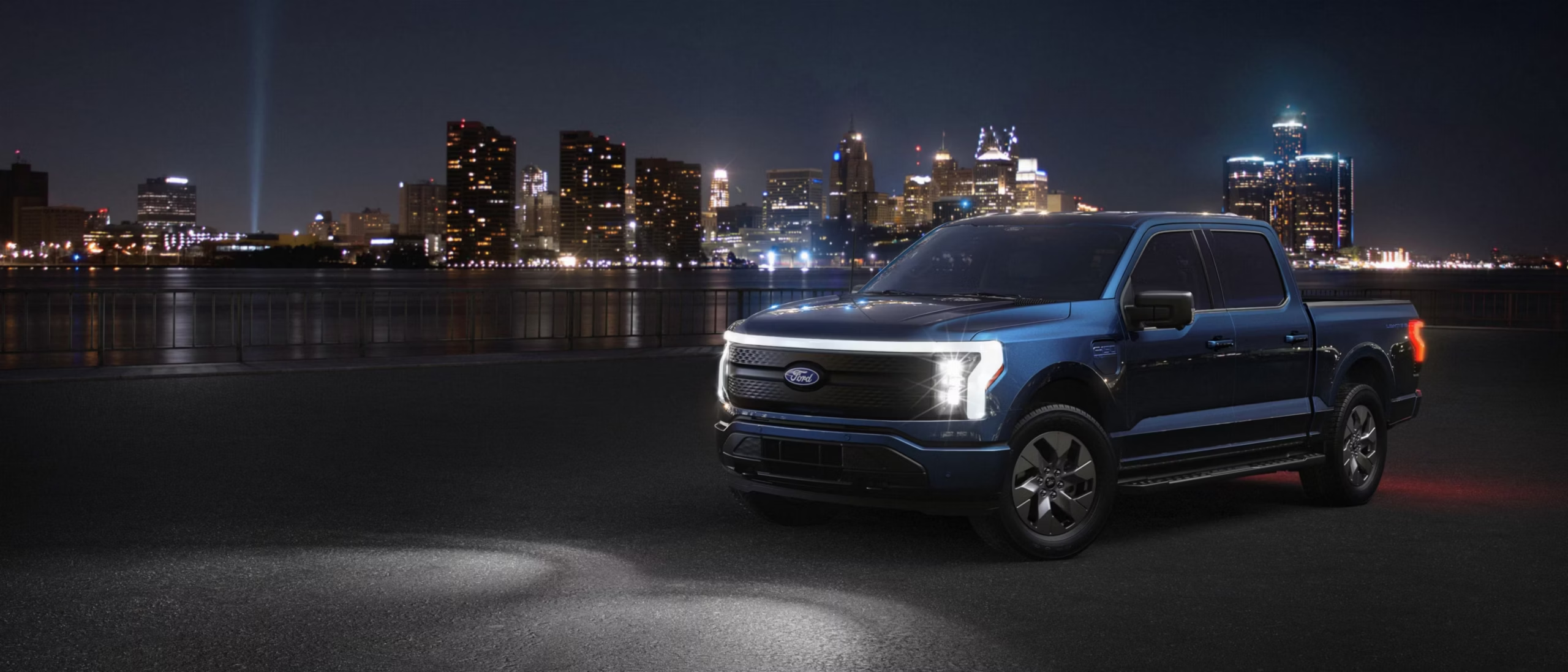
Nothing captures Ford’s misfire quite like the fate of the F 150 Lightning, the all electric pickup that was supposed to be the company’s moonshot. The truck launched with huge fanfare, but the Ford CEO has now agreed to drop the current Lightning production after admitting that EVs just weren’t at the pace needed to justify the costs. In practice, that means the company is walking away from its flagship electric pickup in its current form, a stunning reversal for a model that was marketed as the future of the American work truck.
The retreat is not just about one nameplate. Ford is now planning to replace the fully electric F 150 Lightning with an extended range version that uses a gas engine to recharge the battery, effectively pivoting back toward hybrids. The company has signaled that the Lightning will be joined by several other hybrid leaning models as it tries to find a mix that customers will actually buy at scale. That shift is a tacit admission that the original all electric strategy, including the high profile Lightning and related investments, overshot what the current market could support.
Detroit’s biggest EV bust and the investor whiplash
For investors, the EV unwind is not just a product story, it is a wealth destruction story. Commentators have described the episode as Ford Takes a Billion Hit in Detroit’s Biggest EV Bust, with the $19.5 Billion charge underscoring just how far expectations have fallen. The automaker is now shifting capital away from money losing EVs and toward models with higher profitability, a pivot that effectively concedes that the original growth narrative was oversold. For shareholders who bought into the electric story, the reversal feels like whiplash.
The damage also chips away at Ford’s reputation as a safe, blue chip name. One analysis framed the episode as part of Ford’s broader decade of wealth destruction, arguing that long term holders have watched value erode while management chased big technology narratives. Marketing expert Vikas Mittal, a J. Hugh Liedtke Professor, has described how FORD’s EV BET has SOURS, highlighting how the company slashed its planned EV spending to around $10 billion from $30 billion previously as the reality of slower demand set in.
Outgunned by Tesla and Chinese EV makers
Underneath the financial hit is a more uncomfortable truth for Ford: its electric products simply were not competitive enough. The Ford CEO has openly acknowledged that when engineers tore down rival cars like the Tesla Model 3 and several Chinese built EVs, they found a level of integration and cost discipline that left Ford’s designs looking dated. In a separate account, the Ford CEO described a “shocking” discovery after benchmarking Tesla and Chinese EVs, a moment that led directly to what he called a brutal business decision to rethink the company’s electric roadmap.
That competitive gap showed up in the showroom as well. Analysts have noted that Ford Motor struggled to match the software heavy, vertically integrated vision that Tesla used to define the modern EV. While Ford leaned on familiar truck branding and traditional dealer networks, Tesla and leading Chinese brands pushed aggressive pricing, over the air updates, and sleek user interfaces that made Ford’s offerings feel like a half step into the future rather than a clean break from the past.
What the EV reset means for drivers and the industry
For everyday drivers, Ford’s reset is already visible on dealer lots. A Ford F 150 Lightning sitting at a dealership in Chicago, photographed by Scott Olson for Getty Images, now doubles as a symbol of a market that cooled faster than automakers expected. Industry data shows EV demand growth slowing from the breakneck pace of the early 2020s, leaving companies that overbuilt capacity scrambling to adjust pricing and production. Ford’s decision to lean harder into hybrids suggests that, for a lot of buyers, range anxiety, charging access, and sticker shock still outweigh the appeal of going fully electric.
At the same time, the company’s retreat does not mean The EV era is over, it just means the path there is messier than the PowerPoint decks promised. Ford has already signaled that it will keep investing in electrification, but in a more targeted way that prioritizes profitability and customer demand instead of sheer volume. The company’s own description of The EV business as a long stretch of losing money is now driving a more sober strategy. For the broader industry, the message is blunt: chasing Tesla at any cost is out, disciplined electrification that meets buyers where they are is in, and even giants like Ford can misjudge the curve badly enough to end up writing off $19.5 billion in the process.
More from Wilder Media Group: