


You’ll see how Ford’s CEO frames a clear roadmap that reshapes which vehicles get built in the U.S. and where the company will invest next. He commits to shifting resources toward higher-return trucks, vans, hybrid options, and a new battery energy storage business while scaling EV efforts in select plants to make electric models more affordable and profitable.
This pivot affects manufacturing jobs, plant investments, and the kinds of vehicles that roll off American assembly lines. Expect analysis of his EV strategy, production innovations, and the policy and market forces that will determine whether this plan succeeds.
Ford CEO Jim Farley’s EV Vision and Domestic Production Shift
Ford will refocus EV work toward lower-cost, high-volume models, leaner production, and more U.S. battery and manufacturing investment. The company will pivot some flagship EV programs toward hybrids or extended-range designs while scaling a new affordable EV architecture.
Overview of the Major Announcement
Jim Farley announced a large strategic reset that shifts capital away from some high-end, low-volume electric programs toward affordable EVs and hybrids. The plan includes roughly $19.5 billion in special charges tied to restructuring and write-downs of EV assets, and it re-prioritizes investments to improve near-term profitability and production efficiency.
He described moving from expensive, premium EV launches toward a focus on market demand and lower total cost of ownership for customers. Ford expects to reallocate resources into a flexible, lower-cost Universal EV Platform for smaller vehicles and to slow or cancel some large all-electric truck projects.
Transition to Affordable Electric Vehicles
Farley emphasized building “affordable EVs” that hit price and range targets customers will buy. The company will concentrate on a new platform designed for high-volume midsize and compact models, aiming for lower manufacturing cost per vehicle.
This pivot includes producing a fully connected midsize pickup on the new platform by 2027 and shifting some models to extended-range EV (EREV) or plug-in hybrid configurations to broaden appeal. The goal: reduce upfront sticker price and overall ownership cost through better efficiency, simpler battery packs, and scaled production.
American Investment in Battery Production and Manufacturing
Ford plans to use U.S. battery facilities in Kentucky and Michigan not only for vehicle packs but also for a new stationary storage business. The company announced reallocating capacity toward a domestic battery and energy-storage strategy that supports both vehicles and grid or data-center customers.
That move keeps more of the supply chain onshore, shortens logistics, and aims to capture value from cell-to-system integration. It also preserves jobs at U.S. plants and supports assembly lines set to produce the new Universal EV Platform models starting in Louisville and other domestic sites.
Competing With Chinese Automakers and Global Rivals
Farley repeatedly cited competitive pressure from Chinese automakers and global rivals as a driver of the change. Ford recognizes aggressive pricing and scale from firms like BYD, and the company plans to respond with cheaper, high-volume EVs and hybrid options.
The strategy also addresses competition from GM and other legacy rivals by emphasizing cost discipline, flexible platforms, and U.S. battery capacity to shorten lead times. Ford intends to compete on price, lower total cost of ownership, and manufacturing scale rather than only on premium EV features.
Innovative Production Strategies, Policy Impact, and the Road Ahead
Ford is shifting factory layouts, battery supply lines, and product mix to protect margins and boost U.S. manufacturing. The company plans to lean on modular EV platforms, regional battery plants, and targeted policy incentives to scale electric trucks and vans while keeping hybrid options across the lineup.
Reimagining U.S. Assembly Lines for Next-Gen EVs
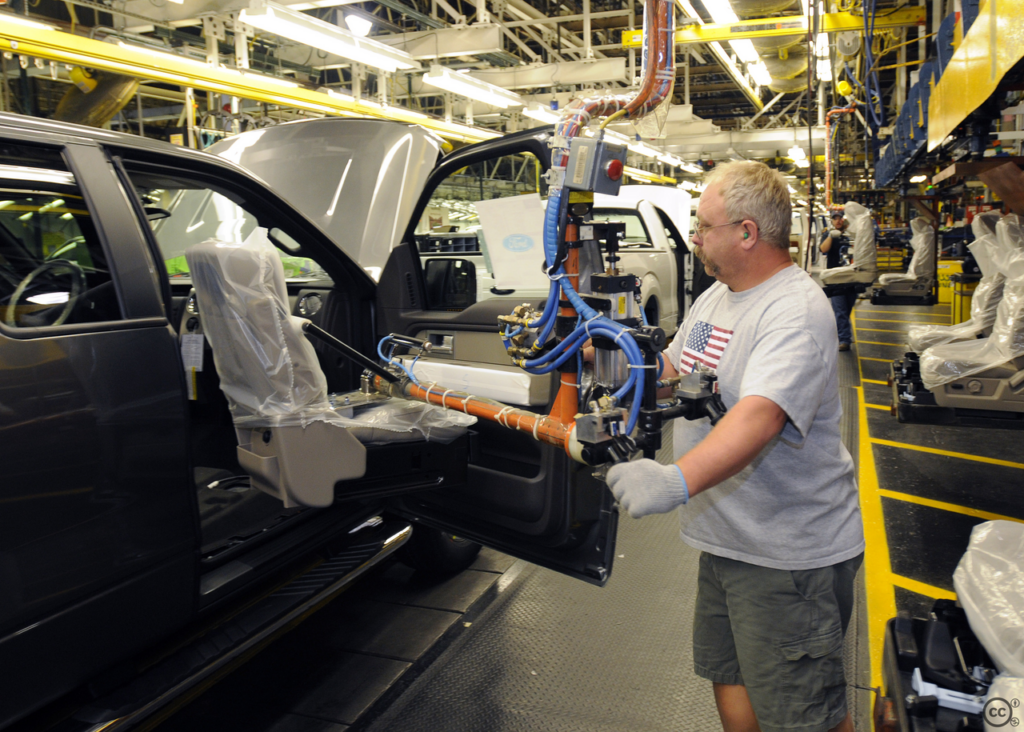
Ford is redesigning assembly processes to support a new Universal EV approach that emphasizes modular platforms and flexible lines. The strategy reduces model-specific tooling by using shared EV platforms and “assembly tree” techniques to speed changeovers between pickups, vans, and SUVs.
Kentucky and Michigan get particular focus: Kentucky will host retooled plants for more affordable EVs, and Michigan remains a hub for engineering and battery integration work. The approach shortens supply chains by colocating battery cells, pack assembly, and final assembly where possible. That reduces inbound logistics costs and helps control quality on electric trucks and large EVs.
This shift requires retraining hourly workers and adding automation where it raises throughput without eroding local employment. Ford expects shorter ramp times for new models and improved capacity to switch between internal-combustion, hybrid, and full-EV builds on the same lines.
Key Policy Factors Influencing Ford’s EV Plans
Federal incentives and trade rules shape which models Ford prioritizes and where it locates production. The Inflation Reduction Act’s domestic content and battery sourcing bonuses make localized battery production more valuable for affordable EV economics.
Tariff policy and EV import rules also affect platform choices and whether Ford produces certain larger electric vehicles domestically. Meeting tax-credit thresholds for battery materials and manufacturing components pushes investment into U.S. plants and suppliers.
State-level incentives in Ohio, Kentucky, and Michigan influence site selection and job commitments. Ford balances these incentives with projected demand and cost curves to decide which EVs and hybrid models to scale first.
Domestic Job Creation and Regional Impact
Ford plans to expand battery production and assembly employment across U.S. states to meet new content requirements and reduce overseas dependency. New or retooled plants in Kentucky and nearby supply clusters create direct manufacturing jobs and indirect roles in suppliers, logistics, and service sectors.
In Ohio and Michigan, investments in battery pack lines, cell partnerships, and engineering centers stabilize regional supply chains. Local workforce programs and apprenticeships aim to bridge skill gaps for battery assembly, software testing, and electrified drivetrain work.
Job creation is targeted but contingent on demand for higher-cost models like large electric trucks. To maximize hiring, Ford is pairing capital investment with commitments to training and supplier development in affected regions.
Challenges and Opportunities for EV Adoption
High upfront costs for battery-electric trucks and vans remain a barrier for many fleet and retail buyers. Ford mitigates that with more hybrid and affordable EV models built on versatile EV platforms and by localizing battery production to cut manufacturing costs.
Supply-chain disruptions—rare-earths, cells, or pack components—still risk timeline shifts. Producing more cells and packs domestically reduces exposure to overseas constraints and tariffs, but it requires sustained capital and supplier coordination.
Regulation and incentives can accelerate adoption if they remain stable. If tax-credit rules change or tariffs shift, Ford may reprioritize hybrids or internal-combustion derivatives to protect profitability while continuing to scale electric truck offerings.
More from Steel Horse Rides: