

Most people who buy their first electric car expect to save money on gas. What they don’t expect is how thoroughly the switch reshapes daily life, from the sound of the morning commute to the disappearance of oil-change reminders from the calendar. As EV adoption continues to climb in early 2026, long-term owners are painting a detailed picture of what changes after the new-car excitement fades, and why, according to S&P Global Mobility data, fewer than 1 in 100 choose to switch back to gasoline.
Five patterns keep showing up in owner accounts, consumer research, and federal transportation data. Together, they explain a loyalty rate that automakers building gas-powered cars would envy.
The Quiet That Sneaks Up on You
Ask a new EV owner what surprised them most, and the answer is often the silence. Battery-electric vehicles produce virtually no powertrain noise at low speeds. The U.S. Environmental Protection Agency notes that eliminating tailpipe emissions also eliminates the combustion rumble that contributes to urban noise pollution, a factor the World Health Organization has linked to elevated stress hormones and cardiovascular risk.
Inside the cabin, the difference is immediate. There are no gear shifts interrupting acceleration, no idle vibration at stoplights. Owners on enthusiast forums frequently say they didn’t realize how much engine drone they had been tuning out until they spent a week without it. Parents report that highway drives feel calmer, phone calls no longer require raised voices, and the overall sense of fatigue after a long commute drops noticeably.
That quieter footprint extends beyond the driver. In dense neighborhoods, the reduction in noise and exhaust fumes is measurable, a point the EPA highlights when discussing the public-health case for vehicle electrification.
Maintenance Bills That Barely Show Up
Fuel savings grab headlines, but many long-term owners say the maintenance gap is the bigger financial revelation. A battery-electric drivetrain has far fewer moving parts than an internal-combustion engine: no timing belts, no spark plugs, no multi-speed transmission, no exhaust system. According to the U.S. Department of Energy, scheduled maintenance costs for a battery-electric vehicle are roughly 40 percent lower than for a comparable gasoline car over the vehicle’s lifetime.
In practice, that means the regular service calendar shrinks to tire rotations, cabin air filters, brake fluid checks, and occasional coolant service for the battery pack. Regenerative braking, which recaptures energy during deceleration, also extends brake-pad life considerably. Consumer Reports has found that EV owners spend about half as much on repairs and maintenance over the first 200,000 miles compared with owners of gas-powered vehicles.
For rural households, where the nearest dealership service bay might be an hour away, fewer required shop visits translate directly into fewer disrupted workdays. The U.S. Department of Transportation’s rural EV toolkit lists lower maintenance costs and reduced breakdown risk as core advantages for drivers in less populated areas.
Home Charging Rewrites the Daily Routine
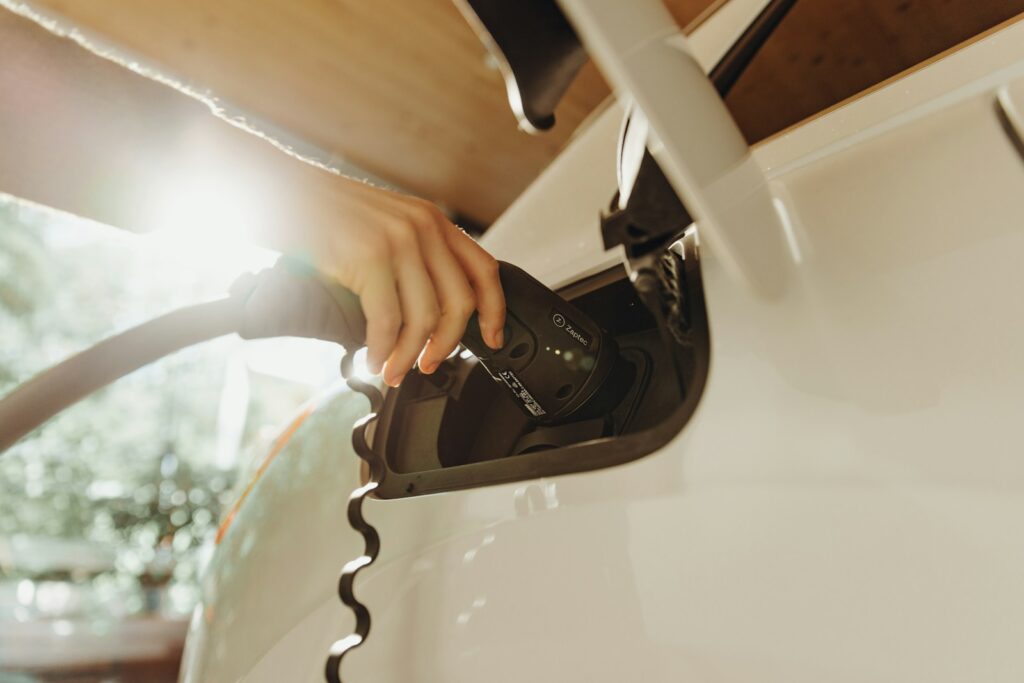
The shift from gas station to garage outlet sounds minor on paper. In daily life, owners describe it as one of the most liberating changes. Plug in before bed, wake up to a full battery. The weekly detour to a fuel pump, the price-checking between stations, the standing outside in January while the tank fills: all gone.
The DOE’s Office of Energy Efficiency notes that more than 80 percent of EV charging in the United States happens at home, typically overnight on a Level 2 (240-volt) setup that costs a few dollars per full charge at average residential electricity rates. For drivers with workplace charging, the car tops off during the hours it would otherwise sit idle in a parking lot.
On the road-trip front, the public charging network has expanded substantially. As of early 2026, the federal National Electric Vehicle Infrastructure (NEVI) program, funded through the Bipartisan Infrastructure Law, continues to add DC fast chargers along major highway corridors. Planned stops at charging stations co-located with restaurants or parks are replacing the rushed gas-and-go, a shift that families with young children say actually improves long drives.
That convenience builds a habit loop that’s hard to break. In online owner communities, a common refrain is that the household’s remaining gas car starts feeling like an inconvenience because someone has to remember to visit a station. One widely shared Reddit thread captured the sentiment bluntly: the biggest reason drivers stay electric is that they simply forget gas stations exist.
Lifestyle Perks Beyond the Commute
Not every benefit fits neatly into a cost spreadsheet. Owners regularly mention quality-of-life improvements that surprised them.
Recreation access. Even shorter-range EVs (around 100 miles per charge) can reach trailheads, beaches, and campgrounds that fall within a comfortable round-trip radius, especially as charging apps make it easy to locate a top-up station near the destination. Drivers who previously wouldn’t have attempted a spontaneous day trip describe doing so routinely once they learned to plan around available chargers.
Stop-and-go comfort. In heavy traffic, an EV doesn’t idle, doesn’t creep forward in first gear, and doesn’t generate heat from a running engine. Instant, linear torque from the electric motor makes low-speed driving smoother and less mentally taxing. In hot-climate cities like Phoenix and Houston, owners note that the absence of engine heat under the hood contributes to a cooler cabin, complementing the air conditioning rather than fighting it.
Safety perception. The Insurance Institute for Highway Safety (IIHS) has noted that EVs tend to perform well in crash tests partly because the heavy battery pack lowers the center of gravity, reducing rollover risk. Many models also come standard with advanced driver-assistance features that are optional on gas-powered trims. Owners frequently cite the combination of structural rigidity and active safety tech as an unexpected source of confidence.
Financial Flexibility That Builds Over Time
The upfront price of an EV remains higher than that of a comparable gas car in most segments, a gap that continues to narrow as battery costs decline. But owners who look at total cost of ownership over five or more years often find the math tips in the EV’s favor, driven by fuel and maintenance savings.
Federal tax credits of up to $7,500 for new qualifying EVs (and up to $4,000 for used ones) remain available under the Inflation Reduction Act, though eligibility depends on the vehicle’s assembly location and battery-sourcing requirements. State-level incentives vary widely. The DOE’s fueleconomy.gov tool lets buyers check which credits apply to a specific model before signing paperwork.
Lease terms have also become more competitive. Because the leasing company claims the tax credit and passes part of it through as a lower monthly payment, some drivers find that leasing an EV costs less per month than financing a gas-powered equivalent. That structure also insulates the driver from concerns about long-term battery degradation, since the car goes back at lease end.
Electricity pricing adds another layer of control. Many utilities offer time-of-use rates that make overnight charging significantly cheaper than daytime power. Paired with a home solar installation, some owners report near-zero fuel costs, a level of budget predictability that gasoline, with its refinery-driven price swings, cannot match.
The Community That Comes With the Car
Switching to electric often connects drivers to a surprisingly active knowledge-sharing network. Online forums, local EV clubs, and social-media groups function as informal help desks where owners trade charging strategies, compare real-world range in different climates, and troubleshoot software updates.
That peer support matters because the technology is still evolving. Charging etiquette, adapter compatibility, and route-planning apps change frequently enough that a tip from another owner can save hours of frustration. Several drivers credit these communities with helping them feel confident enough to attempt their first long road trip on electric power.
Automakers have noticed. Many now host branded owner forums and in-app community features, while third-party apps like PlugShare and A Better Route Planner have become essential tools that double as social platforms. The result is an ownership experience that feels more connected and more supported than the traditional buy-it-and-drive-it relationship most people have with a car.
The Trade-Offs Worth Acknowledging
No honest account of EV ownership skips the friction points. Public fast-charging reliability remains inconsistent in some regions. Cold weather can reduce range by 20 to 40 percent, according to Recurrent Auto’s real-world data. Battery replacement, while rare within the typical warranty period (8 years or 100,000 miles for most manufacturers), is expensive if it happens out of pocket. And apartment dwellers without dedicated parking still face a genuine charging-access gap.
These are real limitations, and they matter. But for the growing majority of owners who can charge at home and drive within their battery’s comfortable range, the day-to-day experience has proven compelling enough that going back to gas feels less like a fallback option and more like a step backward.
More from Wilder Media Group: