


Some cars sell well and disappear. Others change what people believe a car can be, who gets to own one, and what it says about them. The Ford Model T, the Volkswagen Beetle, and the first-generation Ford Mustang each did exactly that, and their influence hasn’t faded. As of spring 2026, all three remain among the most discussed, most collected, and most referenced vehicles in automotive history.
What set these three apart wasn’t just volume, though the numbers were staggering. Each one arrived at a moment when millions of people were ready for a new relationship with the automobile, and each delivered something no competitor had figured out how to offer at scale.
The Ford Model T: The Car That Made Car Ownership Normal
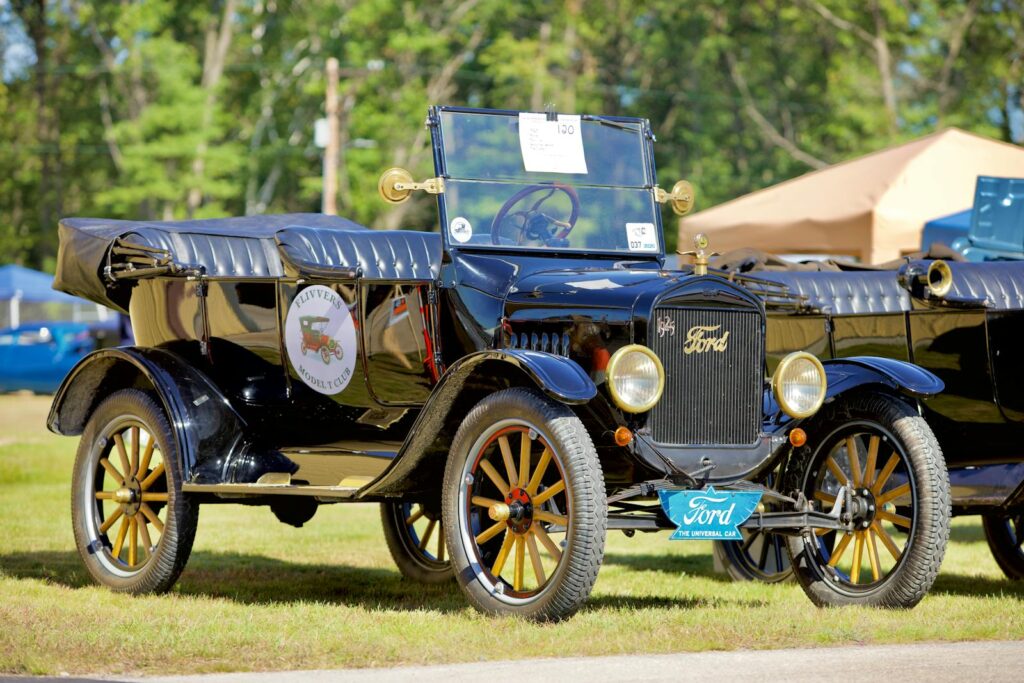
Before the Model T’s debut in 1908, automobiles were handbuilt, expensive, and unreliable. Most Americans had never ridden in one. Henry Ford didn’t invent the car or the assembly line, but he combined them in a way no one had before, and the result was a machine that factory workers could actually afford to buy.
Between 1908 and 1927, Ford produced more than 15 million Model Ts. At its cheapest, in 1925, the touring car sold for $260, roughly $4,500 in today’s dollars. No other product had ever demonstrated mass production’s power so visibly. Automotive historians consistently rank the Model T alongside the Benz Patent-Motorwagen and the Jeep Willys MB as one of the handful of vehicles that fundamentally reset the auto industry.
The car itself was deliberately simple. Its 20-horsepower four-cylinder engine, planetary transmission, and high ground clearance were designed for unpaved rural roads, not speed. Interchangeable parts meant that a farmer with basic tools could handle most repairs. Ford’s own dealers doubled as parts suppliers and mechanics, creating one of the first nationwide service networks.
The Model T’s cultural impact went beyond transportation. It accelerated suburbanization, created demand for paved roads and gas stations, and introduced millions of workers to the rhythms of industrial production. The assembly line that built the car reshaped labor itself: Ford’s famous $5 daily wage, introduced in 1914, was as revolutionary as the vehicle it helped produce.
Enthusiast communities still call it the most iconic Ford ever made. The America’s Car Museum describes the Model T as the machine that brought cars to ordinary people and popularized the nickname “Tin Lizzie” for its rugged, no-nonsense character. That nickname stuck because it captured something real: this was a car built to work, not to impress.
The Volkswagen Beetle: Small, Cheap, and Impossible to Kill
The Beetle’s origin story is one of the strangest in automotive history. Ferdinand Porsche designed it in the 1930s under a commission from Adolf Hitler, who wanted a “people’s car” (Volkswagen, literally) that German families could afford. World War II intervened before civilian production began in earnest, and the factory in Wolfsburg was nearly scrapped by the British occupation authority, which offered it to several manufacturers. None wanted it.
That turned out to be one of the great miscalculations in business history. Once production ramped up in the late 1940s, the Beetle became unstoppable. By the time the last original rolled off the line in Puebla, Mexico, in July 2003, more than 21.5 million had been built across a production run spanning over six decades. The history of the automobile records few vehicles with that kind of longevity.
What made the Beetle work was radical simplicity. The air-cooled flat-four engine sat in the rear, eliminating the need for a radiator and water pump. The body was rounded and compact. Maintenance was straightforward enough that owners’ manuals became bestselling books. John Muir’s How to Keep Your Volkswagen Alive, first published in 1969, sold millions of copies and turned Beetle repair into a countercultural rite of passage.
That counterculture connection gave the Beetle a second life as a symbol. In 1960s and 1970s America, it became the anti-car: small when Detroit built big, simple when competitors added chrome, and cheap when muscle cars chased horsepower. The “Think Small” advertising campaign by Doyle Dane Bernbach, launched in 1959, is still studied in marketing courses as one of the most effective print campaigns ever created.
Classic car enthusiasts who discuss the vehicles that shaped mass motoring regularly place the Beetle alongside the Model T and the Toyota Corolla as the defining “cars of the masses.” Vintage dealers like Worldwide Vintage Autos describe it as a car that captured the look and feeling of its time, and their inventory regularly features Beetles as approachable entry points for new collectors.
For millions of people across dozens of countries, the Beetle was a first car, a project car, or the car that proved you didn’t need much to get where you were going. Its dark origins make its legacy complicated, but its impact on what ordinary drivers expected from an affordable car is hard to overstate.
The First Ford Mustang: When a Car Became a Personality
The Model T and the Beetle were about access. The first-generation Ford Mustang, introduced on April 17, 1964, was about desire. Lee Iacocca, then a Ford vice president, had a specific buyer in mind: young, possibly female, with modest income but strong opinions about style. The car he championed delivered sporty looks, a long hood, a short rear deck, and a base price of $2,368 (about $23,000 today) that undercut nearly every competitor with comparable visual appeal.
The response was immediate and overwhelming. Ford sold 22,000 Mustangs on the first day. Within the first year, more than 418,000 found buyers, smashing internal projections. The Mustang created an entirely new market segment, the “pony car,” and forced GM, Chrysler, and AMC to scramble for competitors. The Chevrolet Camaro, Pontiac Firebird, Plymouth Barracuda, and AMC Javelin all owe their existence to the Mustang’s success.
Part of what made the Mustang work was its options list. The base model came with a 170-cubic-inch inline six that was adequate but unremarkable. Buyers who wanted more could check boxes all the way up to the 289-cubic-inch V8, add disc brakes, upgrade the suspension, and choose between fastback, coupe, and convertible body styles. The car was a platform for self-expression, and Ford marketed it that way.
The Mustang’s cultural footprint grew fast. Steve McQueen’s 1968 film Bullitt turned a Highland Green Mustang GT fastback into one of the most famous movie cars ever filmed, and the chase scene through San Francisco remains a benchmark for automotive cinematography. Surveys of classic cars that Millennials and Gen Z love consistently place the 1965-1966 Mustang at or near the top, evidence that the car’s appeal has outlived the generation that first bought it.
Broader histories of iconic cars note that American muscle cars carved out a distinct identity by leaning into straight-line speed and bold design, while European sports cars emphasized precision and handling. The Mustang split the difference. It wasn’t a pure sports car, but it looked like one, and it seated four. That combination of aspiration and practicality was new, and it proved that a car’s image could matter as much as its spec sheet.
Why These Three Still Matter
The Model T proved that cars could be for everyone. The Beetle proved that small and simple could win worldwide. The Mustang proved that affordable didn’t have to mean boring. Each one solved a problem its competitors hadn’t recognized yet, and each one sold in numbers that forced the rest of the industry to adapt.
As of March 2026, all three remain fixtures at car shows, in restoration shops, and on collector-market watchlists. The Model T is a museum staple. Clean original Beetles command rising prices as the supply of unrestored examples shrinks. First-generation Mustangs, especially V8 fastbacks, have appreciated steadily for two decades and show no sign of cooling off.
These aren’t just old cars. They’re the reason the modern car market looks the way it does: segmented by lifestyle, priced for volume, and sold on emotion as much as engineering. Every crossover SUV marketed to young families, every retro-styled hatchback, every “attainable sports car” pitch traces a line back to decisions made by Ford in 1908, Volkswagen in the 1940s, and Ford again in 1964.
More from Wilder Media Group: