

Not every legendary car had years to build its reputation. Some needed only a single model year, a few hundred units or one dominant racing season to cement their place in automotive history. These four muscle cars were built for specific purposes, sold in small numbers and vanished from showrooms almost as quickly as they arrived. Decades later, they remain among the most coveted machines in the collector market.
Plymouth Superbird: Born for the Oval, Too Wild for the Street
The 1970 Plymouth Superbird exists because of a rulebook. NASCAR required manufacturers to sell street-legal versions of their race cars before those cars could compete, so Plymouth took the Road Runner and bolted on a protruding nose cone, flush rear window and an aluminum rear wing that stood nearly two feet above the trunk lid. The result looked like nothing else in any dealer showroom in America.
Plymouth built approximately 1,935 Superbirds for the 1970 model year, and then production stopped. The car had served its purpose: getting Richard Petty back into a Plymouth for the NASCAR season. Petty had defected to Ford in 1969 after Plymouth refused to let him race the Dodge Daytona, and the Superbird was Plymouth’s answer. With Petty behind the wheel, the winged Plymouth captured eight victories during the 1970 Grand National season.
Buyers at the time were less enthusiastic. The radical aerodynamic bodywork struck many as bizarre, and dealers reportedly removed wings and nose cones from unsold cars just to get them off the lot. That rejection now seems almost comical. As of early 2026, clean Hemi-powered Superbirds routinely command seven figures at major auctions, and even 440-equipped examples have crossed the $500,000 mark. Barrett-Jackson has described the Superbird as “the ultimate in muscle-car homologation specials,” and few collectors would argue.
Dodge Charger Daytona: The Car That Broke 200 MPH and Got Itself Banned
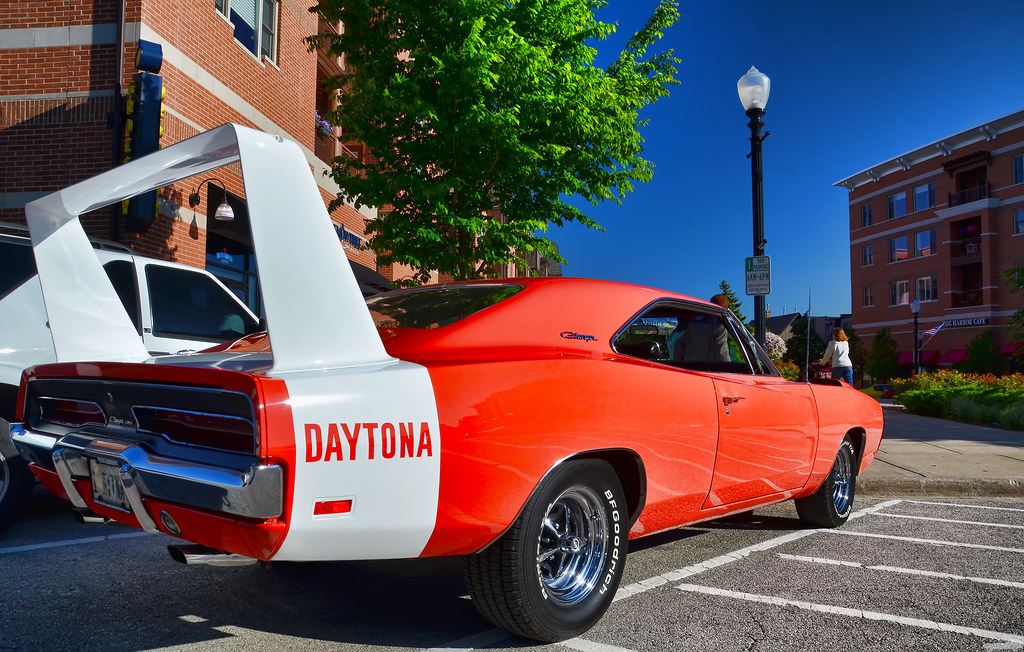
The Dodge Charger Daytona preceded the Superbird by one year and followed the same logic: reshape a production car for aerodynamic dominance on NASCAR’s fastest tracks. Dodge grafted a pointed steel nose and a rear wing onto the 1969 Charger 500, creating a machine that looked purpose-built for speed because it was.
The street version came with a 440 Magnum V8 producing 375 horsepower as standard equipment, with the 426 Hemi available as an option. On the track, the numbers were more dramatic. In March 1970, Buddy Baker drove a Daytona to 200.447 mph during a closed test session at Talladega Superspeedway, making it the first NASCAR vehicle to break the 200-mph barrier. The achievement was so decisive that NASCAR responded by restricting engine displacement for winged cars to 305 cubic inches for the 1971 season, effectively killing the entire aero-car program.
Only 503 Charger Daytonas were built for 1969, making it even rarer than the Superbird. Like its Plymouth cousin, the Daytona struggled on dealer lots. Customers who wanted a Charger generally wanted one that looked like a Charger, not a land-speed-record car with a two-foot nose extension. That indifference evaporated over the following decades. Today, the Daytona and Superbird together represent the peak of Detroit’s aero-warrior era, and both sit firmly in the upper tier of muscle-car collecting.
Ford Mustang Boss 429: A Racing Engine Stuffed into a Pony Car
The Boss 429 was not really a Mustang project. It was an engine project. Ford had developed a massive 429-cubic-inch semi-hemispherical-head V8 for NASCAR competition, but league rules required the engine to appear in production vehicles. The Torino would have been the natural home, but Ford chose the Mustang instead, betting that the pony car’s popularity would help move the required units. The problem was that the 429 engine was so physically large that it barely fit under the Mustang’s hood. Ford contracted Kar Kraft, a specialty shop in Brighton, Michigan, to hand-modify each car’s engine bay, shock towers and inner fenders to accommodate the motor.
Ford produced 859 Boss 429 Mustangs for 1969 and an additional 499 for 1970, bringing the total to roughly 1,358 cars across two model years. Each one carried the “KK” serial number assigned by Kar Kraft, and those numbers have become critical identifiers for authenticating survivors. Hemmings has called the Boss 429 “a holy grail among collectors,” and auction results support that label: well-documented examples have sold for $300,000 to over $500,000 in recent years.
Ironically, the Boss 429 was never the fastest Mustang in a straight line. Its NASCAR-spec heads and conservative street tune meant the smaller Boss 302 was often quicker in magazine tests. But rarity, purpose and the sheer audacity of cramming a racing engine into a pony car have given the Boss 429 a mystique that transcends quarter-mile times.
Buick GNX: A Turbocharged Farewell That Embarrassed Supercars
The Buick GNX arrived in 1987, nearly two decades after the original muscle-car era, and it played by completely different rules. Where the Superbird and Daytona relied on cubic inches and aerodynamics, the GNX used a turbocharged and intercooled 3.8-liter V6 to produce a factory-rated 276 horsepower and 360 lb-ft of torque. Independent tests suggested the real numbers were significantly higher. Car and Driver recorded a 0-to-60 time of 4.7 seconds, quicker than the Corvette, the Ferrari 308 and the Lamborghini Jalpa of the same period.
Buick and McLaren Performance Technologies (not the F1 team, but an American engineering firm founded by the same family) built exactly 547 GNX models as a sendoff for the G-body Regal platform. Each car was sequentially numbered, and many were bought by collectors who never put serious miles on them. The GNX was Buick’s way of proving that its Grand National program, which had been building momentum since 1982, deserved a proper finale.
The car’s reputation has only grown since. In a segment historically dominated by Chevrolet, Ford, Dodge and Pontiac, the GNX proved that a Buick could be the most feared car on the street. It also foreshadowed the direction American performance would eventually take: forced induction, electronic engine management and a focus on real-world speed over displacement bragging rights. Low-mileage examples now regularly sell for $200,000 or more, and the GNX consistently appears on lists of the greatest American performance cars ever built.
Why Short Runs Create Long Legends
These four cars share more than rarity. Each one was built to solve a specific problem, whether that was a NASCAR homologation requirement or the need to send a platform out with dignity. None was designed for long-term production, and none needed it. Their limited numbers guaranteed scarcity, their performance credentials guaranteed respect, and the decades since have guaranteed that the survivors will only become more valuable. For collectors and enthusiasts in 2026, these remain the cars that prove a single model year can echo for generations.
More from Wilder Media Group: