


A 2024 survey by the American Society of Civil Engineers gave America’s roads an overall grade of C-minus, and anyone who drives daily already knew that. Between frost-heaved city blocks, neglected rural routes, and construction zones that never seem to end, the car that actually makes life better is rarely the one with the splashiest horsepower number. It is the one that soaks up punishment without passing it on to the people inside.
Why suspension matters more than most buyers realize
The suspension is the system that stands between a broken road surface and your lower back. Springs carry the vehicle’s weight. Dampers (commonly called shocks or struts) control how quickly those springs compress and rebound. Control arms, bushings, and anti-roll bars tie everything together and keep the tires pointed where the steering wheel says they should go.
When all of those parts are well-designed and in good condition, the cabin stays composed even when the wheels are hammering through rough pavement. Tires maintain contact with the road, which means shorter braking distances, more predictable steering, and headlights that do not bounce around on dark streets. When components wear out or the design prioritizes looks over function, every pothole becomes a full-body event, and emergency maneuvers get noticeably less stable.
According to the Car and Driver suspension primer, the engineering challenge is always a trade-off: a setup stiff enough to resist body roll in corners can punish occupants on broken pavement, while a pillowy ride may wallow through highway lane changes. The best modern systems, particularly adaptive dampers that adjust firmness in real time, try to split that difference. But even a well-sorted conventional suspension can outperform a poorly tuned adaptive one if the basic geometry and bushing compliance are right.
Potholes cost drivers billions and wreck more than tires
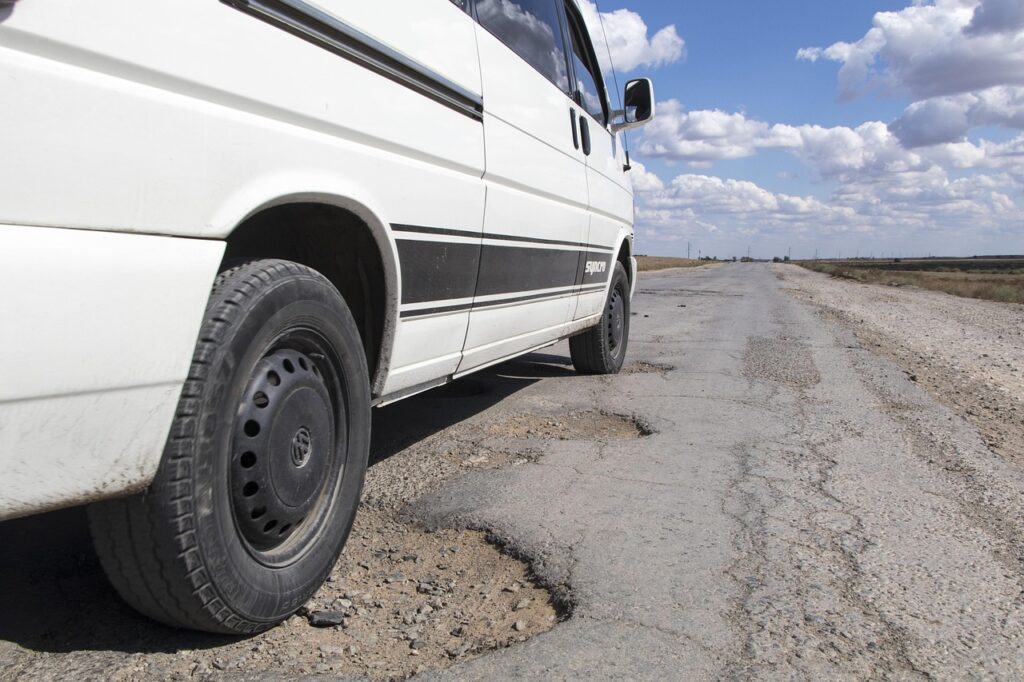
A pothole strike at 30 mph can generate forces equivalent to several thousand pounds concentrated on a small patch of wheel and tire. The immediate damage is often visible: a bent rim, a sidewall blowout, or a cracked plastic undertray. The slower damage is harder to spot. Alignment angles shift, causing uneven tire wear that may not become obvious for weeks. Ball joints and tie-rod ends absorb shock loads they were not sized for, accelerating wear that eventually shows up as clunks or loose steering feel.
AAA’s most widely cited estimate, based on a 2016 national survey, put the annual cost of pothole-related vehicle repairs at roughly $3 billion across U.S. drivers, with individual repair bills averaging around $300 per incident. In states with severe freeze-thaw cycles (think Michigan, Minnesota, Pennsylvania), those numbers skew higher, and the damage is not limited to old or high-mileage vehicles. A three-year-old crossover on 20-inch wheels with low-profile tires can crack a rim on the same pothole that a 10-year-old sedan on 16-inch wheels rolls through without complaint.
What separates a rough-road survivor from a fragile one
Three factors explain most of the gap between vehicles that shrug off bad pavement and those that suffer:
Tire sidewall height. A taller sidewall acts as a secondary spring, flexing to absorb sharp impacts before they reach the rim. The industry trend toward larger wheels (18, 19, even 22 inches on mainstream SUVs) has steadily reduced sidewall height, trading cushion for curb appeal. Buyers who regularly drive damaged roads should seriously consider staying with the smallest wheel option available on their chosen model.
Suspension travel and compliance. Vehicles engineered for comfort, such as the Toyota Camry, Honda Accord, or Subaru Outback, tend to have longer suspension travel and softer bushing rates than sport-tuned alternatives. That extra give lets the wheel drop into a hole and climb back out without slamming the bump stops. Trucks and body-on-frame SUVs often have even more travel, though their heavier unsprung mass can create its own harshness on washboard surfaces.
Component durability. Stamped-steel control arms, rubber (rather than polyurethane) bushings, and conventional shock absorbers are cheaper to replace and more tolerant of repeated abuse than complex multi-link setups with aluminum forgings. That is not an argument against sophisticated suspension design, but it is a reason to factor replacement costs into a purchase decision, especially for drivers in pothole-heavy regions.
The horsepower question most shoppers get backwards
It is easy to fixate on power. Automakers market it aggressively, and spec-sheet comparisons make 250 horsepower look obviously better than 190. But on the roads most people actually drive, surplus horsepower rarely improves the experience and can quietly make it worse.
As Yahoo Autos noted in a 2024 buyer guide, modern engines produce output that would have been exotic-car territory a generation ago, yet the traction available from a standard all-season tire on wet or broken pavement has not changed much. On a frost-heaved two-lane road with patchy grip, a 300-horsepower engine does not help you navigate a sudden pothole cluster any better than a 180-horsepower one. What helps is a suspension that keeps the tires in contact with whatever surface remains and brakes that can scrub speed predictably.
Weight matters here, too. A heavier vehicle needs more power just to feel adequate, which is one reason midsize EVs often carry 300-plus horsepower despite being family transportation. But for a conventional 3,200-pound sedan, 180 to 200 horsepower is more than enough for merging, passing, and highway grades. Spending the budget on a better suspension package, a smaller wheel-and-tire combination, or even a set of quality all-season tires will do more for daily comfort and safety than an extra 50 horsepower ever could.
How to shop with real roads in mind
If your commute includes the kind of pavement that makes passengers wince, a few practical steps can steer the purchase in a better direction:
Test-drive on your actual roads. Dealer lots and freshly paved test routes flatter every car. Ask to drive the vehicle on the roughest stretch you normally face. Listen for harshness, feel for excessive jostling, and pay attention to how quickly the body settles after a bump.
Check the wheel and tire spec before you fall in love with a trim level. Many vehicles offer a base wheel that is two or three inches smaller than the top trim’s option. That difference translates directly into ride quality on broken surfaces.
Look for adaptive or selectable dampers if the budget allows. Systems like GM’s Magnetic Ride Control, Ford’s CCD (Continuously Controlled Damping), or Toyota’s AVS (Adaptive Variable Suspension) let the car firm up for spirited driving and soften for pothole-strewn commutes. They are increasingly available on mainstream models, not just luxury cars.
Factor in repair costs. Before signing, price out a strut replacement, a wheel refinish, and an alignment for the specific model you are considering. The differences between vehicles can be substantial, and that information is easy to find through dealer service departments or repair-cost databases like RepairPal.
The bottom line for spring 2026 car shoppers
Road conditions across much of the United States are not improving fast enough to keep up with the damage winter inflicts every year. For buyers shopping in spring 2026, that reality should weigh heavily in the decision. A vehicle with a well-sorted suspension, sensibly sized wheels, and enough power (not necessarily the most power) will ride better on day one, cost less to maintain over five years, and protect its occupants more effectively when the pavement gives way without warning. That is not a glamorous selling point, but it is the one that matters most once the new-car excitement fades and the daily commute takes over.
More from Wilder Media Group: