What It’s Really Like to Let a Self-Driving Car Take the Wheel
Photo by Pixabay
Madison Cates
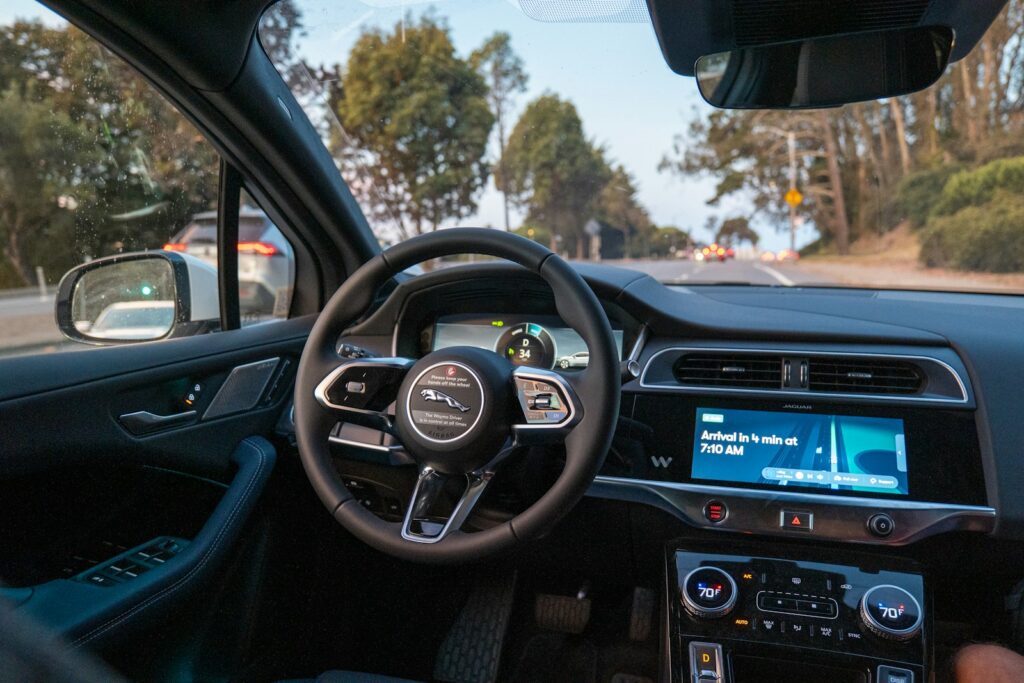
The Waymo pulled up to the curb in Phoenix with its sensors spinning and its driver’s seat empty. Jun, a travel writer covering the city for Matador Network, watched the steering wheel adjust itself, the doors unlock on cue, and the car wait patiently for her to climb in. No greeting, no small talk, no aux cord negotiation. Just a clean backseat, cold air conditioning, and a screen showing exactly what the car planned to do next. Her account of the ride captures a reaction that thousands of first-time robotaxi passengers now share: the future arrived, and it drives like a cautious student on a permit test.
As of early 2026, Waymo’s driverless ride-hailing service, Waymo One, operates in Phoenix, San Francisco, Los Angeles, and Austin, with testing underway in additional markets. The company reported surpassing 150,000 paid weekly trips by late 2024, a figure that has continued to grow as service zones expand. For a growing number of Americans, climbing into a car with no one behind the wheel is no longer hypothetical. But for most, it still sounds like a stunt. Here is what the experience actually feels like, what the research says about it, and why public trust has not caught up with the technology.
Photo by Andri Aeschlimann
The moment the car arrives with no one inside
The strangeness starts before the ride does. A rider taps a phone, watches a dot glide across a map, and then a white SUV bristling with lidar domes rolls to a stop at the pickup pin. There is no driver to make eye contact with, no wave through the windshield. In a short video review, one rider laughs the moment she sees the empty cockpit, calling the vehicle a “Whimo” before the door even opens. That nervous laugh is almost universal.
Waymo leans on design to ease the weirdness. The vehicles are unmistakable on the road, wrapped in branding and studded with visible sensors that signal “this car knows what it’s doing.” The app walks riders through unlocking the doors, confirming the destination, and starting the trip, treating the whole sequence as casually as hailing any other car. The goal is to make the driverless part feel like a feature, not a glitch.
Inside the cabin: quiet, clean, slightly surreal
Once inside, the familiarity is almost disorienting. The seats, seatbelts, and air vents are standard. What is not standard is the silence. There is no driver’s playlist bleeding from the front speakers, no phone conversation to half-listen to, no rearview mirror glance. Jun described the Phoenix interior as spotless, with a dashboard screen showing a real-time map of the route and a calm voice narrating upcoming turns.
Other riders describe the same atmosphere. The cabin feels less like a rideshare and more like a private shuttle. A screen mounted in the backseat displays a simplified version of what the car’s sensors detect: other vehicles rendered as colored blocks, pedestrians as outlines, traffic lights highlighted in green or red. Watching the car “think” in real time is part reassurance, part novelty. Some passengers find it meditative. Others say it makes the emptiness of the front seat harder to ignore.
How the car actually drives
On the road, a Waymo drives the way your most rule-abiding friend would if they knew they were being graded. It brakes early. It leaves generous following distances. It does not nudge into intersections or accelerate through yellow lights. Jun noted that her Phoenix ride involved no sudden movements, and the car rolled gently into turns rather than cutting them tight.
Jason Torchinsky, writing for The Autopian after riding in an autonomous vehicle on public streets, called it possibly “the greatest transportation experience on earth,” but also noted the system was “optimized and conservative to the point of overcaution,” sometimes avoiding routes for reasons that were not obvious to a human passenger. That tension defines the current robotaxi experience: the car is almost certainly safer than most human drivers, but it does not drive like one, and the gap can feel odd in city traffic where assertiveness is part of the rhythm.
Waymo’s own safety data supports the cautious approach. In a peer-reviewed study published with Swiss Re in 2024, the company reported that its vehicles were involved in significantly fewer injury-causing crashes per mile than human-driven cars in the same service areas. The conservatism is not a bug. It is the product.
Comfort and the science of keeping passengers calm
Engineers working on autonomous vehicles treat passenger comfort as a core design problem, not an afterthought. A 2020 study published in the International Journal of Environmental Research and Public Health examined how acceleration patterns, braking intensity, and even the ability to do non-driving activities (reading, looking at a phone) affect whether riders feel relaxed or nauseous in self-driving cars. The researchers concluded that carefully managing those inputs could meaningfully improve passenger comfort, a finding that maps directly onto how Waymo tunes its driving behavior.
In practice, this means the car prioritizes smooth over fast. It accelerates gradually from stops, decelerates well before red lights, and takes turns at speeds that keep passengers from swaying. The tradeoff is pace. In stop-and-go city traffic, a Waymo can feel slower than a human driver who knows when to push through a gap. For passengers prone to motion sickness, though, the smoothness is a genuine improvement over many human-driven rideshares.
Trust, fear, and the first five minutes
The emotional arc of a first robotaxi ride is remarkably consistent across accounts. At pickup: anxiety. During the first few blocks: hypervigilance, with every lane change and stoplight scrutinized. Then, if nothing alarming happens, a slow release of tension that often tips into something close to delight.
A widely shared social media post captures the arc in miniature. The rider starts by emphasizing, in all caps, that there is “NO driver. Like at all,” then ends by rating the experience 10 out of 10 and declaring “the future is happening now.” Another rider, filmed at a Goodwill parking lot in Arizona, ordered an Uber and was surprised when the app matched her with an autonomous vehicle. Her initial shock dissolved into curiosity within seconds as she circled the empty front seat and climbed in.
That speed of adaptation matters. The gap between “I would never get in that” and “this is actually fine” appears to be about three to five minutes of uneventful driving, at least for riders who choose to try it in the first place.
What Americans actually think
Individual reactions tend to skew positive, but national polling tells a more cautious story. The AAA’s annual survey on autonomous vehicles, conducted in 2024, found that 66% of U.S. drivers said they would be afraid to ride in a fully self-driving car. That figure has remained stubbornly high for several years. A 2022 Pew Research Center survey found similar wariness, with concerns spanning safety, job displacement, and the broader societal effects of removing human drivers from the road. Those concerns cut across age, income, and education levels.
The disconnect is striking. People who have taken a robotaxi ride frequently describe it as one of the best transportation experiences they have had. People who have not tend to view the concept with suspicion. The technology, by most measurable safety metrics, is already performing well. Public perception has not caught up, and the gap is unlikely to close through marketing alone. It will close, if it does, one ride at a time.
Robotaxis as everyday transportation
In the cities where Waymo One operates, the novelty is already wearing off. Riders use the service for grocery runs, airport trips, and nights out. Pricing sits roughly in line with UberX in the same markets, though surge pricing does not apply in the same way since there is no human driver to incentivize.
The competitive landscape is shifting around Waymo. Uber signed a multi-year partnership with the company in 2024 to integrate Waymo vehicles into the Uber app, starting in Austin and Atlanta. Lyft has pursued its own autonomous partnerships, including deals with May Mobility and Mobileye. The collapse of Cruise’s robotaxi program in late 2023 and 2024, following a pedestrian-dragging incident in San Francisco, removed Waymo’s most direct competitor and underscored how narrow the margin for error is in public trust. One high-profile failure set the entire industry’s reputation back.
Regulatory frameworks remain a patchwork. California, Arizona, and Texas have been the most permissive, while other states have moved more slowly. Federal legislation specifically governing autonomous vehicles has stalled in Congress for years, leaving companies to navigate a state-by-state approval process.
When the car becomes part of the neighborhood
In Phoenix and parts of San Francisco, where Waymo vehicles have been a daily presence for more than two years, the relationship between residents and robotaxis has evolved past curiosity. One Austin resident, writing for Austin Monthly, described how she and her boyfriend started sitting on their porch at night to watch the driverless cars pass, sometimes standing on the sidewalk to wave at the empty driver’s seat. What began as a novelty became a neighborhood joke, then background noise.
That progression from spectacle to routine may be the most important indicator of where this technology is headed. The cars do not need to be perfect. They need to be boring. And for a growing number of riders and residents, they are getting there.
More from Wilder Media Group: