
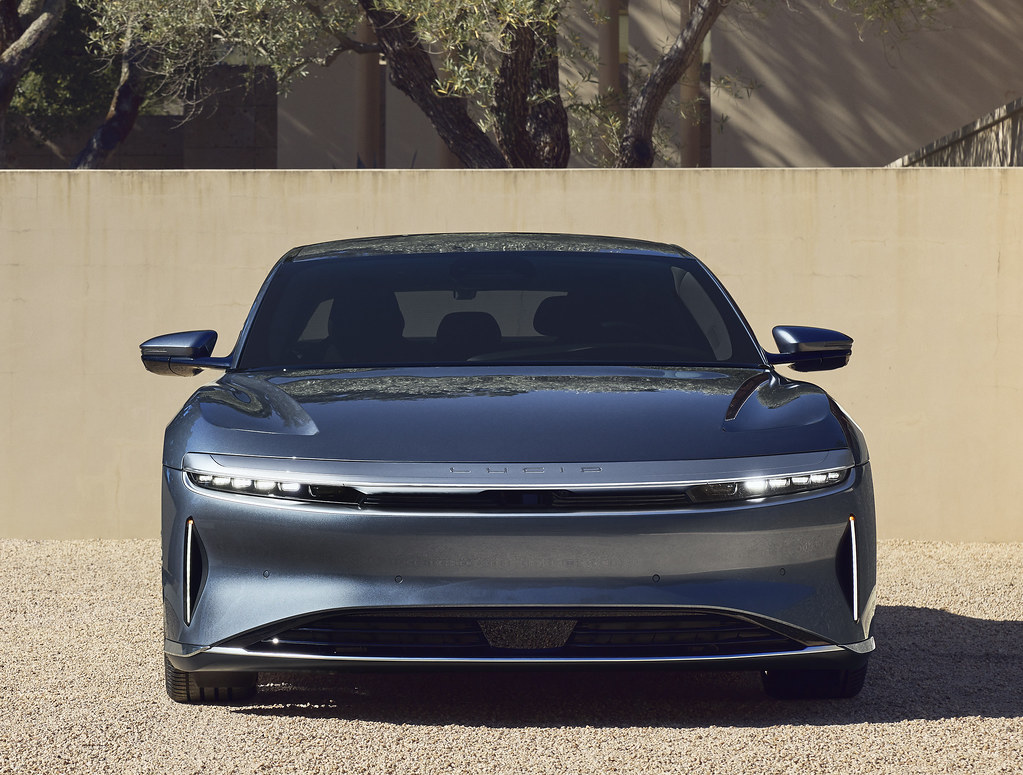

Lucid Group is making a bold move into autonomous vehicles with the unveiling of Lunar, a sleek two-seat robotaxi concept that positions the company as a direct competitor to Tesla’s Cybercab. The electric vehicle maker announced during its investor day that Lunar will be built on its upcoming midsize platform and is designed to maximize efficiency and lifetime operating economics for autonomous ride-hailing services.
The announcement comes as Lucid revealed it’s finalizing an agreement with Uber to deploy vehicles from its midsize platform at scale, similar to its existing Gravity robotaxi program. This partnership could give Lucid a significant foothold in the rapidly growing autonomous mobility market while helping the company accelerate its path to profitability.
Beyond the robotaxi concept, Lucid is betting big on its new midsize platform to expand into higher-volume segments with vehicles starting below $50,000. The strategy combines accessible pricing with the company’s signature efficiency and performance, potentially reshaping how consumers and fleet operators view premium electric vehicles in an increasingly competitive market.
Lucid’s Robotaxi Concept: Lunar and the Autonomy Revolution
Lucid Motors revealed its Lunar robotaxi concept at an investor day event in New York City on Thursday, marking the company’s ambitious push into autonomous ride-hailing. The two-seat vehicle eliminates traditional driving controls and builds on partnerships with Uber to enter the robotaxi market.
Overview of the Two-Seat Lunar Robotaxi
The Lunar robotaxi features no steering wheel or pedals and accommodates just two passengers in a minimalist cabin centered around a large display. Lucid Group designed the vehicle on the same underlying platform being developed for its upcoming mid-size series, which includes the Lucid Cosmos and Lucid Earth models.
Interim CEO Marc Winterhoff initially stated the company was “working on” Lunar. However, Lucid Motors later clarified to TechCrunch that no active development is happening on the dedicated robotaxi yet. The purpose-built robotaxi concept would debut after the mid-size vehicles launch, with the first mid-size model expected by the end of this year starting around $50,000.
Autonomous Ride-Hailing and Uber Partnership
Lucid Motors announced it’s near an agreement with Uber to collaborate on a robotaxi based on one of the mid-size vehicles in the pipeline. The company is currently working with autonomous vehicle company Nuro to make an autonomous version of the Gravity SUV, which will launch on Uber’s network by the end of 2026 in the San Francisco area.
The announcements demonstrate Lucid’s increasing focus on building a business around autonomous and commercial applications to supplement electric vehicle sales. During the presentation, the company displayed a bar chart showing robotaxi partnership revenue expected to greatly eclipse money from licensing its EV tech, though the chart lacked a Y-axis label.
Robotaxi Platform Technologies and Safety Features
Lucid revealed plans to offer monthly subscriptions for its DreamDrive Pro starting in the first half of 2027. The pricing structure ranges from $69 to $199 per month depending on capability levels:
- $69/month: Lowest driver assistance level
- $199/month: Self-driving capability not requiring driver takeover
Lucid Motors acknowledged it hasn’t yet developed the more advanced capability, nor has any other automaker. The company also demonstrated an in-cabin AI assistant capable of handling tasks from adjusting air conditioning to finding locations with specific characteristics, though the live demo failed and required a pre-recorded video instead.
Transforming the EV Market: Lucid’s Midsize Platform and Commercial Strategy
Lucid Group is betting on a new midsize platform to expand its market reach with SUVs priced under $50,000, while introducing software subscriptions and a purpose-built robotaxi concept that could reshape how the company generates revenue beyond vehicle sales.
Advancements in the Midsize Platform and Model Expansion
Lucid named its first two midsize SUVs Cosmos and Earth, both starting below $50,000. The Cosmos focuses on efficiency, interior space, and performance, while the Earth targets buyers with a more adventurous profile. A third consumer model based on the platform will follow, though details remain under wraps.
The platform represents a significant departure from Lucid’s current luxury-focused lineup. Derek Jenkins, Senior Vice President of Design and Brand at Lucid, explained that the company didn’t compromise what makes a Lucid special but instead engineered it to scale. The vehicles deliver recognizable Lucid design and driving characteristics while embracing a simpler, more efficient approach to manufacturing and cost.
At the core sits Atlas, Lucid’s new electric drive unit designed for lower cost and improved efficiency. The drive unit uses identical front and rear housings and mounts, improving manufacturing scale while reducing cost and weight. This standardization could help LCID compete more effectively in higher-volume premium segments.
Autonomy, Subscriptions, and Software Monetization
The electric vehicle maker outlined plans to monetize software and services as it scales production. The company previewed an in-vehicle AI assistant and its autonomy roadmap at investor day, signaling a shift toward recurring revenue streams beyond vehicle sales.
Lucid highlighted advanced discussions with Uber to finalize a deployment agreement for midsize platform vehicles. The intended scale matches the existing Gravity robotaxi program, with plans to expand over time. Dara Khosrowshahi, CEO at Uber, called Lucid a key strategic partner as the ride-hailing company continues deploying autonomous vehicles globally.
The partnership could provide a steady revenue stream from fleet sales and potentially software licensing. Interim CEO Marc Winterhoff framed the strategy as maintaining Lucid’s technology identity while adding financial discipline. The company identified diversified revenue from software, services, platform licensing, robotaxi partnerships, and autonomy as a key lever for its profitability transition.
Cost Efficiency, Smaller Batteries, and Market Impact
Emad Dlala, Senior Vice President of Engineering and Software at Lucid, noted that efficiency leadership directly translates into cost leadership with the midsize platform. Smaller batteries, fewer parts, and tighter integration mean lower cost, better performance, and a superior customer experience simultaneously.
Battery packs represent roughly 30–40% of EV cost. Lucid’s efficiency advantage allows the company to deliver competitive range with smaller battery packs, reducing material expense. This approach could give the company an edge as raw material costs fluctuate and competition intensifies in the midsize EV market.
Taoufiq Boussaid, CFO at Lucid, said the midsize platform fundamentally improves unit economics in the mid-term. Near-term progress comes from scaling Gravity SUV production, disciplined capital deployment, and diversified revenue streams that accelerate the path to sustainable profitability and positive free cash flow. The company expects the platform to increase addressable market size and improve fixed-cost absorption as production volumes rise.
More from Steel Horse Rides: