

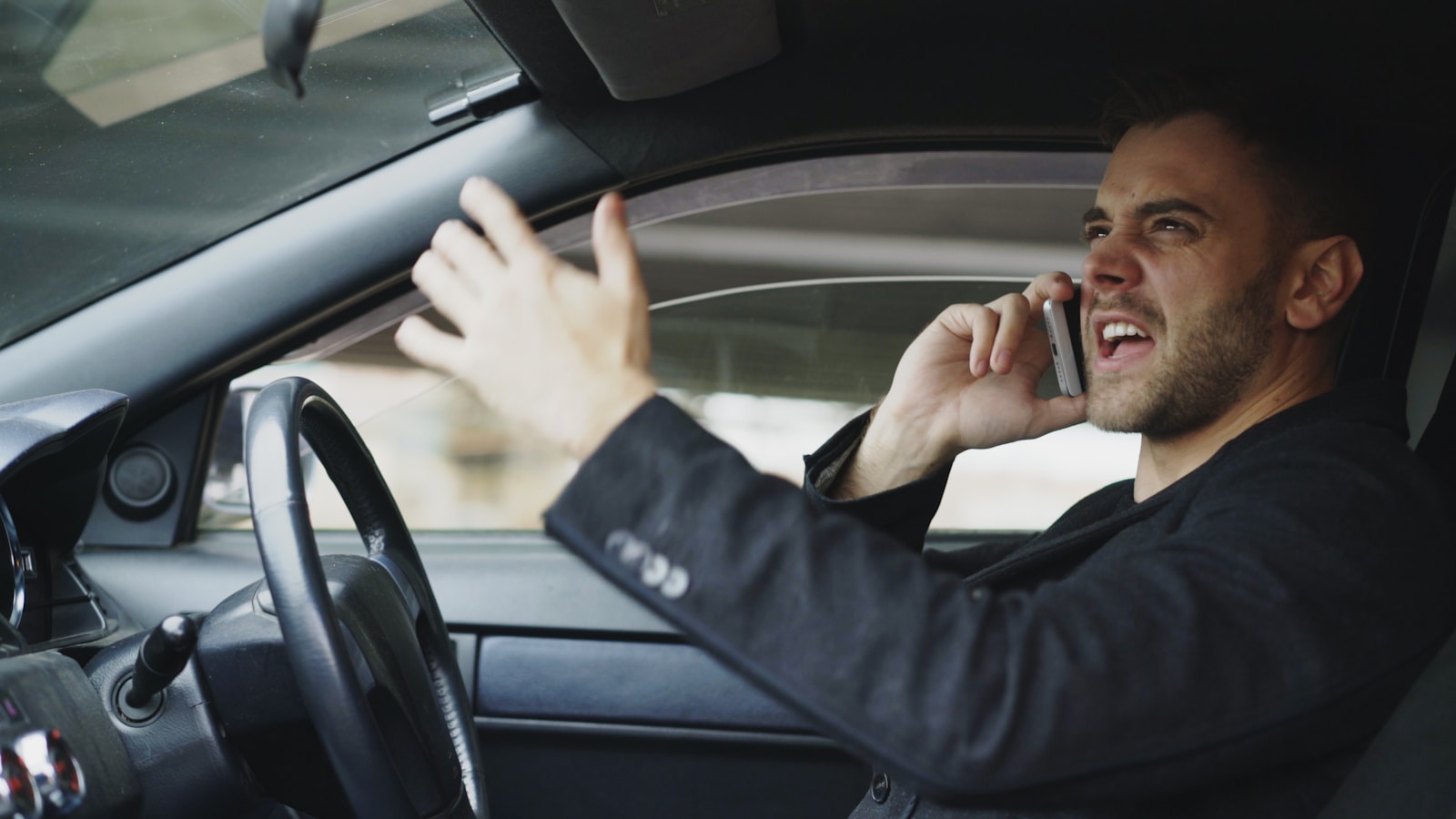
He’d been driving on autopilot the way you do when you’ve got a kid in the back seat and a list of errands buzzing in your head. Nothing reckless, nothing “I’m late for a meeting” frantic—just the usual lane changes and speed-matching that keep traffic moving. His kid was strapped in behind him with a half-open snack bag, humming to something on a tablet, totally unaware of the adult nonsense happening up front.
The first sign that the day was about to get weird was a car that seemed to take every normal driving decision personally. The driver behind him crept up close, then drifted left like he wanted to pass, then didn’t. When the dad checked his mirrors, he caught a glimpse of a face stretched tight in that particular way—jaw clenched, eyes fixed—like the other guy wasn’t just trying to get somewhere, he was trying to win.
And the thing is, the dad couldn’t even tell you what he did to “start it.” Maybe he merged a little sooner than the guy liked. Maybe he didn’t gun it the second the light turned green. Whatever the trigger was, it got lodged in the other driver’s brain like a splinter, and by the time the dad took the exit he needed, the splinter had turned into a full-blown mission.
The tiny moment that flips someone’s switch
It started with tailgating so close it felt like the other car was breathing into his trunk. The dad tried that instinctive de-escalation move most people do: he eased off the gas a hair, let the guy go around if he wanted, gave him space to “win.” Instead, the other driver matched him, staying glued to the back bumper, swerving left and right like he was looking for an opening that didn’t exist.
Then came the horn—long, angry blasts that weren’t about safety so much as dominance. The dad lifted a hand, not flipping anyone off, just that “what are you doing?” gesture people make when they’re trying to keep it from becoming a thing. It didn’t help. If anything, it looked like the exact cue the other guy needed to justify going from irritated to outright hostile.
Inside the car, the kid noticed the sound and asked what the noise was. The dad did that careful-parent voice, the one that tries to keep everything calm and normal even when your stomach is starting to tighten. “Just someone being impatient,” he said, eyes still scanning mirrors, already thinking: don’t lead this person home.
The exit that was supposed to end it
When the dad signaled for his exit, he expected the problem to solve itself the way these things usually do. You take your ramp, the angry stranger blasts forward, and your heart rate slowly drops back to normal while you feel ridiculous for being rattled. He even had that brief relief as he curved off the highway, like the scene was closing and the credits could roll.
Except the other car followed him down the ramp like it was attached by a rope. Not just “also taking the exit,” either—close enough that the dad could see the front grille filling his rearview mirror, close enough that the kid’s tablet glow reflected in the dad’s shaking hand on the wheel. The dad glanced at the speed limit sign and forced himself not to speed up, because he could already feel how this kind of person wanted him to react.
At the bottom of the ramp, traffic slowed for a light. That’s when the dad realized how cornered he was. He was boxed in by normal commuters doing normal commuter things, and right behind him was a guy acting like the exit ramp was a private arena.
Blocked in like it was planned
The light changed, cars started rolling, and the dad tried to keep moving. He stayed in his lane, left enough room, didn’t brake-check, didn’t gesture—nothing that could be interpreted as “challenge accepted.” For about ten seconds it almost worked, until the other driver made his move.
He shot around the dad’s car in a sloppy half-pass, cutting in front so hard the dad had to tap the brakes. Then the guy stopped. Not a gentle stop either—an abrupt, deliberate park-job in the middle of the lane, angled just enough that the dad couldn’t slip around. For a split second, the dad just stared at the back of the guy’s car like his brain didn’t want to accept what he was seeing.
His kid’s voice piped up from the back seat, more confused than scared: “Dad, why aren’t we going?” The dad swallowed and said, “Hold on, buddy,” because what else do you say when a stranger has decided your car is now his stage.
The other driver got out fast, door flinging open, one of those people who moves like a thought already turned into action. He didn’t even look at the traffic piling up behind him. He marched back toward the dad’s driver-side window with his shoulders high and his hands already doing that aggressive open-close motion like he was revving himself up.
The window punches and the kid in the back seat
The dad’s first reflex was to lock the doors, even though they were probably already locked. His second reflex was to keep the car in drive, foot hovering between brake and gas, trying to calculate whether he could hop the curb or squeeze around without hitting someone. His kid had gone quiet—the kind of quiet that means they’ve picked up on fear even if they don’t understand the details.
The guy reached the window and started yelling. The dad couldn’t make out every word through the glass, but the vibe was clear: accusations, demands, “you think you can—” and “say it to my face.” Spittle hit the window, and the guy’s eyes looked too bright, too focused, like he was enjoying the escalation.
Then he started punching the window with the flat of his fist. Not one hit, not a “knock-knock” intimidation thing—repeated blows that made the glass flex and the whole door shudder. Each punch landed like a drumbeat, and the dad could hear his kid’s breathing change behind him, small and tight, like the kid was trying not to cry.
The dad kept his voice low, talking to his kid more than to the guy. “Look at me, hey, you’re okay,” he said, while his eyes flicked between the man’s fists and the side mirror and the sliver of space ahead. He didn’t roll the window down. He didn’t argue. He just tried to be a wall, even though it felt like his body wanted to do the opposite and explode.
Traffic behind them was honking now too, a chaotic chorus that didn’t help. Someone laid on their horn like they thought noise alone could fix it. Another driver yelled something out their window, but it was the kind of useless, distant shouting that doesn’t actually interrupt a person who’s already committed to being the worst version of themselves.
The dad pulled out his phone with one hand, the movement awkward and slow, and held it up like he might be recording or calling. The guy noticed and got even more animated, leaning in, pointing at the phone, punching again. The dad’s hand shook so badly he could barely tap the screen, and for a second he hated himself for not being calmer, as if calmness is a choice when someone’s knuckles are thudding against your car door.
When it finally breaks apart, it doesn’t feel over
What ended it wasn’t a dramatic hero moment. It was a messy combination of time, noise, and the guy’s own short attention span. A car behind them started inching forward like it was going to nudge the guy’s bumper, and somewhere off to the side another driver laid on the horn in a steady, relentless blast that made the whole scene feel exposed.
The road rage guy threw his hands up like he was the wronged party, yelled one more string of words the dad couldn’t fully hear, then stormed back to his car. He peeled out forward, jerky and impatient, fishtailing slightly as he merged back into moving traffic. The dad didn’t follow at a normal pace; he waited a beat, then took the next turn he could, not toward home, just away, making decisions based on distance and visibility rather than directions.
In the minutes after, the dad’s kid asked if the man was going to come back. The dad said no, but he didn’t believe himself enough to sound convincing. He kept checking mirrors at every stop sign, every light, scanning for that same car, that same angry face, the idea that a stranger could decide—over nothing—that your family was worth terrorizing.
Later, once the kid had settled back into the comfort of cartoons and snacks, the dad replayed the whole thing in his head like a loop he couldn’t turn off. The worst part wasn’t even the punches; it was how quickly the situation flipped from ordinary to dangerous, how little control he actually had once the other guy decided to escalate. And even after the road rage psycho disappeared into traffic, the dad was stuck with the lingering question that doesn’t have a satisfying answer: if it happened that easily once, what stops it from happening again the next time a stranger decides they’re the main character and everyone else is just in their way?