


She was doing that ordinary, half-bored kind of driving that happens when you’re running errands and thinking about dinner at the same time. Mid-afternoon traffic, nothing heroic. The only thing on her mind was making the light before it changed and not getting stuck behind the bus that had been stopping at every other corner.
Then a guy in a pickup decided her existence was a personal insult. It started small—one of those petty, pointless moves people do when they want to “win” a lane merge—until it turned into the kind of scene that makes you lock your doors without even realizing you’re doing it. By the end of it, she says he was spitting on her window, kicking her car, and walking away with a felony charge like it was a party favor.
The weirdest part is how quickly it flipped from mundane to scary. One minute she’s just trying to get across town. The next minute she’s staring at a red-faced stranger who’s acting like her compact car is the enemy and her rolled-up windows are an invitation to perform for an audience that isn’t there.
The Merge That Turned Into a Grudge
The driver—let’s call her Maya, because the story reads like someone who’s learned to keep details vague for safety—was in a standard two-lane situation where one lane thins out, forcing everyone into a single line. She did what most people do: signaled, checked her mirror, eased in with enough space that nobody had to slam on their brakes. She wasn’t cutting anyone off, just taking her turn in the zipper that everyone pretends they understand.
That’s when the pickup behind her decided to rewrite the rules of physics. The man surged forward as if closing the gap was a moral duty, riding her bumper so close she could see his mouth moving in her rearview mirror. She could also see his hands, the exaggerated gestures, the theatrical head shake like he was auditioning for “Most Offended Man in Traffic.”
At first, she tried the usual non-response. Eyes forward, keep your speed steady, don’t feed it. But he didn’t want to be ignored; he wanted a reaction, the kind that turns a stupid moment into an actual conflict he can justify in his own head.
The Slow Boil: Horns, Gestures, and the Follow
Once they were through the merge, Maya expected it to fade. People rage, they pass, they peel off at the next turn, and you exhale like you’ve escaped an invisible net. Instead, the pickup stayed glued to her like he’d decided she was his project for the day.
He flashed his brights even though it was broad daylight. He leaned on the horn at times that made no sense—when she was already moving with traffic, when there was a car in front of her, when the speed limit was the speed limit. Every time she checked her mirror, there he was, making sure she knew he was still mad.
At a stoplight, he pulled up beside her in the next lane, window down, and started yelling across the gap. She couldn’t hear the whole thing, but she caught enough to know the theme: “You people,” “learn to drive,” and a few words that don’t belong in polite company. She kept her eyes forward and her hands visible on the wheel, the way you do when you don’t want to give someone even a millimeter of excuse.
That’s when he did the first move that made it feel less like road rage and more like a threat. He angled his truck slightly toward her lane, creeping into her space at the red light, like he wanted her to flinch. She didn’t. Her doors were locked, windows up, and she started mentally mapping the quickest route to somewhere public.
The Parking Lot Turn: When It Stops Being “Traffic”
Maya’s next stop was a small shopping plaza, the kind with a pharmacy, a coffee place, maybe a dry cleaner. She turned in, hoping that would be the end of it—because surely nobody follows a stranger into a parking lot over a merge, right? The pickup turned in behind her like it was the most natural thing in the world.
That moment is where the story gets cold. On a road, you can pretend there are rules and witnesses and lanes that keep you separate. In a parking lot, it’s just two vehicles and whatever version of reality the angriest person wants to create.
She didn’t park immediately. She drove slowly past the storefronts, eyes scanning for people, cameras, anything. The pickup stayed close, and when she finally pulled into a spot near the entrance of a busy store, he stopped behind her at an angle that made it feel intentional—like he was trying to block her in without fully committing to it.
She sat there with her car running, phone in hand, debating whether calling police would inflame him or save her. She says she didn’t have time to decide because he was already out of his truck and walking toward her driver-side window with that stiff, purposeful stride that’s never a good sign.
Spit on Glass and a Boot to the Door
He didn’t start with conversation. He started with presence—standing too close, leaning toward her window, trying to make her feel trapped inside her own car. Maya kept the window up, which turned his words into muffled shapes and spit into a visible spray of indignation on the glass.
And yes, she says he actually spit on her window. Not a stray angry droplet, but a deliberate, aimed spit that slid down the glass in a way that made her stomach turn. It wasn’t just gross; it was intimate in the worst way, like he was trying to mark her space.
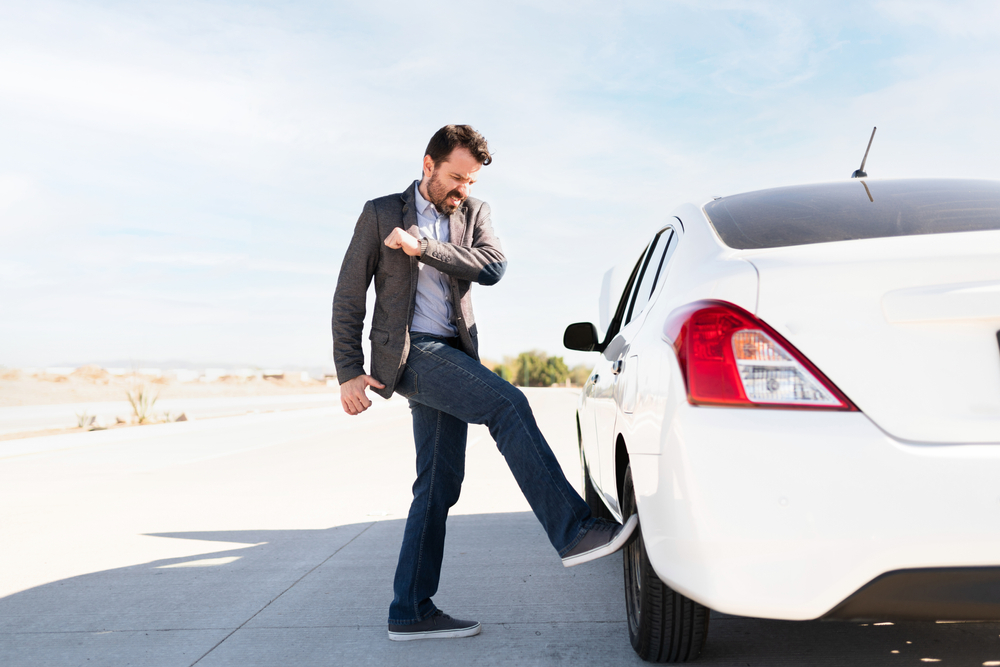
Then he kicked the side of her car. The sound is apparently what snapped her out of the frozen, disbelieving trance—metal thudding under a shoe, her door shuddering, the whole car rocking slightly. It wasn’t enough to crumple the panel, but it didn’t need to; it was a physical declaration that he was willing to escalate.
People nearby looked over, but that weird bystander hesitation kicked in. A few slowed their steps. No one rushed in. Maya says she hit record on her phone, not because she thought it would make him stop, but because she wanted proof in case he did something worse.
He kept shouting, pointing at her like she’d committed a felony by existing in “his” lane earlier. The more she didn’t respond, the more he seemed to work himself up, pacing, stepping in and out of her line of sight, like he couldn’t decide whether he wanted to punish her or perform for the invisible jury in his head.
How It Turned Into a Felony
This is where the story gets messy, because real-life consequences don’t always arrive in clean, satisfying beats. Maya didn’t jump out and fight him. She didn’t roll down the window to argue. She stayed in her car, doors locked, and did the most frustrating thing you can do to someone who wants a reaction: she treated him like a problem to document, not a person to engage.
Somewhere in the chaos—between the spit, the kick, the yelling, and him hovering around her car like he owned the space—someone finally called it in. Maybe it was a store employee who saw enough to recognize it wasn’t just “a couple arguing.” Maybe it was a shopper who realized she wasn’t getting out because she couldn’t. However it happened, the sound of sirens eventually threaded through the parking lot.
When police arrived, the pickup guy’s energy shifted fast. Maya described it like watching a balloon deflate while still trying to look tough. He backed away from her car, started talking with his hands, trying to explain himself before anyone asked, the classic move of someone who knows they’ve gone too far but still wants control of the narrative.
The felony part, according to her account, wasn’t some dramatic movie charge like “attempted murder.” It was tied to the physical escalation—damage to the vehicle, aggressive contact, and the way he trapped and confronted her in a confined space. Depending on the jurisdiction, spitting can also push things into assault territory, especially when it’s intentional and targeted. The point is: he didn’t just get a lecture and a “move along.” He got cuffed.
Maya’s takeaway wasn’t triumph. It was that jittery, delayed reaction that hits after the danger passes—the realization that she’d been cornered over something as stupid as merging. Her car still had the smear of spit on the window and the scuff where his shoe connected, and she was left wondering how many other days he’d done some version of this and gotten away with it, and whether the felony would actually stick or just be another story he tells himself where he was the victim and everyone else was the problem.
More from Steel Horse Rides: