


She brought the car in for something boring. A warning light, a weird noise, the kind of appointment that’s mostly fluorescent lighting and stale coffee, then you’re back to your regular life. The dealership had her keys, her mileage, her phone number, and that quiet little assumption everybody makes: your car goes from the service drive to a bay and back, not on a joyride.
It was late afternoon when she did the drop-off, the usual clipboard routine with a service writer who had that “I’ve said this speech 400 times today” cadence. He typed, nodded, and slid the paper across the counter like a receipt at a fast-food place. She left with a shuttle ride and the expectation that, at worst, she’d be annoyed about the price.
The next day, when she came to pick it up, she was annoyed about something else entirely. Before she even got out of the driver’s seat at home, she glanced at the odometer out of habit—because she always did, because she tracked maintenance, because it was her car and she liked knowing what was going on. The number looked wrong in that immediate, stomach-dropping way, like spotting a new dent under a streetlight.
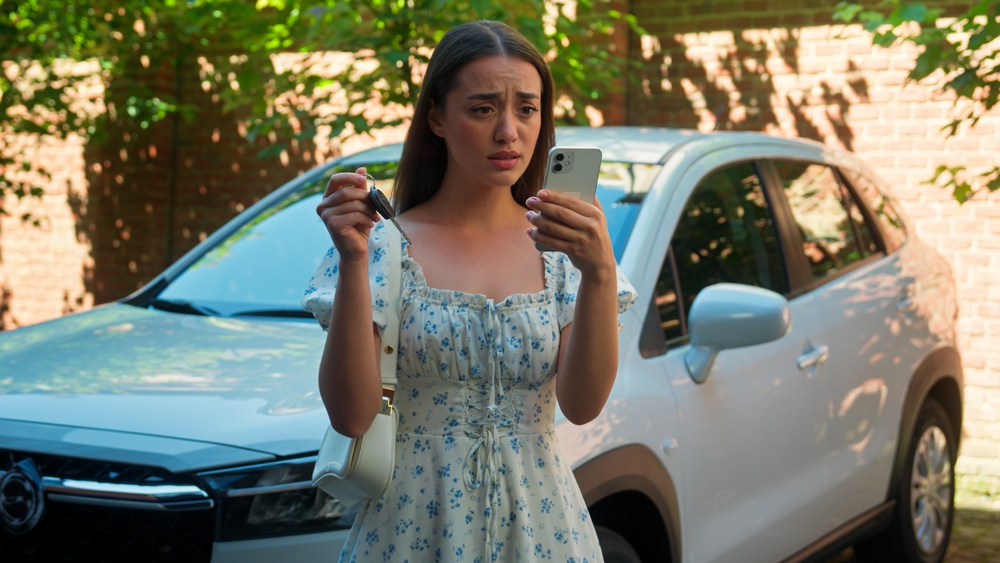
The number that didn’t make sense
It wasn’t a mile or two. It wasn’t “they test drove it around the block.” It was around ninety miles, the kind of distance that implies highways and time and someone settling in with the radio like it’s their commute.
Her first impulse was to do mental math. Had she misremembered the drop-off mileage? Was she mixing it up with a different car? She pulled out her paperwork, because dealerships usually write the mileage right there at check-in like it’s a sacred number. The sheet matched her memory, and the odometer still didn’t.
So she did what most people do when reality starts acting slippery: she called the dealership and tried to keep her voice neutral. Not accusatory, just careful. “Hey, quick question—why is my car showing ninety extra miles since yesterday?”
The person on the phone didn’t have an answer, which was the first little spark of tension. They said test drive. They said sometimes technicians have to verify issues. They said it in that breezy way people do when they’re trying to close a conversation fast. She pointed out that ninety miles isn’t verifying; it’s a road trip.
“It was probably just diagnostics”
The next step was her showing up in person, because phone explanations have a way of evaporating. At the service counter, she got the same general vibe: a polite wall. The service writer—same guy as before—kept his face arranged in professional calm, like this was a misunderstanding about tire pressure.
He repeated the usual line about “extended test drives,” like that would make the number shrink. She asked where the test drive route was that conveniently added up to ninety miles. She asked why no one told her. She asked, flat out, who drove it.
He didn’t answer that last one. He did the thing where he looked at the computer screen longer than necessary, scrolling like the answer might appear if he stared hard enough. Then he said he’d “check with the technician,” which in dealership language can mean anything from “I’ll ask right now” to “please leave so I can regroup.”
She waited in the seating area and watched the staff move around like nothing was happening. It’s a weird feeling, sitting under a TV playing daytime news while you’re trying not to spiral about who’s been in your car. She kept thinking about the little stuff inside it—charging cables, sunglasses, receipts, the fact that her life was basically stored in the center console.
The story starts to shift
When the service writer came back, the explanation had changed shape. Now it wasn’t “probably diagnostics.” Now it was “we had to verify the repair,” and then, more vaguely, “there may have been an issue with parts availability.” He sounded like someone assembling a story out of leftover pieces.
She asked again, slower this time, who drove it. The service writer’s tone tightened, that tiny shift from customer-service sweetness to irritation. He said he’d speak with the service manager.
The manager arrived with the posture of a person who’s had to smooth things over before. He apologized in a general way—sorry for the confusion, sorry for the inconvenience—without actually acknowledging what happened. She had to pin him down with specifics, like a prosecutor who won’t accept vibes as evidence.
That’s when the manager finally admitted something real: the car had been taken off-site. Not for a specialized diagnostic facility, not for an emissions test, not for anything that sounded normal. Off-site as in somebody drove it away from the dealership after hours.
“Taken home” is the part that hits wrong
Once the words were out, the story got uglier fast. The service writer—who’d been the friendly face at check-in—had taken the car home for the night. Not a technician on an official test route, not a transport driver moving it between locations. The guy who wrote the estimate had driven her car to his house, put those miles on it, and brought it back.
Even in the best possible framing, it felt invasive. People don’t just borrow someone’s car because it’s convenient, especially not a customer’s car that’s been entrusted to the shop. And ninety miles isn’t a quick detour; it’s dinner plans, errands, maybe a commute, maybe a whole evening of the car being someone else’s temporary life.
She asked the obvious question: why. The answers came out half-formed—something about needing to “cycle” the car, something about “recreating the issue,” something about the writer living near a route that would help. Nothing that sounded like a policy, more like a justification you invent once you’re caught.
The worst part was how long it took them to say it. It wasn’t offered up front; it was dragged out after she pushed and pushed. That delay made it feel less like a mistake and more like a decision: they were hoping she wouldn’t notice or wouldn’t fight.
The fight over accountability
She didn’t just want an apology. She wanted to know whether her insurance had been at risk, whether the dealership’s insurance covered it, whether any cameras showed the car leaving, whether anyone authorized the writer to take it. The manager’s responses stayed carefully noncommittal, like he was trying to keep the dealership’s exposure small.
They offered the typical make-good stuff first: a discount, a free oil change, a “we’ll take care of you next time.” It landed badly, because it treated the situation like a pricing dispute instead of a trust breach. She kept coming back to the same point: the problem wasn’t the mileage; it was the permission.
At some point, the manager shifted into damage control mode. He said it “shouldn’t have happened,” which is corporate-speak for “yes, it happened,” and mentioned they’d “address it internally.” The service writer, meanwhile, was suddenly nowhere to be seen, which only made the whole thing feel more deliberate.
She asked for something in writing. Not a vague apology, but an acknowledgment of what happened and who drove the car. The manager hesitated, because paper trails are forever, and dealerships aren’t in the business of creating evidence against themselves. The longer he stalled, the more it confirmed that this wasn’t just a rogue moment—it was a mess they didn’t want documented.
By the time she left, she had her keys back but not the feeling that she’d gotten the truth in full. She’d gotten the version they were willing to admit once they realized she wasn’t going away. And now she had this new, paranoid awareness that her car had spent a night somewhere she didn’t choose, parked in a stranger’s driveway, used for reasons she’d never be able to verify.
What stuck wasn’t the ninety miles as a number—it was what those miles represented. A dealership asking customers to hand over trust like it’s part of the service package, then treating that trust like a spare key on a hook. And even after the admission, the situation still dangled in that uncomfortable space where you know something happened, but you can’t tell whether you’ve heard the whole story—or just the smallest piece they could confess without lighting themselves on fire.
More from Steel Horse Rides: