

She thought she was doing the wholesome parent thing: find a cheap first car, teach her teenage son how to be responsible, and give him a little freedom without taking out a loan. The listing looked perfect in that very specific “Facebook Marketplace miracle” way—older sedan, decent paint, “runs and drives,” a price low enough to feel like a win but not so low it screamed disaster.
The seller was a guy who typed like he was always in a hurry. One-word answers, lots of “yep,” and that classic reassurance everyone has heard at least once: “It’s solid.” He met them in a grocery store parking lot, popped the hood like it was a formality, and talked over every question with the same calm confidence, like the car’s flaws were imaginary if you didn’t name them out loud.
Her son was buzzing in that way teenagers get when they’re trying to act cool about something they desperately want. He did the test drive with her in the passenger seat, hands tight on the wheel, eyes doing that constant dart between mirrors and speedometer. It felt fine—no weird shaking, no warning lights glaring, nothing obvious screaming “don’t.” So they paid, signed whatever scrap of paper passed for a bill of sale, and watched the seller drive off like he’d just unloaded a lawn mower.
The drive home started normal, then got weird fast
They didn’t even make it far enough to relax. The plan was simple: drive it home, park it, and spend the evening celebrating the new “first car” reality. Her son had already started talking about what he’d clean first, what he’d change on the stereo, and whether his friends would fit in the back.
Then came the smell. At first it was faint, like hot plastic or an overworked space heater, and she told herself it was just “old car smell” mixed with nerves. Her son cracked a window and laughed it off, but he kept sniffing like he didn’t trust his own nose.
Within minutes it went from “maybe something’s warm” to that sharp, unmistakable burnt electrical odor. The kind that makes your brain start running through worst-case scenarios before you’ve even spotted anything. Her son asked if they should pull over, and she said yes immediately—because whatever pride she had about the purchase evaporated the second her stomach dropped.
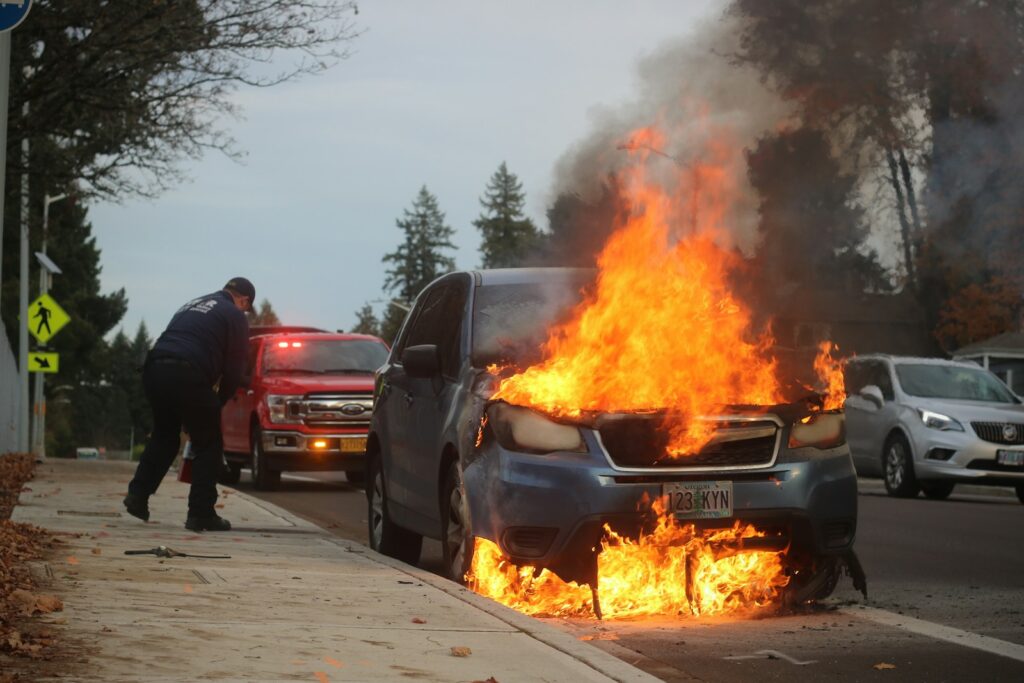
He eased onto the shoulder, hazards clicking, and they were barely stopped before thin smoke started curling out from the front edge of the hood. Not steam. Not “it’s just overheating.” Smoke.
On the shoulder, it turned into a real fire
They both got out fast, because suddenly the car wasn’t a symbol of independence—it was a thing that might explode. She told him to stand back while she fumbled for her phone, and he hovered near the passenger side, half-frozen and half ready to do something heroic without knowing what.
She popped the hood latch and immediately regretted it. The smoke thickened like it had been waiting for oxygen, and then there was a flash of orange—small at first, like a candle you didn’t mean to light. The flames caught around something low in the engine bay, and the sound changed from “car problem” to that crackly, hungry noise that makes you realize how fast metal and plastic can become a bonfire.
She called 911 with one hand while waving her son farther back with the other. He kept saying, “I literally just bought it,” over and over, like repeating it might reverse time. A passing driver slowed down and shouted something about a fire extinguisher, but nobody had one, and the only thing they could do was stand on the gravel shoulder and watch their “new” car start eating itself.
By the time the fire truck showed up, the front of the car looked like it had aged ten years in ten minutes. The firefighters handled it quickly, but “quickly” still means long enough for a teenager to watch his first big purchase dream melt into black smoke. When it was out, the hood was warped, the plastic was dripping, and the air smelled like the inside of a burned-out electronics store.
The seller’s first response was basically a shrug
Once everyone was safe and the immediate panic faded, she did what most people would do: she called the seller. Not to scream—at least not at first—but to say, “Hey, the car you sold us just caught fire.” There was a moment of silence on the line that felt like the seller deciding which version of reality he wanted to commit to.
His answer wasn’t “Are you okay?” or “That’s insane, I’m so sorry.” It was, “It was running great yesterday.” Like the flames were just an overreaction on their end, or like the car’s recent past was some kind of legal shield. The way he said it—flat and mildly annoyed—hit her harder than she expected.
She explained, slowly and clearly, that it didn’t matter how it ran yesterday because today it had turned into a roadside barbecue. She mentioned the firefighters, the smoke, the fact that her son was standing there shaking. The seller stayed locked in that same line: it was fine when he had it, he didn’t know what they did, maybe they “drove it wrong,” maybe something “got spilled.”
It didn’t take long before the conversation turned into that specific kind of circular arguing where every sentence ends with someone feeling more insulted than before. She asked for a refund, even partial. He said it was sold as-is, and that he wasn’t a dealership, and that cars “have issues sometimes.”
Details started feeling less like bad luck and more like a pattern
While waiting for a tow, she started replaying the whole meet-up in her head. The way the seller had been eager to keep things moving. The way he’d shrugged off questions about recent work. The way he’d insisted the check engine light “comes on sometimes but it’s nothing,” even though she hadn’t actually seen it during the test drive.
Her son remembered something too: the seller had told him not to “mess with the radio” because “the battery’s kinda touchy.” At the time it sounded like old-car quirks, the kind people joke about. Now, standing next to a charred front end, “touchy battery” landed differently.
She also realized they’d never really gotten to see a true cold start. The car was already warmed up when they arrived, idling like it was ready to go. She’d accepted that because most people don’t want strangers hanging around their driveway, but now that detail felt loud.
When she texted the seller photos—actual flames, firefighters, the blackened engine bay—he didn’t suddenly switch into remorse. He doubled down with the same vibe: “That’s crazy. It wasn’t like that here.” He tossed out a suggestion that maybe they’d hit something on the road, like a piece of debris had leapt up and caused a fire within fifteen minutes of purchase.
The messy part wasn’t just the car, it was the powerlessness
By the time they got home—without the car, with her son riding silently and staring out the window—the emotional shape of the day had changed. It wasn’t only about losing money. It was the humiliation of getting scammed (or feeling like you did), the fear that it could’ve gone worse, and the gut-punch of watching your kid learn a hard lesson in the most theatrical way possible.
Her son kept doing that teenage thing where they try to act like it’s fine while clearly not being fine. He said, “It’s whatever,” then asked how much it would cost to fix, then asked if the insurance would cover a car they’d owned for less than an hour, then went quiet again. She could see him trying to decide whether to be angry at the seller, angry at her, or angry at himself for being excited.
She looked back at the bill of sale and the messages, trying to figure out what mattered and what didn’t. As-is meant as-is, sure, but there’s a difference between “it needs brakes” and “it catches fire immediately.” The seller’s refusal to even pretend to care felt like its own kind of cruelty—like he wasn’t just dodging responsibility, he was erasing their experience by insisting his version was the only one that counted.
And that’s where the tension sat: not in a neat courtroom-fantasy way, but in the ugly gray zone where someone can sell you a disaster, shrug, and hide behind the casual rules of private sales. She still had the seller’s number, a set of photos that made her hands shake when she looked at them, and a teenager who’d learned that “running great yesterday” doesn’t mean a thing when you’re standing on the shoulder watching your first car burn.
More from Steel Horse Rides: