
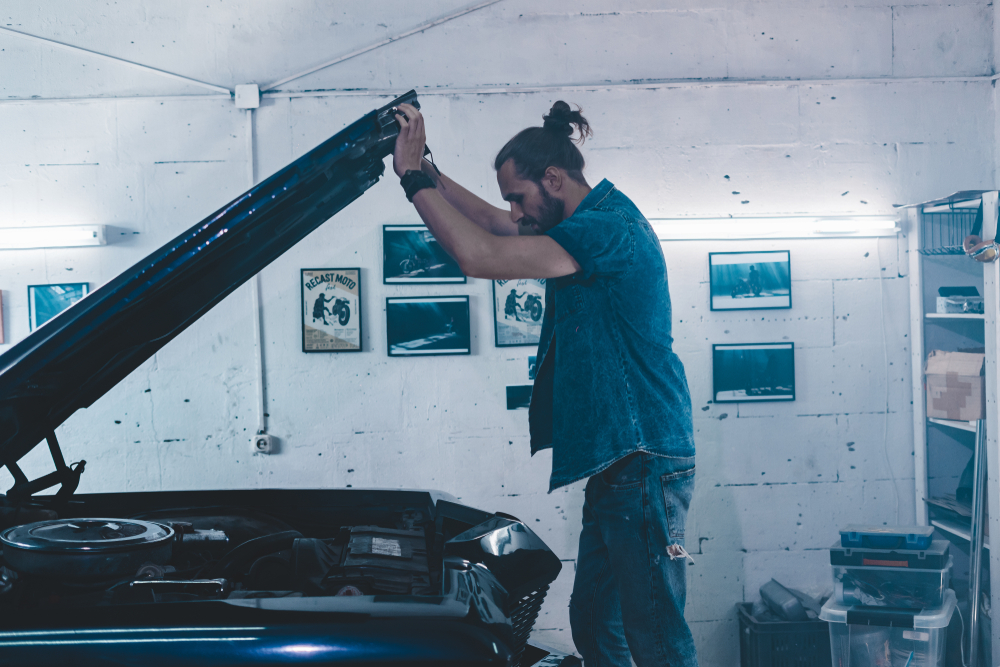

It started the way these things always start: with a link texted at 11:47 p.m. and the kind of excitement that makes an adult man type in all caps. Her husband had “found it,” he said—the project car he’d been talking about for years, the one he claimed would be “an investment” if they ever got lucky enough to stumble across the right example.
They weren’t car people as a couple. She tolerated the YouTube restoration videos playing in the background, the late-night forum scrolling, the constant “listen to this exhaust note” interruptions. But they were very much savings people—two incomes, a spreadsheet, a plan: emergency fund, pay down the last of the debt, maybe a bigger place in a year or two.
So when he came home a week later acting like he’d just adopted a rare animal, she assumed it was a lead he wanted to follow, not a purchase he’d already made. Then she saw the bank notification, the wire transfer, and the way he avoided eye contact like a teenager who’d dented the family car.
The “once-in-a-lifetime” find
He’d found the car through a friend-of-a-friend situation, the kind that always gets framed as insider access. The seller had a storage unit full of parts, a story about a stalled restoration, and a claim that the car was “one of a handful” in that year with that package. Her husband repeated the phrase “numbers-matching” like it was a religious concept.
What made her stomach drop wasn’t just the price—though it was basically their entire savings—but the speed. He told her he had to move fast because “there were other buyers,” because “these don’t sit,” because “if I waited, it’d be gone.” He didn’t ask; he announced, like the decision had already been approved by some invisible board.
He tried to soften it with practical noises. He’d sell a couple of his old hobby things, pick up extra shifts, flip some parts. He said the car would be worth more “even as a roller,” and that the parts haul alone was “worth a fortune.” She asked, in the calmest voice she could manage, why none of that required talking to his wife before draining their account.
Dragging home a dream on a trailer
Delivery day had the energy of a celebration that nobody agreed to. A flatbed rolled up with what was, objectively, a tired shell of a car—primer blotches, missing trim, a sad interior that smelled like old carpet and mouse droppings. Her husband stood in the driveway grinning, filming video, narrating plans for “phase one” like he was hosting a show.
The seller had sent along bins and boxes: labeled baggies, greasy wrapped items, random chrome pieces, and a few big-ticket-looking parts her husband handled like museum artifacts. He kept saying, “Look at this,” holding things up to the light, pointing out casting numbers and stampings he’d apparently memorized. She watched the neighbor’s curtain twitch and wondered how long they could pretend this was normal.
That night he spread everything out in the garage like a treasure map. He made a list on a whiteboard, drew arrows, and talked about sourcing the last missing pieces. She asked one question—just one—about paperwork: did he get the title, and is it clean?
The first crack: “Why does this part look… off?”
It wasn’t a mechanic who popped the bubble at first. It was his own impatience. He posted photos in a couple of enthusiast groups, looking for confirmation that he’d scored something special, and instead got back a bunch of cautious, nerdy questions.
People wanted close-ups of stampings, weld seams, tags, and rivets. Someone asked why the “factory” markings were too crisp. Someone else pointed out that a certain bracket style didn’t exist that year. Her husband started insisting the car had “rare mid-year changes,” but the replies kept coming, more detailed and less polite.
Then he took a couple of the “big” parts to a local specialty shop for a sanity check. He came home quieter than usual, carrying the items like they’d gained weight. He told her the shop said some of the stuff was reproduction—fine for a driver, not fine for a “rare” build—and at least two pieces were straight-up counterfeit, the kind that gets aged and stamped to look original.
His first move was anger, not panic. He paced the kitchen blaming the seller, blaming the “flippers,” blaming “this hobby” like it had betrayed him personally. She listened, arms crossed, watching him avoid the one obvious topic: how they were supposed to pay for life while he’d bought a pile of question marks.
The title problem turns into a full-on nightmare
He tried to reassure her that at least the car itself was real, and that the title was “in process.” That phrase turned into their new household alarm bell. When she asked to see the paperwork, he produced a manila envelope with a bill of sale, some photocopies, and a handwritten note from the seller about “lost title, easy to fix.”
She asked if the VIN on the dash matched the documents, and he said yes, probably, he thought, he’d checked. That was when she realized he hadn’t actually verified anything in the careful way he’d talked about online. He’d been seduced by the story and the clock ticking in his head.
They started calling the DMV, which is how they learned that “easy to fix” is code for “you’re about to waste weeks of your life on hold.” The car’s previous title history was muddy: an old lien that might’ve been released but not recorded properly, a state-to-state transfer that didn’t line up, and a gap where no one could explain why the chain of ownership looked broken. Somewhere in that mess was the possibility that the title wasn’t just missing—it might not be clean at all.
Her husband kept insisting it would be fine once they filed for a bonded title. Then the DMV rep told them they might not qualify if the VIN had any discrepancy or if there was an unresolved lien. “Worst case,” the woman said, “it becomes a parts car.” Her husband went pale in a way she’d never seen.
Fights in the garage, silence in the house
Their arguments weren’t cinematic. They were the kind that happen over dishwater and receipts, the kind where someone says, “I can’t believe you did this,” and the other person says, “I was trying to do something good for us.” He started staying in the garage late, not even always working—sometimes just sitting on an overturned bucket staring at the car like it might apologize.
She kept doing the math, because that’s what she did when she felt cornered. Rent, bills, groceries, the emergency fund now vaporized, and a new set of expenses blooming: storage fees if they couldn’t keep it where it was, legal help if the title problem escalated, and replacement parts if they wanted the car to be what he’d promised. Every plan they’d made together had to be revisited with a big red “CAR” written across it.
He started making frantic phone calls, trying to track the seller down for answers. The seller was suddenly hard to reach, then “out of town,” then insisting he’d sold it “as-is” and that the buyer should’ve done his due diligence. When her husband threatened small claims court, the seller got mean fast, implying the title situation was the buyer’s problem now.
In one of their worst fights, she told him she didn’t even care about the car anymore—she cared about the fact that he’d treated their shared money like his personal poker stack. He snapped back that she “never supports” anything that makes him happy, which landed like a slap because it turned the whole thing into a character trial instead of a concrete mess with paperwork and missing dollars.
By then, the car had become a third person in their marriage: a silent, expensive object that lived in their garage and kept score. Every time she walked past it, she saw the savings account balance. Every time he looked at it, he saw the version of himself who’d been certain he was making a bold, smart move.
They hadn’t resolved it when the dust settled, because the dust didn’t settle—it just shifted. The title still wasn’t sorted, the “rare” parts list was now a mix of questionable pieces and confirmed fakes, and the money was still gone. The hardest part wasn’t even the possibility that they’d been scammed; it was watching two people realize, in real time, that trust can be harder to rebuild than any project car.
More from Steel Horse Rides: