
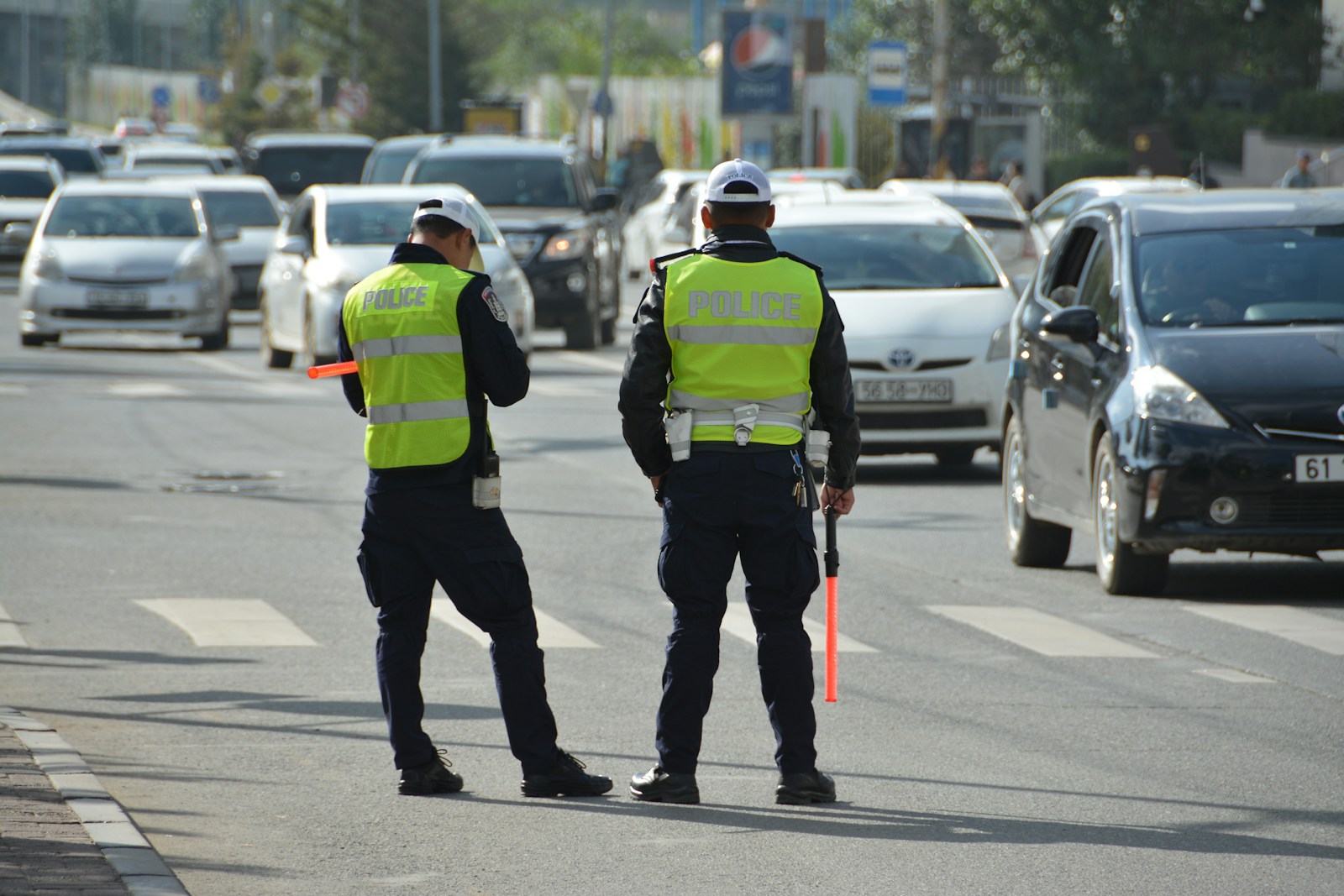

It started as one of those routine, nothing burger traffic stops that barely deserves a mention. A guy driving home in a clean, newer-looking coupe—glossy paint, tinted windows, rims that probably cost more than his first beater—gets lit up by a patrol car as he’s rolling through a stretch of road lined with strip malls and fast-food lights.
He pulls over like he’s done a hundred times. Hands visible, hazard lights on, wallet ready, the whole “please don’t make this weird” routine. The officer walks up slow, flashlight doing that little sweep across the interior, and instead of the usual “license and registration,” the first thing out of his mouth is basically: where’d you get this car?
The driver answers the obvious way—he bought it—and the officer doesn’t laugh, doesn’t nod, doesn’t move on. He just stares a second longer, like he’s waiting for the real story to come out. And that’s where the stop starts sliding from mildly annoying into something uglier: the cop isn’t treating it like a traffic stop anymore, he’s treating it like a contradiction that needs to be corrected.
The “too nice” comment lands like a slap
The driver is mid-explanation—yes, it’s financed, yes, he’s insured, yes, his name matches the registration—when the officer drops the line that ends up defining the whole encounter. The car is “too nice” to be legitimately his. Not “too loud,” not “too fast,” not “your tags are expired,” just… too nice.
It’s the kind of comment that’s hard to respond to without sounding defensive, because what are you supposed to say? “No, officer, I promise I’m allowed to have nice things”? The driver tries to keep his voice level, but you can practically hear the gears grinding as he realizes this isn’t about his speed or his lane change.
The cop asks what he does for work, where he works, how long he’s worked there, and whether he can “prove” it. The driver offers to show an employee badge and a pay stub on his phone, and that somehow makes it worse—like he’s trying too hard, like he’s rehearsed.
They stop talking about a traffic violation and start fishing
The officer circles the car, lingering near the trunk and the rear bumper, doing the slow, theatrical scan that says, “I’m looking for a reason.” He asks if there are drugs or weapons in the vehicle. The driver says no, of course not, and the officer comes back with the classic follow-up: “You mind if I take a look?”
Here’s where things get tense in a very specific, very human way. The driver knows that consenting is a bad idea, but refusing is also a bad idea, because refusals get treated like confessions. He chooses the only option that feels remotely safe: he politely declines and asks if he’s being detained or if he’s free to go.
That question flips the officer’s mood from suspicious to irritated. Suddenly the driver is “being difficult,” and the officer’s tone shifts into that clipped, performative patience that’s basically a threat wrapped in professionalism. He tells the driver to step out of the vehicle “for everyone’s safety,” and the driver does it because at this point he can feel the stop turning into a scene.
The curbside interrogation turns into a spectacle
Once he’s out of the car, the officer positions him in that awkward spot near the shoulder where passing drivers can see everything. Headlights sweep by, people slow down to look, and the driver is standing there with his hands slightly raised like he’s trying to show he’s not a problem. The officer keeps asking where the money came from, like the driver has to justify the existence of his own property.
Then a second patrol car shows up, which is the moment it stops feeling like a disagreement and starts feeling like an accusation. The second officer doesn’t introduce himself so much as join the posture—arms crossed, chin up, eyes scanning the driver like he’s inventory. The first officer repeats the “too nice” line, but now it’s said louder, like it’s evidence being presented to an audience.
The driver tries to keep his answers short and factual. He says he works, he saved, he traded in his old car, he has a loan. But the officers keep steering it back to the same implication: that the paperwork might be real, but the story behind it isn’t.
At one point, the first officer asks him—still out on the shoulder—whether the car is “actually” his or if he’s “holding it” for someone else. The question hangs there, absurd and humiliating, because it’s basically asking him to confess to a crime the officer can’t name. The driver looks past them and realizes there are people at a nearby gas station watching, phones out, pretending they aren’t.
Search pressure, paperwork games, and the slow squeeze
The officers don’t outright say “we’re going to search your car no matter what,” but they don’t have to. They start talking about calling in a K-9 unit, about how that might take “a while,” about how the driver can either cooperate or “sit here.” It’s not a direct threat, exactly—just a menu of inconveniences arranged to make one choice feel inevitable.
The driver stays firm about not consenting. That’s when the conversation starts getting petty: “Why are you so nervous?” “If you’ve got nothing to hide…” “You know this would go faster if…” The driver isn’t yelling, but his face is tight, and he keeps glancing at his own car like it’s being repossessed in real time.
They take his license back to the patrol car and let the minutes stretch. Every couple of minutes they come back with another question that doesn’t match any traffic stop script—who he lives with, where he was headed, why he’s in this part of town, whether he’s been arrested before. It’s less like they’re investigating a violation and more like they’re trying to talk him into contradicting himself.
Eventually one of them says something about the registration being “interesting,” like it’s a puzzle. The driver asks what that means, and the officer shrugs and says they’re “verifying” things. The whole time, the driver is standing there on display, feeling like the nicest thing he owns has turned into a billboard that says he doesn’t belong in it.
How it ends: no ticket, no apology, just the stain
After what feels like forever—long enough for the driver’s embarrassment to curdle into anger—they return his license and paperwork with a sudden, almost casual shift. No clear explanation for the stop, no citation that matches the time spent, no discovery that justifies the interrogation. The first officer says something like, “Just be careful,” in the same tone you’d use to end a conversation you never wanted to have.
The driver asks, as evenly as he can, what the actual reason was. The officer doesn’t answer directly; he just says they’re “out here doing their job” and gives him that look that says the conversation is over because the badge says it’s over. Then he adds one last comment about the car—something about it “drawing attention”—as if the humiliation is a natural consequence of owning something nice in public.
When the driver gets back in the seat, his hands are shaking, and it isn’t adrenaline in a cool, cinematic way. It’s the kind of shaking that comes from swallowing a dozen small insults while trying not to do anything that could be interpreted as a threat. He drives off carefully, not because he suddenly respects the law more, but because he can’t stand the idea of being pulled over again and having to perform innocence for a second round of strangers.
Later, he’s stuck on the same detail everyone gets stuck on when they hear it: they didn’t accuse him of speeding, or reckless driving, or anything you can point to on a statute. They accused him of not matching his own car. And the part that doesn’t leave him alone isn’t even the stop itself—it’s the way the officers seemed comfortable turning that assumption into a roadside spectacle, then walking away like it was nothing, leaving him to carry the “too nice to be yours” label home in the passenger seat.
More from Steel Horse Rides: