

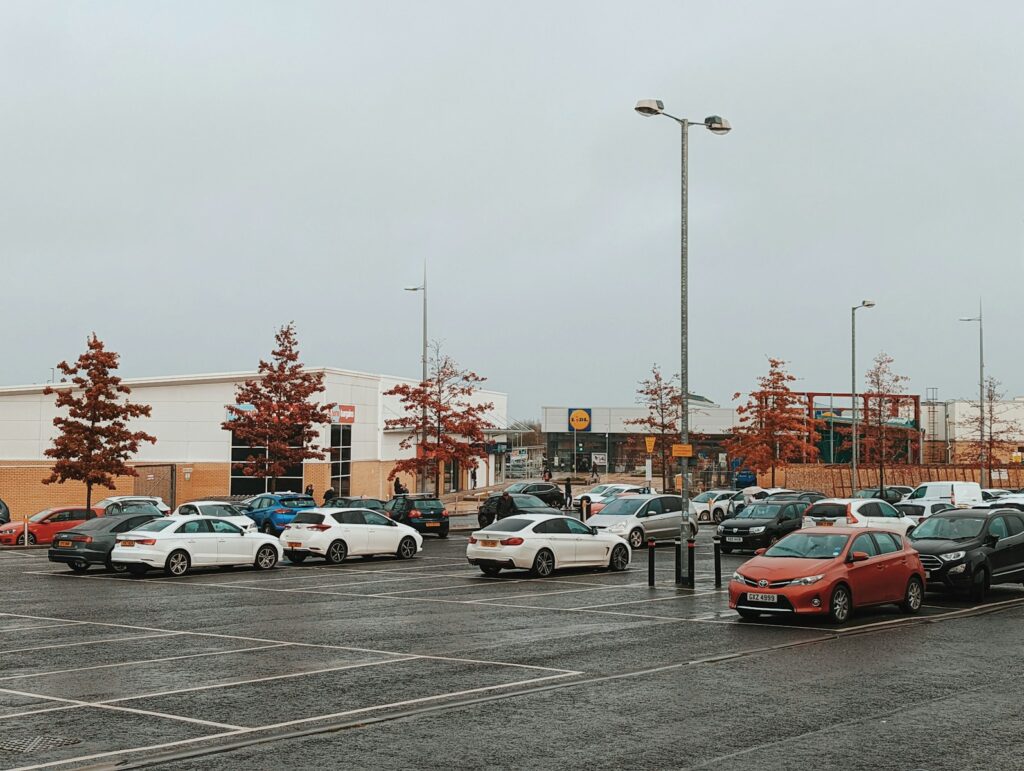
It started the way most parking lot drama starts: slow, awkward, and just loud enough that nearby people pretended not to notice. A driver had pulled into a crowded strip mall lot on a weekday afternoon, the kind of place where every spot feels like it’s already half-owned by somebody circling with their blinker on.
He’d barely gotten his door shut when a guy two rows over began waving like he was flagging down a helicopter. At first it looked like normal “hey, you almost hit me” hand-flapping. Then the guy’s face tightened, and he started pointing at his own car like it was a crime scene.
The driver hadn’t even realized anything had happened. There wasn’t a crunch, no jolt, no scraping sound—just the usual shuffling of cars and carts. But the guy had decided there’d been a scratch, and once that idea landed, he treated it like the entire parking lot had personally wronged him.
The “scratch” and the instant courtroom vibe
The guy marched up fast, phone already out, recording before he was close enough to be heard. He positioned himself near the driver’s front fender and kept pointing, repeating the same phrase like it was a magic spell: “You hit my car. You hit my car. Look at that.”
The driver tried to do the normal thing—get out, look where the guy was pointing, and talk like adults. From a few feet away, whatever damage existed was basically invisible, the kind of faint scuff you’d expect from shopping carts or someone’s purse buckle. The driver asked, calmly, “Where? I don’t see anything.”
That question flipped the guy from angry into theatrical. He leaned in so close to the paint that his forehead almost touched it, tracing an area with his finger as if he were outlining a body. Then he spun back around and started saying the driver was “lying” and “playing dumb,” getting louder every time the driver tried to speak.
When the phone comes out, the tone changes
The driver noticed the guy filming and asked him to stop. That didn’t work; it actually seemed to energize him. He held the phone higher, making sure the driver’s face was in frame, and started narrating what was happening like he was hosting a show.
“Say it again,” he kept demanding. “Say you didn’t hit my car.” He wasn’t listening for an answer—he wanted a clip that sounded like a confession or a denial he could mock later.
The driver offered to exchange insurance information anyway, partly because it was easier than arguing and partly because standing in a parking lot arguing about paint felt like a trap. That should’ve been the off-ramp. Instead, the guy snapped that insurance was “too easy” and that he wanted the driver to “admit it” on camera.
A couple walking toward the stores slowed down, then sped up. A woman loading groceries into an SUV paused with a carton of eggs in her hands and watched like she couldn’t decide whether to intervene or just enjoy the free show. The driver kept glancing around, hoping somebody would magically turn into a mediator, but everyone had that same tight expression people get when they’re calculating how much danger a stranger can create in thirty seconds.
The crowd forms, and so does the paranoia
The argument drifted from the cars toward the lane of moving traffic, not because anyone chose it but because the guy kept stepping forward and the driver kept stepping back. The guy’s voice got sharper and faster, the words tumbling over each other. He accused the driver of trying to “escape,” even though they were still standing there, in public, with nowhere to go.
Then he started recruiting witnesses like he was building a jury. He flagged down a teenager pushing carts and demanded he look at the scratch. The kid glanced, shrugged, and kept walking, which only made the guy angrier.
He pointed at random people and barked, “You see this, right?” A middle-aged man near the storefronts tried a cautious “Hey, man, just get his insurance,” and the scratch-guy whipped around like he’d been insulted. Suddenly it wasn’t just about the car. It was about everyone “taking his side” and “ganging up” on him.
The driver’s patience started to fray, but he still tried to keep his voice level. He repeated that he didn’t feel anything, didn’t hear anything, and couldn’t see fresh damage. He asked if they could just call the police for a report. The guy scoffed and said, “Yeah, call them. Call them. I’ll tell them everything.”
The threats start, and the vibe goes cold
There’s a moment in conflicts like this where people stop being embarrassed and start being scared. It happened when the guy’s insults turned into threats that weren’t even connected to the scratch anymore. He started saying he’d “make sure” the driver regretted it, that he had “ways” of handling people who “think they’re slick.”
The driver asked him, directly, to back up. The guy didn’t. He stepped closer, jabbing the air with his finger, and kept the phone trained on the driver’s face like a weapon. The driver’s hands stayed visible at his sides, but his posture changed—less annoyed, more braced.
Other bystanders finally did the thing people always say they’ll do in these situations. A woman near the entrance told the guy to calm down and stop yelling. A man with a ball cap put himself between them for a second, palms out, trying to create space without touching anyone.
The scratch-guy took that as a personal attack. He started yelling about being “threatened” and “surrounded,” even though he was the one charging into everyone’s space. He swung his phone toward the bystanders, recording them now too, calling them names and demanding they “say your name” like he was taking roll call.
That’s when he said the line that made people step back: something along the lines of, “Keep talking and you’re all gonna have a problem.” It wasn’t a specific promise, but it didn’t need to be. The parking lot got quiet in that stunned way, where the only sound is a car alarm chirping in the distance and someone’s cart wheels rattling over a crack.
The meltdown peaks with one stupid choice
At this point the driver had already pulled out his own phone, not to film for entertainment but to have a record in case things got worse. The scratch-guy saw that and went nuclear, accusing him of “copying” and “trying to spin it.” He tried to move in front of the driver’s camera, then pivoted back to his car and started yanking on his driver’s door like he was about to grab something.
People didn’t know what he was reaching for, and that uncertainty hit like a wave. The man in the ball cap put his hand out again and told him not to do that. Someone else yelled, “Don’t!” from farther back, the kind of shout that comes from pure instinct.
The scratch-guy didn’t pull anything out, but the damage was done. He stayed half-in, half-out of his car, hurling threats and acting like he was being oppressed by the concept of consequences. Then he slammed the door, stomped back toward the driver, and repeated that the scratch was “real” and that the driver was “done.”
The driver finally stopped negotiating. He said he was calling the police, and he did it in front of everybody. That should’ve made the scratch-guy rethink things, but instead he started pacing in tight circles, ranting about how the driver was “wasting resources” and how he’d “tell them the truth,” as if the truth was a thing you could win by yelling harder.
By the time a security guard from one of the stores wandered over—moving with the slow caution of someone who’s seen too many unhinged parking lot scenes—the scratch-guy was still filming, still narrating, still trying to provoke someone into giving him a cleaner villain. The guard didn’t grab him or heroically restrain him. He just stood at an angle, watching both men, quietly asking the driver if he was okay and telling the other guy to step back.
The argument didn’t end with some neat resolution. It ended with the scratch-guy realizing the crowd wasn’t feeding him anymore and that the driver wasn’t going to swing back, confess on camera, or magically produce cash. He retreated to his car, still talking, still recording, still promising “this isn’t over,” while the driver stood there with that tight, exhausted look of someone who came for errands and got shoved into someone else’s breakdown.
And that’s the part that sticks: not the tiny mark on the paint, but how fast a normal day turned into a standoff because one guy couldn’t tolerate the idea of being ignored. The driver left with adrenaline buzzing in his hands, the bystanders went back to their shopping with that rattled silence people wear like a coat, and somewhere in that lot, a grown man sat in his car gripping his phone like it owed him a different reality.
More from Steel Horse Rides: