
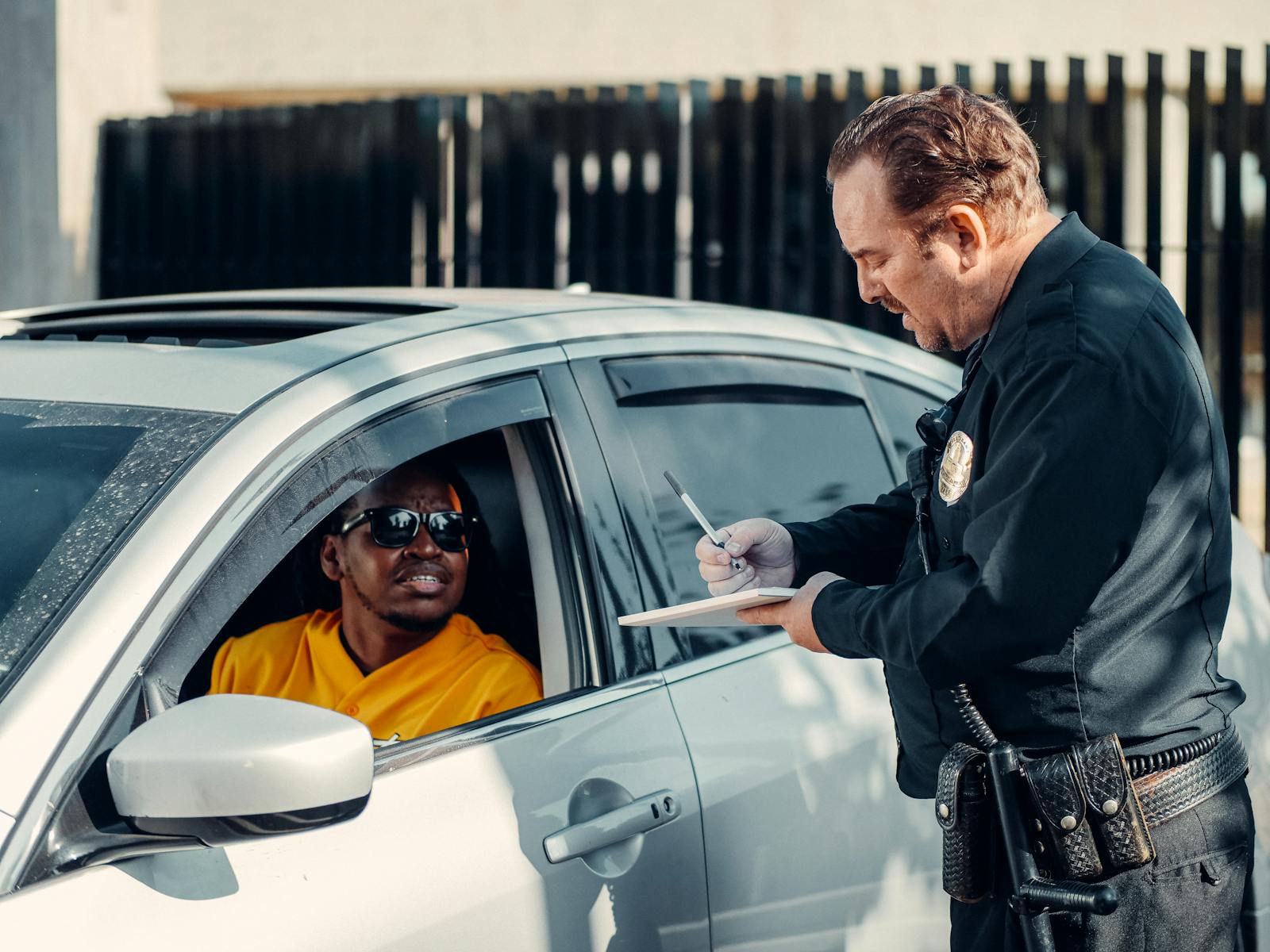

He wasn’t lurking in a stranger’s driveway or creeping behind a closed business after hours. He was sitting in his own car, in a perfectly normal spot, killing a few minutes before heading inside. The kind of dead time most people fill by scrolling their phone, answering a text, or just enjoying the quiet.
That’s when a patrol car rolled up like it had been waiting for an excuse. The driver watched the headlights swing across his hood, then felt that familiar, unpleasant pressure of being “noticed” in a way that doesn’t feel casual. The officer didn’t park and walk over like a normal person either—he angled the cruiser in, close enough to make it clear this wasn’t a friendly check-in.
And right out of the gate, the cop told him he was “acting suspicious.” Suspicious for sitting in his own car. Suspicious for existing in a parking lot without immediately performing an approved, visible task.
The “Suspicious” Part Was Literally Just… Sitting There
The driver did what people do when they know an interaction is already sliding downhill: hands visible, window down, voice calm. He asked what the problem was and tried to keep it light, like, “I’m just waiting a minute.” The officer didn’t take the offramp.
According to the driver, the cop repeated “suspicious” a few times like it was a magic word that made everything else make sense. He asked why the driver was parked there, where he was going, who he was meeting. The driver answered—this was his car, he was allowed to be there, he was waiting before going inside—and the cop acted like each answer was somehow more evidence.
It got awkward fast, because the questions weren’t really questions. They were prompts, like the officer was fishing for a story to sound wrong. The driver could tell he was being sized up not as a person in a car, but as a potential problem the cop wanted to confirm.
Then Came the ID Demand, Like It Was Inevitable
The officer asked for his license. Not “Can I see it?”—more like the tone people use when they’ve already decided you’re going to comply. The driver hesitated, partly because he wasn’t driving and partly because he could feel how quickly “routine” was turning into “procedure.”
He asked if he was being detained or if he’d done something wrong. The cop didn’t give a clean answer, which is usually the moment the temperature changes. Instead, the officer pivoted to a vague explanation about “calls in the area” and “checking on things,” the kind of broad phrasing that’s impossible to argue with because it’s not specific enough to disprove.
Eventually the driver handed over his ID anyway, because refusing in that moment can turn into a whole different kind of risk. The officer took it and walked back to the cruiser without another word. The driver sat there with that hollow feeling people get when they realize they’re now stuck in a script they didn’t agree to.
Waiting in Silence While the Officer Wrote the Story
There’s a special kind of frustration in watching someone sit in their car with your information, running your name, while you’re left staring straight ahead pretending you’re not rattled. The driver said he could see the officer’s head bobbing down, like he was typing or reading, taking his time. Every minute felt like the stop was being inflated on purpose.
When the officer came back, it wasn’t with an apology or even a neutral “All good.” He came back with more questions, sharper this time, like he’d found a new angle. Was the driver on probation? Did he have anything illegal in the car? Was there any reason a K-9 would alert?
The driver said he felt the conversation shift from “Why are you here?” to “Give me a reason to search.” He told the cop no, nothing illegal, and asked again what he was being stopped for. The officer, apparently annoyed, went back to the idea that he’d been “acting suspicious,” as if that was a traffic code.
The Search Talk Turned Into a Pressure Test
Then came the part that always feels like a trap: consent. The officer asked if he could search the car. The driver said no, as calmly as he could, because he didn’t want his trunk and glovebox turned into a scavenger hunt just to satisfy a hunch.
The officer didn’t accept the no like it was a normal answer. He leaned into the window line, closer now, and started talking about how refusing “makes you look guilty.” It was the same tactic people describe over and over—frame consent as cooperation, frame boundaries as evidence, keep the target talking until they slip.
The driver held the line and repeated that he didn’t consent. That’s when the officer started narrating the driver’s behavior back at him, like he was reading body language for a jury: nervous, avoiding eye contact, shifting around. The driver said the irony was brutal—he was nervous because a cop was escalating, and the cop was using that nervousness as justification to escalate further.
At some point the officer told him to step out of the car. Not for a clear safety reason, just a command tossed out with the assumption that the driver didn’t get a vote. The driver complied, because again, this is the part where noncompliance tends to end with hands on you.
It Gets Physical-Adjacent Without Crossing the Line
Outside the car, the driver said the officer positioned him in a way that felt deliberate: off to the side, away from the door, where he couldn’t casually reach back in. Another unit either showed up or was already nearby—he remembers a second presence, which made the whole thing feel less like a check and more like a scene.
The officer asked again about drugs, weapons, “anything I need to know about.” The driver said no, and then asked, plainly, if he was free to leave. The officer didn’t say yes.
Instead, he circled back to the car and did that slow, theatrical scan of the interior through the windows, flashlight bouncing off the dashboard even though it wasn’t dark. The driver stood there feeling like he was being displayed, like the whole point was to make him small and compliant. He said the officer kept trying to talk him into consenting—“It’ll be faster,” “If you’ve got nothing to hide,” “Why make this difficult?”—as if the driver’s time and dignity were bargaining chips.
And the whole time, the original “suspicious” behavior remained unchanged: sitting in his own car for a couple minutes. No contraband in plain view, no smell, no obvious cause, just a vibe the officer didn’t like. The driver said it felt like the officer needed something to come of it, because leaving empty-handed would mean admitting the stop never had real legs.
Eventually, after enough stalling, the officer handed the ID back. No ticket. No warning. No acknowledgment that the driver hadn’t actually done anything. Just a final line about “keeping an eye on the area” delivered with the smugness of someone who wants to be thanked for wasting your evening.
The driver got back in his car, hands still a little shaky, and sat there for a second before starting it—partly to breathe, partly because he didn’t want to give the officer the satisfaction of seeing him rush off. He left feeling less relieved than unsettled, like the whole encounter was designed to remind him how thin the line is between “normal” and “problem” when a cop decides you look like one.
What stuck with him wasn’t that he’d avoided a search or gotten his license back. It was the way the officer kept trying to turn ordinary human reactions—confusion, frustration, nerves—into a storyline that justified control. Sitting in your own car shouldn’t be an invitation for an interrogation, but he drove away with the uncomfortable sense that, for some people, it always is.
More from Steel Horse Rides: