

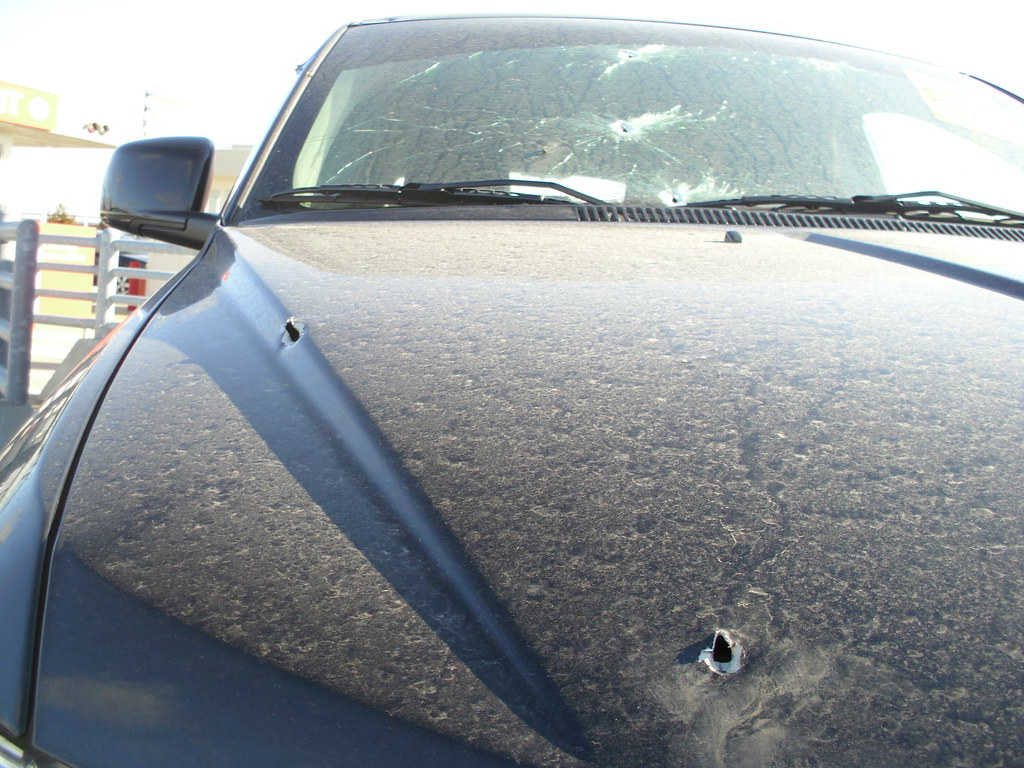
It started as a boring, routine errand: a dad dropping his daughter’s car off at a local shop because it was “making a weird noise” and the inspection sticker was coming due. The kind of appointment where you expect a phone call about brake pads, maybe a lecture about bald tires, and a bill that makes you wince but doesn’t change your life.
He was in the waiting area with a burnt coffee, scrolling through emails, when the mechanic leaned through the doorway and said, real casual, “Hey, can you come back into the bay for a second? I want to show you something.” Not “bad news,” not “you’re gonna want to sit down.” Just that tone people use when they’ve found something they’ve never seen on a Tuesday.
The dad followed him past the lifts and the clanking tools, already bracing for some rusted frame horror show. Then the mechanic pointed at the driver-side door, right around the midline, and there it was: a clean, sharp little puncture with spiderwebbed paint around it. The kind of hole that doesn’t come from a shopping cart or a rogue pebble on the highway.
“That’s… a bullet hole.”
The mechanic didn’t even sound dramatic about it, which somehow made it worse. He ran a finger near the edge of the damage like he was tracing an oil leak and said, “I’m not a cop, but I’ve seen enough to tell you what that is.” The hole had that unmistakable look—metal punched inward, not scraped, not dented outward like a collision.
The dad just stared for a second, waiting for the part where it became less insane. Then he did what most people do when confronted with something that doesn’t fit their mental filing system: he tried to make it fit anyway. “Could it be… like, road debris?” he asked, and the mechanic gave him a look that was half sympathy, half disbelief.
The mechanic pointed out the angle, the way the inner panel looked warped, and the tiny flecks of material inside. He said he hadn’t even noticed it at first until he got the car under bright light and walked around it. “You’d be surprised what people don’t see on their own cars,” he added, like that was supposed to make this feel normal.
That’s when the dad said the line that made the mechanic stop what he was doing: “My daughter’s been driving this like this for weeks.” He wasn’t even sure about the number at first—two weeks, a month—until he remembered when she’d first mentioned the door “sounded a little windy” on the highway. They did the math in their heads and landed on the same number, both of them grimacing.
The daughter’s version: “It’s probably nothing.”
The dad called his daughter right there in the bay, because what else do you do? She picked up with that distracted tone of someone who’s walking between classes or digging for keys, and he didn’t ease into it. He asked her if she’d noticed a hole in her driver-side door.
There was a pause that felt like her brain doing a frantic search. Then she said, “Oh, that. Yeah. I thought someone hit it with a rock or something.” The dad asked what she meant by “that,” and she clarified—like she was describing a scratch on a bumper—that there was a little puncture and some paint chipping.
He asked when she first saw it. She said she noticed it about six weeks ago, after she left work late one night and got into the car under a dim parking lot light. She’d run her hand over it, shrugged, and told herself she’d deal with it later because she had a test the next morning and she was tired.
The dad’s voice climbed an octave without him meaning it to. “You didn’t think to tell me? You didn’t think to call anyone?” She got defensive fast, saying she didn’t want him to freak out and it didn’t seem like a big deal because the car drove fine.
Trying to reconstruct six missing weeks
Once the initial shock wore off, the conversation turned into that frantic, circular interrogation families fall into when they’re scared. Where were you parked? Which route do you take home? Did you hear anything? Did anyone say anything? She kept answering “I don’t know” and “I don’t remember” and “probably the usual,” which made the dad angrier because it sounded like she wasn’t taking it seriously.
She said she hadn’t heard a gunshot. No bang, no pop, nothing that made her duck. Just a normal night, music on low, thinking about work, then noticing the damage later. The dad couldn’t wrap his head around it: if it really was a bullet hole, how do you not hear it? But then again, people hear what they expect to hear, and a tired twenty-something walking to her car doesn’t expect anything like that.
The mechanic chimed in with the most infuriatingly calm observation: depending on the caliber, the distance, the angle, and whether it struck anything else first, she might not have registered it as a gunshot at all. It could’ve been a stray round, it could’ve been someone firing in the distance, it could’ve ricocheted. None of those options were comforting.
They looked for an exit hole and didn’t find one, which opened a whole new branch of dread. If the bullet lodged inside the door, it might still be in there, sitting behind the panel like a nasty little surprise. The dad imagined his kid rolling the window down, resting her arm, and all he could think was how close “door” is to “person.”
The moment it stopped being about the car
When the daughter finally showed up at the shop, she walked in with that stubborn, casual posture people wear when they know they’re in trouble but don’t want to admit it. She took one look at her dad’s face and softened for a second, then snapped back into defensiveness when he started talking. She kept saying, “I’m fine,” like being fine now proved she’d been fine the whole time.
The mechanic, trying to be helpful and making it worse, said, “Ma’am, I’m not trying to scare you, but you should treat this like a real incident.” He suggested filing a police report, at least documenting it, maybe checking nearby parking lot cameras if any still existed. She rolled her eyes—just slightly—and said the cameras probably overwrote everything by now, and she didn’t want the hassle.
That’s when the dad lost it. Not screaming, not a theatrical blow-up, but the tight, controlled anger of someone who’s picturing alternate timelines. He said, “You don’t get to decide it’s not serious because you don’t want paperwork.” And she fired back, “You don’t get to act like I’m a child because you’re scared.”
It turned into a fight about everything adjacent to the bullet hole. Her independence, his protectiveness, the fact that she’d been brushing off maintenance issues, the fact that she’d been parking in a lot she always complained felt sketchy, the fact that she’d stopped sharing details about her schedule. The car was just the object everyone could point at while they argued about the real thing: how close she might’ve come to getting hurt without even realizing it.
What the shop found, and what they didn’t
The mechanic offered to pull the inner door panel to see if anything was lodged inside. The dad wanted it done immediately; the daughter hesitated because she didn’t want to pay for extra labor on top of whatever else the car needed. That hesitation—money, inconvenience, denial, all tangled together—made the dad look at her like he didn’t recognize her for a second.
When they opened it up, they found metal fragments and gouging, but no intact bullet sitting there like a movie prop. That suggested it either fell out somewhere along the way, got pulverized, or never lodged cleanly in the first place. The absence should’ve been a relief, but it somehow made it creepier, like the evidence had evaporated and left them with only questions.
The mechanic photographed everything for documentation and advised them again to make a report. He wasn’t pushy, just firm, like someone who didn’t want to be responsible for the next part of the story. The daughter stood there watching, arms crossed, chewing the inside of her cheek, finally looking less annoyed and more unsettled.
She admitted, quietly, that she’d felt weird about it when she first noticed. She just didn’t want to tell herself what it might be. Saying “rock” out loud was easier than saying “someone shot near my car,” because “rock” doesn’t require you to rearrange your life or your routines or your sense of safety.
The dad didn’t soften, not fully. He kept thinking about six weeks of her driving around with that damage, parking the car, walking up to it at night, never once stopping to ask, “What if this isn’t nothing?” And she kept thinking about how quickly his fear turned into control, how the first words out of his mouth were demands instead of questions.
By the time they left the shop, the door was still dented, the paperwork was still on the counter, and the tension between them had its own weight in the car. The bullet hole wasn’t the only thing that had punched through something—it had just made visible what was already fragile: her belief that she could shrug off danger, and his belief that he could keep her safe just by staying on top of things.