

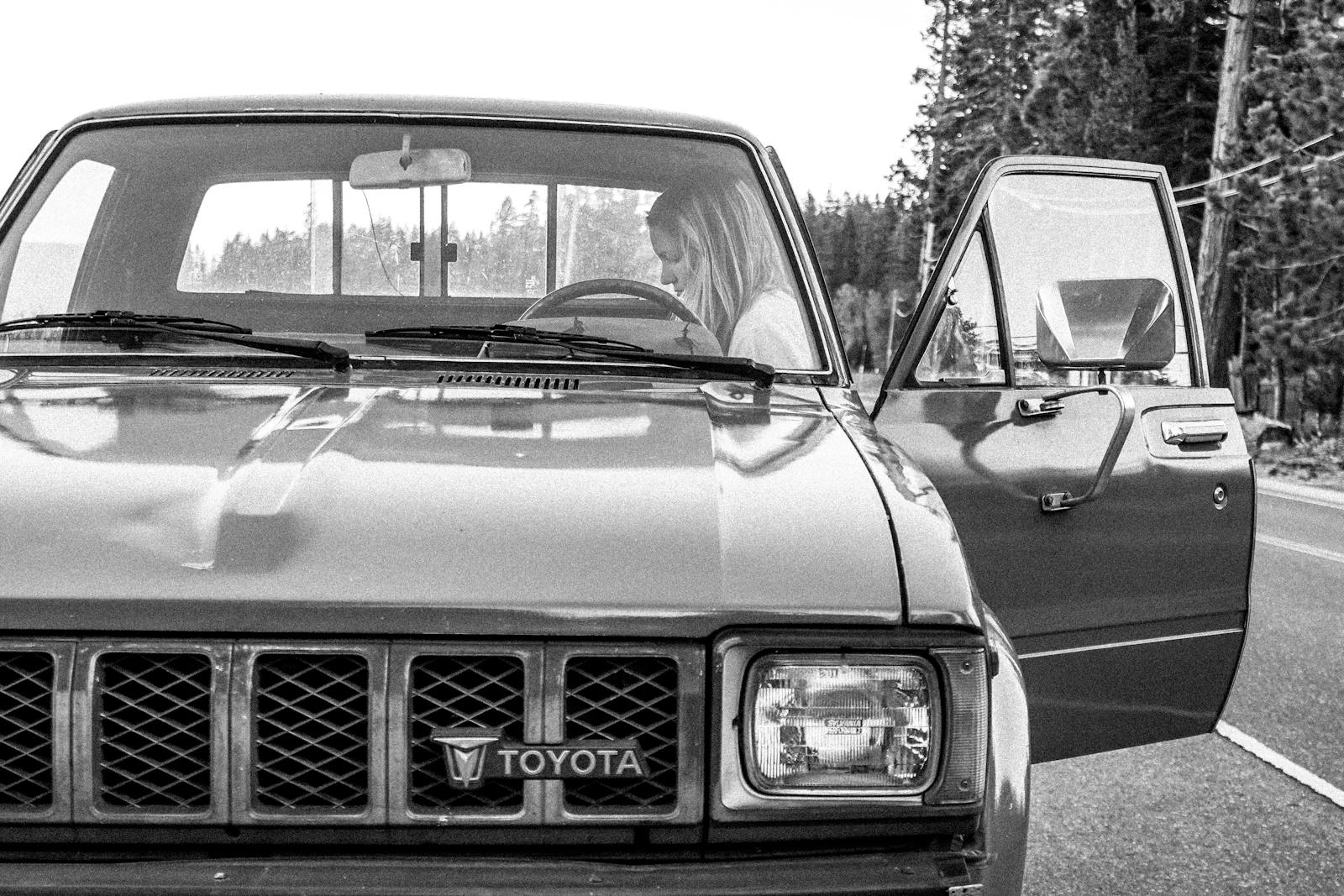
It started the way a lot of “we’re finally doing it” car buys start: a couple in their late 30s, one of them a veteran, walking onto a used lot on a Saturday with a number already in their heads. They weren’t browsing for fun. He’d been talking about a Tacoma for months—reliable, holds value, good in bad weather, the whole practical-dream-truck pitch.
The salesman latched onto that immediately, the way they do when they smell a buyer who’s already emotionally moved in. The truck was clean, mid-mileage, the kind of Tacoma that looks like it’s been detailed to within an inch of its life. The veteran asked the only question that mattered: what’s the out-the-door price?
“Thirty-four,” the salesman said, like it was a simple fact of the universe. Taxes, title, fees—done. The veteran repeated it back to him, just to make it real, and the salesman nodded, smiling, already steering him toward the desk where the pens and paperwork lived.
The number that made everything feel settled
The veteran wasn’t reckless. He asked again, casually, as if he was just making conversation: “So 34K out the door, that’s the final number?” The salesman gave him the practiced reassurance—yes, that’s what it’ll be, and they can make the monthly payment work depending on term and rate.
They test-drove the truck, came back, and the salesman did the whole “let me talk to my manager” lap. The veteran texted his wife a picture of the Tacoma from the lot, that proud angle that says this is the one. She didn’t come with him because she was home with their kid and honestly didn’t expect the buying part to happen that day.
When the salesman came back, he had that slightly too-enthusiastic grin and a page with numbers. The top-line was still $34K out the door. The veteran felt that small relief you get when the negotiation doesn’t turn into a three-hour hostage situation.
So he signed. Not everything, he thought—just the normal stack. Some initial here, some signature there. The finance office was busy, the printer was spitting out papers, and the salesman kept pointing to lines with a pen like a metronome: here, here, and here.
The finance office fog
In the finance office, the vibe changed from friendly to fluorescent-serious. The finance manager talked fast but calm, like a pilot listing flight conditions. He offered a warranty, paint protection, some tire-and-wheel coverage, and the veteran declined the stuff that sounded optional.
What he didn’t realize is how “declined” can still turn into “included” when it’s folded into a monthly payment and buried under jargon. The finance manager kept the conversation on monthly payments, not totals. “We can keep you around the same payment,” he said, which is one of those sentences that seems helpful until you realize it’s a magic trick with the term length and add-ons.
The veteran remembered the $34K and treated everything else like noise. He left with keys, the little temporary tag, and a fat envelope of paperwork. He drove home feeling like he’d accomplished something—like the responsible adult version of winning.
His wife was happy at first, too. She came outside, looked at the truck, ran a hand along the fender, asked what it cost. He said, “Thirty-four out the door,” like he’d been rehearsing it. She nodded, but she also did that thing some spouses do when a big purchase happens without them: she asked to see the paperwork.
The kitchen table audit
That night, after dinner, she spread everything out on the kitchen table. Not in a suspicious way at first—more like a “let me file this” way. But she noticed there were more pages than there should’ve been, and the numbers didn’t line up cleanly across documents.
One page listed the vehicle price. Another had an itemized breakdown. Another had something that looked like an addendum—smaller print, more “fees,” more line items that didn’t sound like registration or taxes. She started circling things with a pen, the way people do when they’re trying to force a mess to become understandable.
There it was: add-ons. Not one or two small ones, but a pile that added up like someone went shopping with his signature. A service contract, a “protection package,” a theft-recovery system, a document fee that seemed oddly high, and some kind of maintenance plan that didn’t match anything they’d discussed.
The total wasn’t $34K. Depending on which document you looked at, it was climbing into the mid-40s. The hidden part—the stuff that wasn’t the truck—came out to around $11,000.
The moment it turns from confusion to anger
She called him over, tapping the paper with the back of her pen. “What is this?” she asked, and the veteran did the first thing most people do when confronted with paperwork they didn’t read: he leaned in and tried to translate it on the fly.
At first he thought it was just “options” they could cancel. Then he realized these weren’t suggestions; they were financed. The monthly payment suddenly made more sense in a sickening way, like realizing you’ve been eating something expired because it was covered in sauce.
He got defensive—not because he wanted the add-ons, but because embarrassment comes out sideways. He insisted the salesman said $34K out the door. His wife wasn’t arguing that point; she was arguing that the contract didn’t care what anyone said out loud on a dealership floor.
They went back and forth for a minute, not screaming, but sharp. He kept saying, “I told them no warranty.” She kept pointing at a line that said otherwise, with his signature next to it. The fight wasn’t really about the truck anymore; it was about how easily he’d been guided through a room full of professionals whose job was to make the paper say what they wanted.
Back to the dealership, different energy
The next morning, he called the dealership. He tried to keep it calm, military-calm, the tone of someone who wants a correction without drama. He said there were charges in the contract he didn’t authorize, and he wanted them removed.
The salesman’s voice changed when he realized this wasn’t a “how do I pair my phone” call. Suddenly it was all “you signed the paperwork” and “that’s standard.” The veteran asked for the manager, and the manager repeated the same line with a different cadence.
They told him some products were cancelable, but not everything. The dealership used words like “already installed” and “third-party” and “processing.” They acted like the couple was being unreasonable for wanting the price they were told—in plain language, multiple times.
So he drove back over there with the folder. This time, he didn’t walk in with that excited-new-truck posture. He walked in like someone returning a defective appliance that costs as much as a year of childcare.
At the desk, the veteran laid out the papers and pointed line by line. The staff kept trying to redirect the conversation to monthly payments and “value.” He kept dragging it back to totals and signatures. The wife wasn’t there, but you could feel her presence in the way he was suddenly reading every word and refusing to be hurried.
The dealership offered partial fixes: cancel this warranty, refund that plan in six to eight weeks, maybe adjust something after paperwork “processed.” But they weren’t volunteering to unwind the whole deal or admit the $34K out-the-door promise had been turned into a $45K reality through a quiet stack of add-ons.
The fallout that doesn’t wrap up neatly
By the time he left, he had a list of cancellation forms and a whole new understanding of how slippery “optional” can be. The Tacoma was still in his driveway, but it felt different now—like a trophy that came with an invoice taped underneath.
His wife kept asking the most brutal, simplest question: “If it was $34K, why does the contract say otherwise?” And he didn’t have a satisfying answer, just a mix of guilt, anger, and that sinking feeling that he’d been played in a way that was technically legal.
The dealership, for its part, stayed politely unmoved. They weren’t shouting; they didn’t need to. Their power was in the signatures and the slow churn of “refund processing,” the way time makes people tired enough to accept less than what they were promised.
And that’s where it sat—this weird limbo where the truck was real, the payments were real, the add-ons were real, and the only thing that felt unreal was how easily a clean $34K handshake number turned into $11,000 of extra weight. The veteran kept the folder on the counter like a threat and a reminder, and every time the Tacoma started up in the driveway, it came with the same question hanging in the air: how much of that engine sound was satisfaction, and how much was the noise of trying not to feel duped.