

The mom didn’t think she was being paranoid at first. It started as one of those tiny, half-conscious observations you file away while you’re carrying groceries or taking the trash out: a car that didn’t belong, tucked into the shadowy part of the cul-de-sac, headlights off like it was trying not to be noticed.
It was always there late. Not every single night, but enough that she started recognizing the silhouette—an older compact, low profile, kind of boxy in that early-2000s way. The weird part was how consistent it was about being “dark,” like whoever parked it didn’t even want the porch cameras or motion lights catching the license plate.
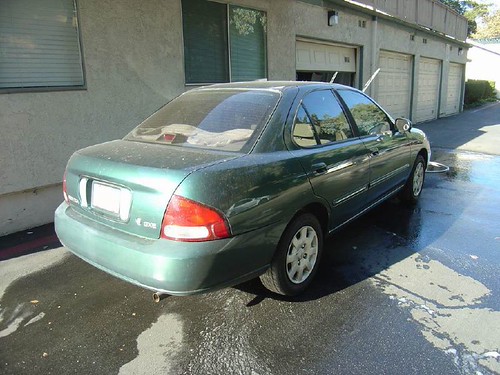
And then one evening, as she walked past the window and caught the angle just right, she realized what she was looking at. It wasn’t just any random car. It was the ’02 Sentra she’d sold her teen daughter’s boyfriend for $900 a couple months earlier.
The “Nice Kid” and the Too-Cheap Sentra
When her daughter first brought the boyfriend around, he came off like the kind of kid adults relax around. Polite, quiet, always offering to help with dishes, always saying “yes ma’am” with this practiced softness that made him seem older than he was. He didn’t swagger, didn’t mouth off, and he didn’t carry that obvious chip-on-the-shoulder vibe some teens bring into other people’s homes.
He also didn’t have a car, and in their suburb, not having a car at that age might as well be a social disability. The mom had an old Sentra sitting in the driveway that had become the family’s unofficial spare—fine for short trips, ugly enough that no one cared if it got dinged. It had faded paint, a slightly wheezy A/C, and a radio that liked to blink out like it was thinking about retirement.
So when he asked if she’d ever consider selling it, she did the math in her head and landed on $900. It wasn’t a “deal” so much as a convenient way to clear space, get a little cash, and help her daughter’s boyfriend have some independence. He promised he’d pay in full, said he’d handle the paperwork, and looked almost painfully grateful when she handed over the keys.
For a while, everything seemed normal. He drove her daughter to school sometimes, showed up for weekend hangouts, and parked in the driveway like a regular kid visiting his girlfriend. The Sentra became part of the background, just another clunker in a neighborhood full of minivans and crossovers.
Why the Car Kept Showing Up After Midnight
The first time she noticed it in the cul-de-sac late at night, she assumed it was coincidence. Teenagers do weird things—driving around, killing time, sitting in cars talking. She figured her daughter and her boyfriend were doing that harmless, semi-secret teen thing where they want privacy but don’t want to go too far.
But it wasn’t her daughter’s curfew that set her off. It was the pattern: the Sentra would show up after the household had settled, often after midnight, and it wouldn’t pull into the driveway. It would park just far enough away to not be “at” the house, but close enough that anyone inside could walk to it in under a minute.
And the headlights were always off, even during the approach. No slow roll with lights, no brief flash as it turned—just a dark shape sliding into place like it didn’t want anyone to see it arrive. The mom started checking her daughter’s room in those moments, expecting to catch an empty bed or a glowing phone screen and a guilty face.
Her daughter was always there. Door shut, lights out, sometimes asleep, sometimes watching something with earbuds in. She wasn’t sneaking out, wasn’t whispering into the dark, wasn’t acting like she knew anything about a car sitting in the street for hours.
The Night She Walked Outside
Eventually the mom did what people do when their brain won’t stop grinding on a question: she went to confirm reality. One night, after seeing the Sentra settle into its usual spot, she threw on a hoodie and stepped out onto the porch like she’d “forgotten something” in the garage. She waited a beat, listening for the normal sounds—sprinklers, a distant TV, a dog shifting behind a fence.
The cul-de-sac was quiet in that way that makes every small noise feel amplified. The Sentra sat there with the windows dark, no interior light, no phone glow, nothing. If someone was in it, they weren’t moving.
She walked closer, not trying to be sneaky exactly, but not announcing herself either. Halfway there, she got that cold little dip in her stomach—because the car didn’t look empty. The front seat was pushed back oddly far, like someone had been reclining in it, and there was clutter on the passenger side that didn’t look like normal “teen car” junk.
As she got to the driver’s side, she saw it: a rumpled blanket, a backpack shoved under the dash, a couple of fast-food cups, and what looked like a rolled-up hoodie acting as a pillow. The windows were fogged slightly from the inside, and she realized she’d been wrong to think no one was there. Someone was breathing in that car.
She knocked on the window, not hard, but hard enough to send a message. A second later, the shape in the driver’s seat shifted, and the boyfriend sat up like he’d been yanked out of a dream. He blinked at her, confused, hair flattened on one side, and for a second he looked less like a “nice kid” and more like a kid caught trying to survive.
The Explanation That Didn’t Quite Add Up
He rolled the window down a few inches, and the first thing he said was her name, like that alone might smooth over what was happening. He tried to smile, then stopped when he saw her face. The mom didn’t raise her voice, but she didn’t soften it either—she asked him what he was doing, why he was parked there every night, and why he’d been turning his headlights off.
He started with a story about having trouble at home. “It’s just… complicated,” he said, in that vague way people talk when the details make them look bad or feel exposed. He said he’d been “staying with friends” and sometimes couldn’t, and sometimes it was easier to just crash in the car for a few hours.
The mom asked the obvious question: why here? Why in her cul-de-sac, outside her house, and not in some neutral place like a parking lot? That’s when he glanced toward her home, quick and guilty, like he was checking whether her daughter’s window light was on.
He said he felt “safe” here. He said he didn’t want to bother anyone, didn’t want to knock on the door late, didn’t want to make it weird. He said he parked with the lights off because he didn’t want to wake anyone up or have neighbors complain. Everything he said had a reason, and every reason sounded like it was designed to avoid admitting the simplest truth: he’d been living in the Sentra, and he’d chosen her street on purpose.
She asked whether her daughter knew. He hesitated long enough to answer without answering. He said, “She knows I’m dealing with stuff,” which is a sentence that can mean anything from “we’ve talked” to “I’ve lied carefully.”
When the Mom Brought It Into the House
The mom went back inside with that sick, buzzing feeling you get when something is both sad and unacceptable. She didn’t wake her daughter immediately; she stood in the kitchen and stared at the counter like she was waiting for the right emotion to arrive. Anger would’ve been easier, but what she had instead was a knot of worry and distrust pulling in opposite directions.
The next day, she asked her daughter about it in the least dramatic way she could manage—casual voice, careful phrasing, like she was testing ice. The daughter looked genuinely startled at first, then went defensive fast. She said he’d told her his family was “hard,” that he was “sorting things out,” but she claimed she didn’t know he was sleeping in the car outside their house.
Then came the messy part: the mom asked why he’d never asked for help if it was that bad. The daughter immediately took it personally, like the question implied her boyfriend was a liar or a user. She insisted he was proud, that he didn’t want charity, that he’d never hurt her, that he was just trying to get through a rough patch.
The mom didn’t accuse him of hurting her. She didn’t need to—she could already see how the dynamic might work. A kid with nowhere to go, a teen girl in love, a family home that feels like a warm island, and a boyfriend quietly orbiting it every night, close enough to feel anchored but not close enough to trigger rules.
That evening, she told the boyfriend he couldn’t park there overnight anymore. Not as a punishment, not as a power move—because now it wasn’t just “a car in the cul-de-sac.” It was a problem sitting at the edge of her property line, one that could spill into her daughter’s life in a hundred unpredictable ways.
What stuck with her wasn’t the blanket or the backpack, or even the headlights-off creepiness of it all. It was the way he’d looked when she knocked—like he’d been startled into remembering that adults exist, that someone might notice, that he couldn’t just quietly become part of the neighborhood scenery. And the hardest part was that there wasn’t a clean next step: if she pushed too hard, her daughter would dig in and protect him; if she did nothing, she’d be silently agreeing to a teenager’s idea of a solution—one more night, and then another, and then suddenly the Sentra wasn’t just a car she’d sold for $900, it was a shelter parked outside her house, full of secrets her daughter might be carrying alone.