

The whole thing started the way a lot of car nightmares start: a normal repair that shouldn’t have been dramatic. A 2019 Ford Edge went into a shop for a wheel bearing, the kind of job that’s annoying but routine. The customer wasn’t asking for custom work or a miracle—just that grinding, humming front-end noise to go away.
The tech on the ticket was one of those guys who moved fast and didn’t talk much. The service advisor did the usual “we’ll have you in and out” smile, and the customer did the usual “cool, I’ll wait for the call” nod. Nothing about it screamed, today’s the day you’re going to watch your own wheel pass you.
The Edge got picked up like it always does. The customer paid, got the keys, did the quick glance around the interior like people do when they’re half-checking nobody broke anything, and pulled out. It drove fine at low speed—no warning lights, no weird vibration, no immediate sign that anything was about to go sideways.
The “simple” wheel bearing job
A wheel bearing on that Ford isn’t just “swap a part and move on.” You’re dealing with the hub assembly, the axle, and a bunch of hardware that all has to go back together in the exact way it came apart. On modern crossovers, it’s not like an old rear-wheel-drive car where the bearing can be a neat little standalone thing—this is a stack of parts that only behaves when it’s clamped down correctly.
That axle nut is the big one. It’s not decorative; it’s what preloads the bearing and keeps the whole hub/axle interface from doing anything creative. If it’s loose—or even just not torqued to spec—it’s basically inviting the wheel end to start wobbling itself to death.
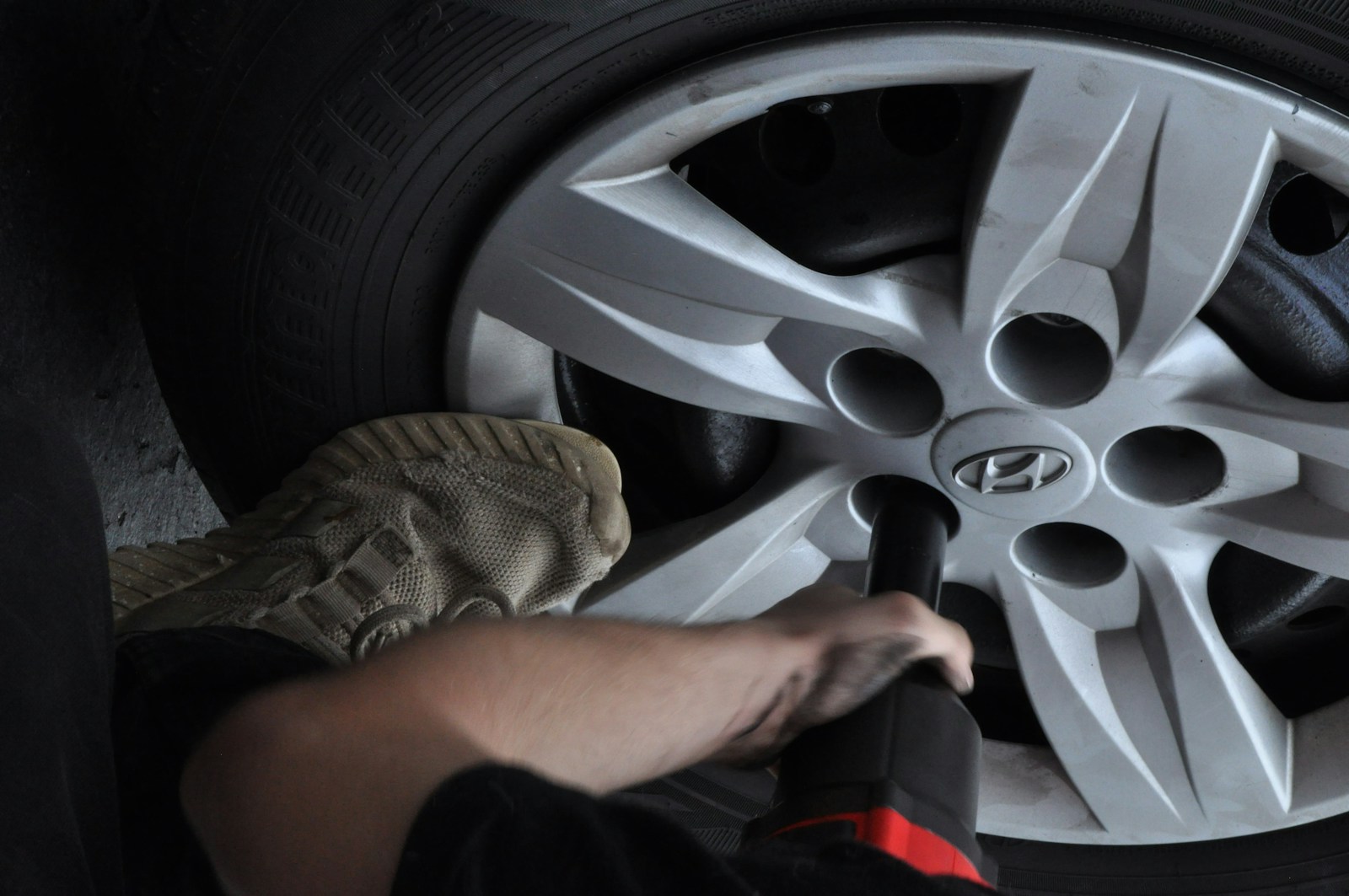
In the shop, though, it’s easy for it to look “done” even when it isn’t. The wheel’s back on, the lug nuts are tightened, the car rolls out of the bay. If someone got interrupted mid-assembly, or used an impact gun to spin the axle nut on and meant to come back with a torque wrench later, there’s your opening.
Leaving the lot with a time bomb in the hub
The customer didn’t head straight home. They went the normal route—city streets, a couple lights, then toward the on-ramp for the highway where everything finally stretches its legs. That’s where a lot of mechanical mistakes go from “huh, that’s odd” to “call your insurance.”
Pulling onto an on-ramp is the first time you load up the suspension and driveline in a specific way: accelerating while the wheel is turned, the vehicle leaning, the CV axle dealing with angle and torque. Any slop in the hub assembly suddenly has a chance to announce itself. And in this case, it didn’t announce itself quietly.
The customer later described it as a loud pop—more like something letting go than something rubbing. Not a squeak, not a clunk over a bump, but a sharp, metallic “that wasn’t supposed to happen” sound. The kind of noise that makes your stomach drop even if you don’t know cars.
The pop, the lurch, and the wheel that decided it was done
Right after the pop, the Edge didn’t just feel “off.” It lurched, and the steering went weird in that immediate way where you realize you’re not in full control anymore. A wheel coming loose doesn’t feel like a normal flat tire; it feels like the car has suddenly grown a hinge.
There’s a brief moment in stories like this where the driver tries to process it. Maybe it’s a tire. Maybe it’s the road. Maybe something shifted in the trunk. Except the sound is too sharp and the pull is too violent, and you can hear things grinding that aren’t supposed to grind.
Then the wheel came off. Not “the tire went flat,” not “it wobbled,” but off-off—separated enough that the corner of the vehicle dropped and the rotor/knuckle area started making contact with the road. The Edge ended up skidding and scraping, the driver trying to keep it from darting into traffic while also realizing they’re now piloting a 2019 crossover that’s missing one of its major commitments.
It’s hard to picture until you’ve seen it: the wheel isn’t always fully gone like it’s rolling down the freeway forever. Sometimes it flops outward, sometimes it tucks weirdly, sometimes it’s tethered by nothing but geometry and luck. Either way, the car is suddenly a loud, grinding, sparking problem in the middle of an on-ramp.
The phone call that no service advisor wants
The customer didn’t calmly drive back to the shop. They couldn’t. They ended up stopped and shaken, calling for a tow and then calling the place that had just touched that wheel. The tone wasn’t “hey, quick question,” it was “your repair just tried to kill me.”
Shops always have an initial reflex in moments like this, even the decent ones: slow down, get details, don’t admit anything on the phone. The service advisor likely asked where the car was, what happened exactly, and whether anyone was hurt. But the customer’s summary didn’t leave much wiggle room—there was a loud pop, and then the wheel came off after a wheel bearing replacement.
The awkward part is how fast everyone mentally goes to the same place. If you’re even slightly familiar with wheel-end work, you immediately think: axle nut. You think: torque. You think: someone didn’t finish the job. Because there aren’t many scenarios where a properly assembled hub and axle on a modern SUV just decides to eject itself during normal driving.
By the time the tow truck was arranged, there was already that looming question hanging over the whole thing: does the shop send someone to the scene, or do they make the customer drag the wounded Edge back like it’s some kind of evidence? Either option feels bad. Sending someone looks like you know you screwed up; not sending someone looks like you don’t care.
Back in the bay: looking for the missing torque wrench moment
When the Edge finally got back to the shop, it wasn’t subtle what had happened. A wheel-off incident doesn’t hide. There’s damage around the wheel well, the brake components are angry, the rotor may be chewed up, and the underside has fresh scars from sliding on parts that were never meant to touch pavement.
Now you’ve got the internal shop tension, too. The service advisor is trying to keep the customer from lighting them up while the tech is being called off whatever they’re doing to come explain themselves. There’s a particular silence that happens when a manager is staring at a vehicle and running the mental math of liability, repair cost, and how many cameras are pointed at the lot.
The simplest, ugliest explanation is also the most believable: the axle nut wasn’t torqued. Maybe it was spun on with an impact and never finished. Maybe it was finger-tight, waiting for the final torque step that never came. Maybe the tech got pulled to another bay, or lunch, or a “quick question” that turned into a whole other job, and the Edge got rolled out with an unfinished wheel end.
And if that nut backed off, the chain reaction makes grim sense. The hub can move, the bearing can be destroyed in minutes, the CV axle can walk, and the whole assembly can come apart under load. That “pop” on the on-ramp wasn’t mysterious—it was the moment the last bit of friction and luck stopped holding.
Fallout: who pays, who admits it, and what can’t be undone
The customer wasn’t just dealing with a broken car anymore. They were dealing with the fact that a professional shop had returned a vehicle in a condition that could’ve put them into a guardrail or into another car. Even if nobody got hurt, the emotional aftertaste is the same: you start replaying the ramp, the traffic, the sound, and how close it could’ve been.
The shop, meanwhile, was stuck in that miserable space between “we need to fix this” and “we need to protect ourselves.” A manager might offer to make it right—cover towing, repairs, maybe a rental—while still choosing words carefully. Because once you say, out loud, “we forgot to torque the axle nut,” you’re not just talking about a mistake; you’re talking about negligence.
There’s also the uncomfortable human element. If it was one tech’s miss, that person’s name becomes a magnet inside the building. The conversation turns from parts and procedures to trust, training, and whether anyone checked the work before it left. Shops love to say they have a final inspection, but moments like this are where you find out what that actually means.
What makes the whole situation stick in people’s heads is that it’s such a small action with such a huge consequence. Torquing an axle nut is not exotic craftsmanship; it’s one of those “this is why we’re professionals” steps. And now the customer is left with a repaired-but-scarred Edge, a story they didn’t ask for, and that lingering anger that the most dangerous part of their day wasn’t the highway—it was the moment they trusted someone else’s wrench.