

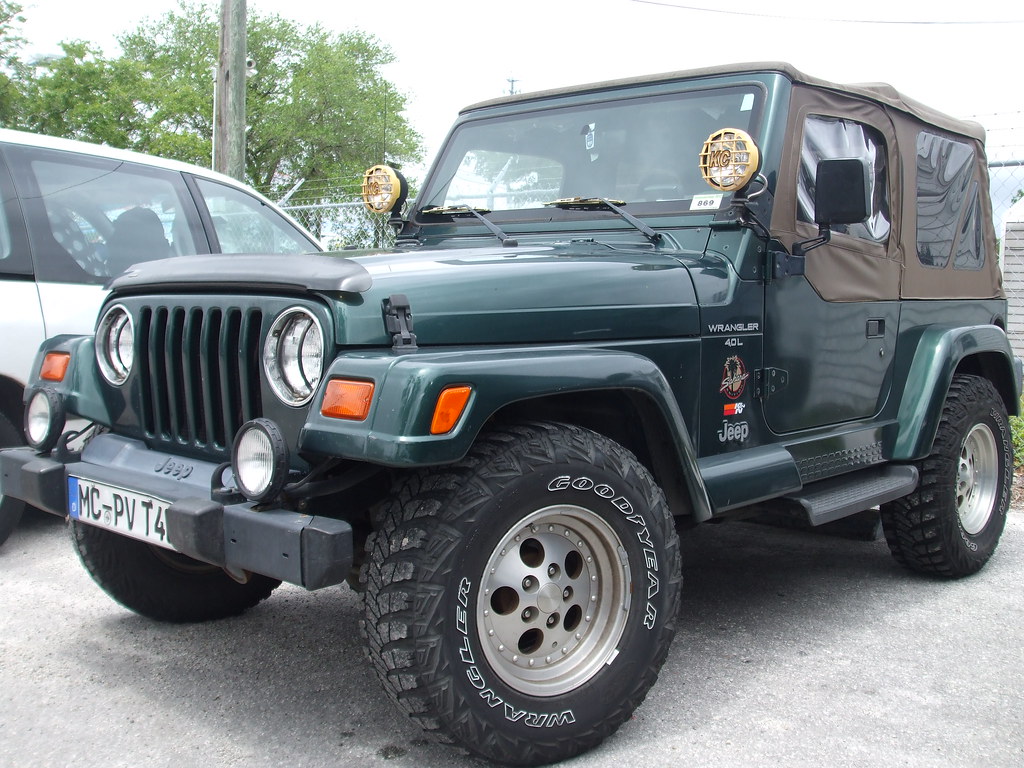
He’d been staring at the listing for two days like it was going to change if he blinked hard enough. A Wrangler—clean photos, the kind of “just adventurous enough” spec you can picture in a driveway without it feeling like a midlife crisis purchase. The price was the hook: $32,995, big and bold, with that little “internet price” tag dealers love because it sounds like a secret handshake.
So he did the thing people do when they think they’ve found the rare car-deal unicorn. He called, asked if it was still there, got a casual “yep,” and then committed to a three-hour drive like it was a Saturday errand. He packed snacks, lined up a buddy as a ride-back plan, and told himself that even if it wasn’t perfect, it was close enough to be worth seeing in person.
By the time he pulled into the dealership lot, he was already tired in that specific way you get from highway hypnosis and anticipation. He found the Wrangler pretty quickly—because of course it was parked front and center, freshly washed, angled just right. It looked like the photos, which is usually where these stories take a pleasant turn. This one didn’t.
The “internet price” starts doing gymnastics
Inside, the showroom had the usual vibe: fluorescent lights, a coffee machine that looks like it’s been there since the Bush administration, and salespeople orbiting like they can smell someone who drove in from a different ZIP code. He told the first guy who approached him he was there for the Wrangler listed at $32,995. The salesperson nodded like this was all straightforward and led him to a desk.
They did the normal small talk—where you’re from, what you’re driving now, how long you’ve been looking—while the salesperson pulled up the listing on a computer. The number was still there on the screen, still $32,995, still framed like a deal. Then the salesperson started asking questions that felt slightly off for a simple “can I test drive it” situation.
“Are you planning to trade something in?” the salesperson asked, and the customer said he could, maybe, depending on how things shook out. “And what were you thinking for down payment?” That question landed differently, because most people don’t drive three hours to be quizzed about cash before even seeing numbers on paper.
That’s when the salesperson casually slid in the condition like it was a normal footnote: the internet price required $7,500 down and a trade. Not suggested. Not “to qualify for additional savings.” Required.
Trying to keep it calm while the math stops making sense
For a second, the customer just stared, because the brain does this little buffering thing when reality doesn’t match the script. He asked what the price would be if he didn’t have a trade, or if he put less down. The salesperson didn’t get defensive, but he also didn’t budge, like he’d said this line a thousand times and the argument was already happening in his head on autopilot.
The customer pointed at the listing and said, basically, “It says $32,995.” The salesperson agreed it did, and then started talking about “programs” and “market adjustments” without ever calling it a markup. There was a lot of language that sounded like it meant something—“internet price,” “qualified buyer,” “rebates”—but none of it answered the simple question: what is the actual price of the truck if you’re a normal person walking in off the street?
It turned into one of those conversations where every sentence is technically polite but spiritually aggravating. The customer asked if the $7,500 down payment was being counted as part of the price or if it was on top of it. The salesperson answered like the customer was asking about the weather: the $32,995 number was only if you brought $7,500 down and had a trade, and otherwise the pricing changed.
So the customer did what anyone would do. He asked for a breakdown in writing.
The paper comes out and the room gets weird
The salesperson went to get a worksheet, and you could feel the tempo shift. The customer wasn’t yelling, wasn’t insulting anyone, wasn’t doing the “I’m gonna leave a bad review” routine. He was just calm in a way that makes salespeople nervous, because calm means you’re paying attention.
When the paper finally came back, it had the Wrangler’s price, but it also had a pile of additions and conditions that weren’t anywhere on the glossy listing. The “internet price” was basically a theoretical number living at the bottom of a very specific staircase: $7,500 down, trade-in applied, and who knows what kind of “trade-in value” they were imagining. Without the trade, the deal shifted upward fast.
He asked what the trade requirement even meant. If his trade was a ten-year-old sedan with 160k miles, did it still “count,” or did it need to be a vehicle they could flip for profit? The salesperson did the classic dodge—something like, “We’d have to appraise it,” “We’ll do everything we can,” “We work with all kinds of trades”—which sounded friendly but didn’t answer the question at all.
Now the customer’s thinking about the three hours he already drove, and the three hours still waiting for him after this. He came expecting to talk about the Wrangler. Instead he’s being asked to restructure his entire purchase around a down payment target and a trade they haven’t even looked at yet.
The tension spikes: “So you drove here for a price that doesn’t exist”
At some point the customer said it plainly: he drove three hours because the Wrangler was listed at $32,995. If the dealership couldn’t sell it for that price without a $7,500 down payment plus a trade, then the listing was misleading. Not “confusing,” not “missing details”—misleading.
The salesperson did that thing where they try to keep their voice soft but their words get sharper. They pointed to the fine print, the “disclaimer” language people never read, the idea that “internet price” assumes certain qualifications. The problem was, even if there was a disclaimer, the condition wasn’t some minor asterisk. It was the entire structure of the deal.
What made it worse is that the dealership could’ve solved this at the start. When the customer called before driving three hours, somebody could’ve said, “Hey, just so you know, that price assumes a trade and $7,500 down.” Instead, they let him show up, sit down, and mentally commit to the vehicle before pulling the rug out.
It got awkward in that quiet, professional way. The customer wasn’t there to have a philosophical debate about financing incentives. He wanted to know what he’d actually be paying for the truck and why the listing didn’t say, in big obvious words, “Price requires $7,500 down and trade-in.”
Walking out doesn’t feel like winning when you still have a six-hour drive
He stood up, because what else do you do when the numbers are doing backflips and nobody will say them plainly? The salesperson tried to keep him in the chair with the usual moves: “What payment are you trying to be at?” “Maybe we can make it work.” “Let’s just appraise your trade real quick.” All of it hinged on him staying long enough to get emotionally invested again.
The customer didn’t bite. He said he wasn’t trading a vehicle just to unlock a price that was advertised like it was the actual price, and he wasn’t dropping $7,500 down just to be allowed into the deal. He came for a $32,995 Wrangler, not a scavenger hunt.
Out in the lot, the Wrangler still sat there looking innocent, like it had nothing to do with any of this. That’s the part that sticks in these situations—the object is real, the desire is real, the photos are real. It’s the “price” that turns out to be a fictional character with a complicated backstory.
He climbed back into his car and started the three-hour drive home, and the anger didn’t even hit right away. First it was exhaustion, then that slow-burn irritation where you replay every line of the conversation and realize how carefully the dealership kept everything technically deniable. The truck was $32,995… if you entered the cheat code.
And the unresolved part—the thing that keeps gnawing at him—wasn’t just that he wasted a day. It was the feeling that the whole setup depended on one simple bet: that after driving three hours, most people would rather overpay than admit they got played and turn around empty-handed.