

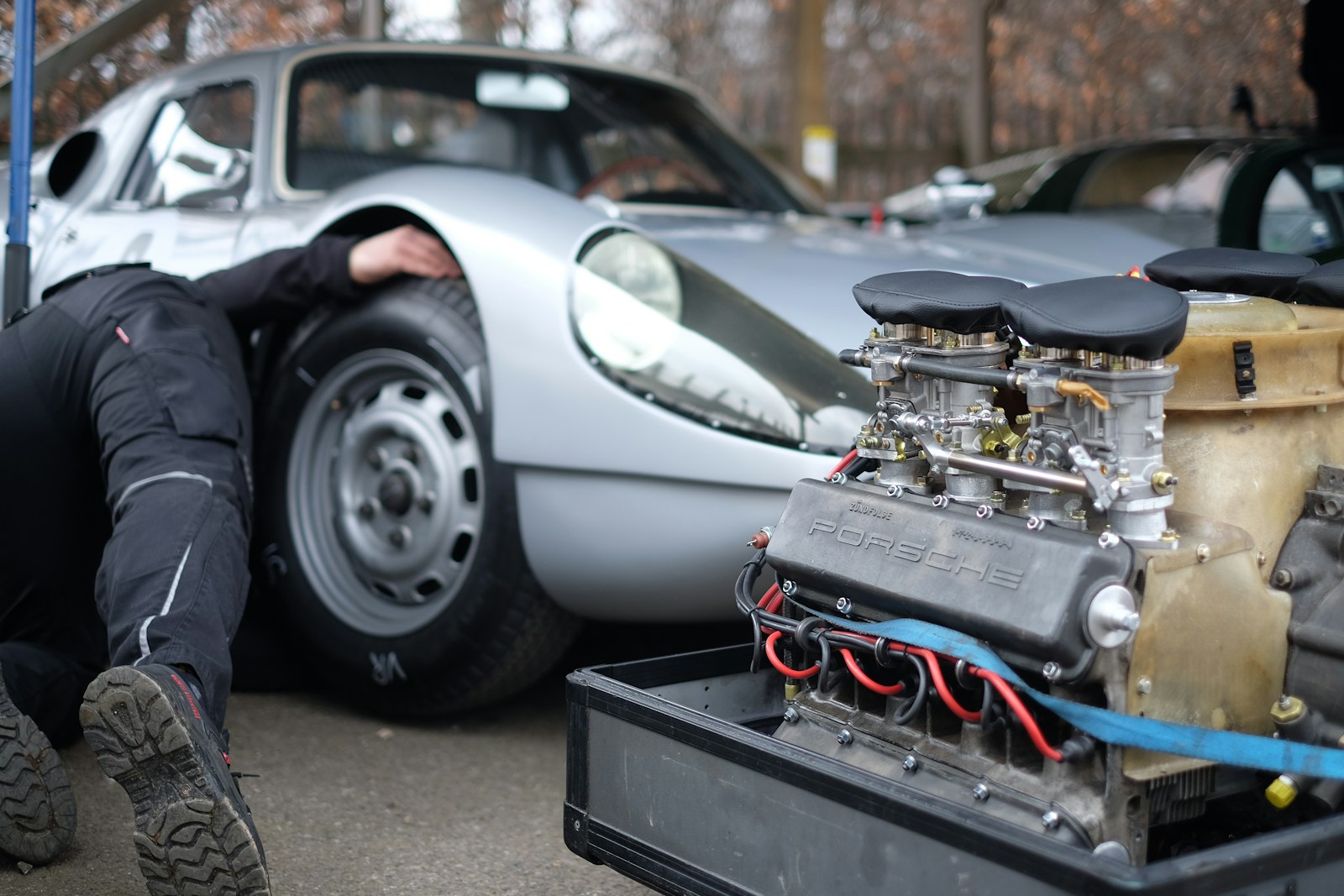
He’d been in the garage since breakfast, the kind of day where you don’t really eat so much as you orbit a cold coffee and whatever’s closest to the workbench. The crate engine sat there like a dare: fresh paint, clean casting marks, none of the grime and mystery you get with a junkyard pull. It was supposed to be the “easy” part of the build, the reward for months of measuring, cutting, and tacking metal together.
The plan was simple enough. He’d fabricated custom mounts to get the engine exactly where he wanted it, then had a buddy source the mount hardware from a local guy who “does fab stuff” and always seems to have bins of bolts and random brackets. They were finally at the satisfying stage where the hoist is doing less work, the drivetrain is hovering in its forever spot, and you can start picturing the first fire-up instead of another weekend of grinding welds.
He eased the hoist down a hair, watching the mount ears line up and the bolts seat. Everything looked right—until it didn’t. The whole drivetrain didn’t just settle; it dropped. Not a gentle sag. A straight, sickening fall of about four inches, like the engine decided it was done pretending and wanted to live on the crossmember now.
The moment it let go
At first he thought the hoist slipped. That’s the most comforting explanation, honestly: operator error, the chain shifted, maybe the boom pin wasn’t locked. But the hoist was fine, still holding tension, and the engine wasn’t swinging like something had slipped; it had simply ended up lower, tilted, and sitting wrong.
He froze with his hand still on the hoist handle, doing that mental scan everyone does when they hear a noise in a garage. No oil waterfall, no broken bellhousing, no shattered headers. Just the ugly geometry of things no longer being where they’re supposed to be, and a gap where there shouldn’t be one.
Then came the sound after the sound: a couple of small metallic ticks as pieces finished settling. His buddy, who’d been standing near the fender with a phone light, backed away like the car had feelings and might choose violence. Nobody said anything for a few seconds, because you don’t want to be the first one to name the problem out loud.
“Those bolts were tight… right?”
Once he was sure nothing was actively falling, he jacked the engine back up a little and started tracing the load path with his eyes. Mount plates looked intact. Welds weren’t torn. The motor mounts themselves hadn’t split in half the way cheap rubber sometimes does when it gets loaded weird. The failure was sneaky—something had let go internally, leaving the exterior looking almost normal.
He put a wrench on the mount bolt and immediately got that wrong feeling. It wasn’t loose like it had backed out; it was loose like the threads weren’t real anymore. The bolt turned with a gritty, inconsistent resistance, like it was chewing a candle. When he backed it out, it didn’t come out cleanly with crisp threads; it came out dragging pale, powdery metal and a couple of shiny flakes.
That’s when the “oh no” turned into the specific kind of “oh no” that makes you sit on the garage stool and stare at nothing. The bolts weren’t just threaded into steel or welded nuts like you’d expect. They were welded into something soft and cheap—pot metal, the brittle cast stuff that’s fine for ornamental parts and absolute garbage for anything holding an engine over your feet.
The drivetrain hadn’t dropped because he did something sloppy that morning. It dropped because the “welded-in bolts” were basically anchored in metal that can crumble if you look at it wrong. Under load, the threads didn’t strip so much as the surrounding material gave up, turning into glitter and dust while the engine chose gravity.
Following the parts back to their source
Once the initial adrenaline burned off, the investigation started. Where did those bolts even come from? He hadn’t welded them in himself; he’d been proud of the mounts, but the hardware and a couple of small plates had been “taken care of” by the buddy who knew a guy who knew a guy.
The story, as it emerged, was a familiar chain of garage logic. The local fabricator had “these mounts” already, or at least something close. He’d “reinforced” them. He’d “welded the bolts in so you don’t have to fight them.” It was all pitched as saving time, and at the moment it probably sounded reasonable because the engine was sitting there and everyone wanted to make progress.
But when the builder looked closer, it was obvious the parts weren’t made to live in that car, with that engine, under that torque. The welds had the look of someone who can make metal stick together but doesn’t think much about load direction. And the pot metal wasn’t a tiny cosmetic piece—it was part of the actual assembly that had been expected to hold hundreds of pounds and handle vibration like a punishment.
He sent pictures to the fabricator. Not dramatic photos, just close-ups: the powdered metal around the bolt, the weird porous fracture surface, the way the “reinforcement” ended exactly where stress would concentrate. The reply wasn’t an apology. It was more like confusion, then defensiveness, then the classic move: acting like the engine drop was proof the builder must’ve “done something” wrong during installation.
The argument nobody wanted to have
This is where it got personal, because it wasn’t just a bad part; it was a bad part delivered through a friend. The buddy who sourced the hardware wasn’t trying to sabotage anything. He’d been trying to help, and now he was stuck in the middle, watching the builder’s project take a hit and realizing his “I know a guy” shortcut had teeth.
The builder didn’t scream. That’s the part that made the tension worse. He got quiet and precise, laying the bolt and its crumbly captive metal on the bench like evidence. He started asking questions the way you do when you already know the answers and you’re trying to see if the other person will admit it.
Could the fabricator explain why a structural mount used pot metal at all? Why the bolt was welded into a material that can’t be trusted under cyclic load? Why none of this was disclosed, especially when the whole point of a crate engine and custom mounts is reliability and predictability? The answers were a mix of “it should’ve been fine,” “I’ve done it this way before,” and “you’re overthinking it.”
Meanwhile, the buddy was doing that awkward mediation where he repeats everyone’s points back in a softer tone, hoping language can turn a mechanical failure into a misunderstanding. But the builder wasn’t mad about a misunderstanding. He was mad because he’d been inches away from an engine crushing something expensive—or worse, someone.
Damage control in the garage
They spent the rest of the day undoing what had just been done. The engine got lifted back into a safe hover and supported with blocks, not just the hoist. The mounts came off, and once they were on the bench, the full stupidity of the setup was easier to see: the pot metal wasn’t just present; it was the foundation for the “welded-in bolt” trick.
He cut one of the assemblies open to confirm what he suspected. The inside wasn’t steel. It wasn’t even an alloy you’d argue about. It was the kind of casting that fractures like a cookie and leaves a dull, granular surface, the exact opposite of what you want near a weld holding a load-bearing fastener.
There was also the realization that the four-inch drop was almost a best-case scenario. It happened while they were lowering under control, not during a test drive when torque and vibration would’ve turned that failure into a chain reaction. If it had let go at speed, it could’ve yanked on the transmission mount, stressed the driveshaft angle, and damaged things that don’t just bolt back on with a better attitude.
So they did what builders always do when reality slaps them: they made a new plan that cost more time and more money. Proper steel mounts, proper hardware, proper captive nuts or welded bungs made from material that won’t crumble. No mystery parts, no “I had it laying around,” and no trusting someone’s confidence more than their metallurgy.
And the fabricator? He still wanted to argue it wasn’t his fault, that pot metal was “fine if you weld it right,” that the builder must’ve “shocked it” when lowering. The builder didn’t buy any of it, but he also didn’t get the satisfying closure of someone admitting they’d built a failure into the car. The engine ended the day suspended and safe, but the uncomfortable part hung around: it wasn’t the drivetrain that dropped four inches—it was the trust, and nobody could quite jack that back into place.