

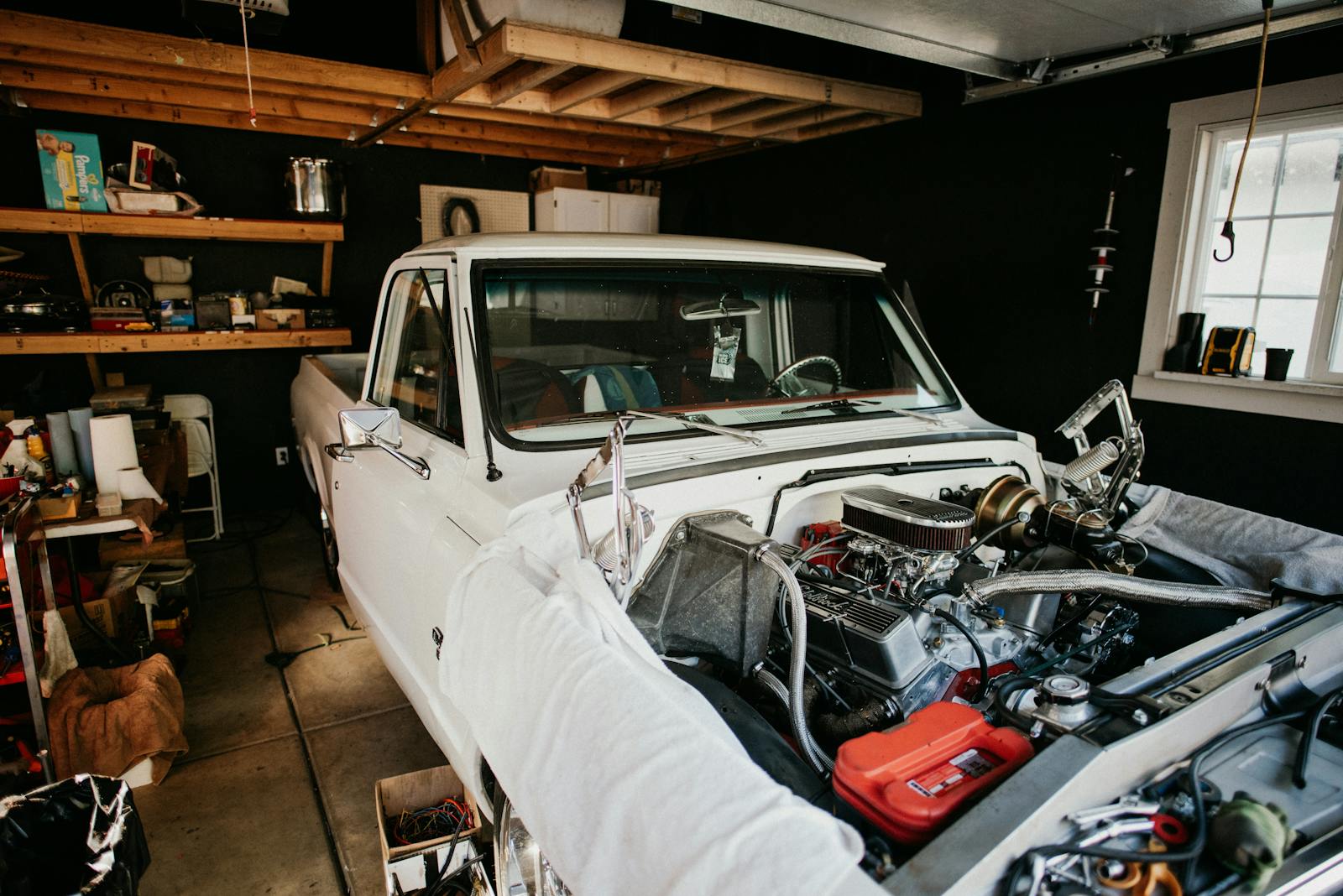
He’d been calling it a “quick Saturday fix,” the kind of lie every project-truck person tells themselves when they’re staring at rusty floorboards and a stack of sheet metal. The cab was up on stands, doors cracked open for airflow, and the whole garage smelled like hot steel and old upholstery. He’d already done the annoying part—cutting out the rotten sections—so in his mind the hard work was behind him.
The plan was simple: tack in the new floor pans, stitch-weld the seams, grind it all smooth, then reward himself with lunch. The carpet was still in the cab because he’d been working around it, lifting corners and shoving it back like it was a tarp. He’d even joked earlier that it was “fine” because he was only welding near the transmission tunnel and he had a spray bottle “if anything got spicy.”
What he didn’t clock—because nobody ever clocks it until they learn the hard way—is how long heat sticks around in thin sheet metal, and how nasty old carpet padding can be when it starts cooking. He set down the helmet, walked out, shut the garage door most of the way like he always did, and drove off thinking he’d be back in 30 minutes. The truck sat there quietly, doing its own slow, ugly chemistry experiment.
The floor pan job that wasn’t supposed to be a big deal
He’d bought the truck as a “solid cab with character,” which is code for: it looked decent from ten feet away and everything structural was trying to return to the earth. The floors were the worst of it—soft spots, jagged edges, and that familiar flake-rust that turns into confetti when you poke it with a screwdriver. He’d ordered replacement pans, spent a week measuring and trimming, and finally had them sitting in place like puzzle pieces that never quite match the picture on the box.
The cab interior was still mostly intact because he was doing this in a home garage, not a restoration shop with unlimited space and a rolling body cart. Pulling the seats and carpet sounded like “another whole day,” and he’d convinced himself the risk was manageable. He’d moved wiring out of the way, shoved a welding blanket near the firewall, and kept the extinguisher where he could see it.
There was also the momentum thing—once you start cutting and fitting, you don’t want to stop. He’d been in that hyper-focused zone, bouncing between the MIG welder and the angle grinder, checking gaps, tapping metal into alignment. Everything felt controlled, noisy, and productive, which is exactly how you miss the quiet problems starting under your feet.
The tiny warning signs he ignored
At some point he noticed a smell that wasn’t just welding—more like warm plastic and old dust. He paused, lifted his helmet, and looked around the cab like the answer was going to be obvious. The smoke he saw was faint, the kind that could’ve been residue burning off or old seam sealer getting toasted.
He spritzed the area with the spray bottle, more out of habit than alarm. It hissed on the warm metal, which made him feel like he’d done something responsible. Then he leaned back in, ran another short bead, and told himself he was overthinking it.
The thing about old truck carpet is that it’s never just carpet. It’s carpet, padding, adhesives, whatever somebody spilled in 1998, and sometimes a layer of jute that acts like a wick. You can hit it with sparks all day and nothing happens—until the heat gets trapped underneath and it starts smoldering like a barbecue starter you didn’t mean to light.
He left for lunch, and the cab stayed behind with a slow fire
When he decided to break for lunch, it wasn’t a dramatic decision. He was hungry, the welds were “good enough for now,” and he figured letting everything cool wouldn’t hurt. He unplugged the welder, took his gloves off, and walked away without doing a full look-over of the interior.
He didn’t open the doors wide and check under the carpet. He didn’t put his hand near the seams to feel for hidden heat. He didn’t sit in the cab and sniff around like a paranoid dog, because the job felt like it had reached a safe stopping point.
Inside the cab, though, the metal was still radiating heat into the padding. The carpet wasn’t flaming, not yet; it was doing that dangerous in-between thing where it cooks and smokes and builds momentum. With the garage door mostly shut, the smoke had nowhere to go except into the cab’s airspace, soaking into everything like a bad memory.
He came back to the kind of smoke that makes your brain hit the panic button
When he got home, the first thing that felt off wasn’t the sight—it was the smell. That sharp, chemical-burnt odor hit him as soon as he stepped into the garage, like melted electronics and scorched dirt. For a second he just stood there, trying to place it, because it didn’t match the normal “shop smell” he’d been living in all week.
Then he saw the haze. Not a cute little wisp, not a “something’s warm” hint—an actual thick, trapped cloud sitting inside the cab like the truck had been hotboxed with poison. The windows looked slightly fogged from the inside, and the interior had that muted look it gets when the air is full of particulates.
He yanked the door open and got a faceful of it. The kind of smoke that doesn’t just make you cough; it makes your eyes water immediately and your throat go scratchy like you swallowed sand. He backed up fast, suddenly aware that whatever was in there wasn’t just “smoke,” it was burning foam and adhesive and who-knows-what, and breathing it was a terrible idea.
He ran for the extinguisher on instinct, because that’s what your body does when you think “fire,” even if you don’t see flames. When he got back, he didn’t rush into the cab; he leaned in and looked low, scanning the floor seams, the edges of the new pan, anywhere the carpet tucked under. There was a dull orange glow in one spot near where the pan met the tunnel—tiny, but real.
He hit it with the extinguisher in short bursts. Powder went everywhere, instantly turning the cab into a chalky mess, but the glow disappeared. He wasn’t satisfied, though, so he grabbed the carpet and yanked it up harder than he’d been willing to earlier, tearing some of the old padding and exposing a blackened patch that looked like it had been charcoaled with a torch.
The mess afterward: not flames, but fallout
The immediate crisis ended the second the smoldering stopped, but the cab wasn’t “fine.” The interior smelled like burnt insulation and fire-extinguisher dust, a combo that clings to your clothes and makes you feel like you’ve been doing something criminal. The carpet had a scorched section and the padding underneath was half-melted, stuck to the metal like tar.
He opened both doors and dragged a fan over, then stood there in the driveway for a while just breathing normal air and replaying the last hour in his head. The scary part wasn’t what happened; it was how quietly it happened. He kept thinking about how close it came to actual flames licking up into the dash, and how he would’ve found out—if he found out at all.
There was also the awkward reality that he’d told people he was being careful. He’d mentioned the extinguisher, the spray bottle, the “I’ll keep an eye on it” routine, like saying it out loud makes it true. Now he was looking at the evidence that he’d basically left a slow-burning chemical factory inside a closed cab while he went to grab lunch.
He didn’t get to go back to welding that day. The rest of the afternoon turned into pulling more of the interior than he’d planned, scraping soot, vacuuming extinguisher powder, and trying to figure out what wiring or insulation might’ve gotten cooked without showing it. He kept pausing to sniff around like he was hunting for the next hidden ember, because once you’ve been surprised like that, you stop trusting “probably fine.”
By the time the garage aired out, the truck looked worse than it had that morning—more disassembled, more raw, like the project had decided to bite back. The floor pan welds were still there, but now they came with a side quest: replacing carpet, checking harnesses, and wondering what damage was done by smoke you couldn’t even see at first. And the part that stuck with him wasn’t the cleanup or the cost—it was the image of that cab sitting alone, doors shut, quietly filling with toxic smoke while he ate lunch like nothing in his world was on fire.