

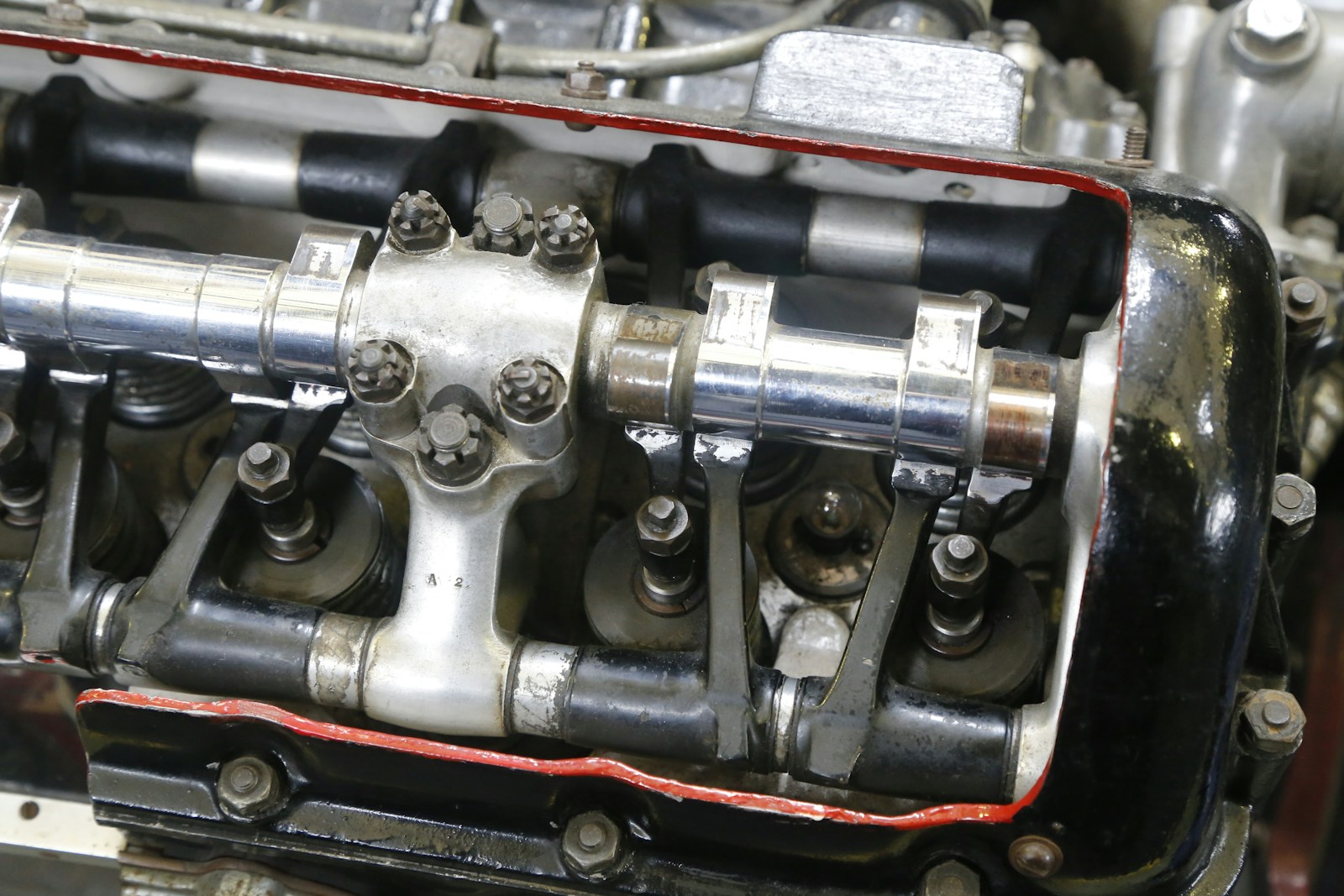
He had the valve covers off and a clean rag tucked into the valley like he was about to do surgery. The engine was fresh enough that the assembly lube still looked wet in places, and the guy building it—one of those patient, detail-obsessed project builders—was doing the slow, methodical dance of setting valve lash. Turn the crank, watch a rocker sweep through its arc, snug the adjuster, lock it down, move to the next one.
It was supposed to be the boring part. The kind of task where you can almost hear the engine running in your head while you work, because everything is new and square and finally coming together. He’d waited months to get to this point, and two months ago he’d paid a machine shop to handle some of the internal stuff he didn’t want to risk messing up. This was the payoff stage: bolt-on accessories, timing, lash, then fire.
And then, right in the middle of a normal adjustment, there was a sharp little pop that didn’t belong in any “new engine” soundtrack. Not a tool slipping. Not a wrench clicking. A pop like something loading up and letting go. He froze, stared, and watched a pushrod do something pushrods are not supposed to do: it bowed, kinked, and folded like a drinking straw.
The “This Can’t Be Right” Moment
He didn’t even reach for a wrench at first, because the instinct was denial. People don’t build engines for months just to casually snap a pushrod while turning things over by hand. The rocker was sitting at a weird angle, the pushrod looked like it had been hit with a hammer, and the valve spring beneath it was still standing there innocently like it had nothing to do with the crime scene.
He backed off the adjuster, thinking maybe he’d somehow cranked it down too far, maybe he’d caught the wrong cylinder on the wrong stroke. But the pushrod wasn’t “slightly bent,” the kind of bend you can roll on glass and frown at. It was bent in half. It had a crease. It was the mechanical version of a bone sticking out.
So he did what every careful builder does when something makes zero sense: he stopped. No more turning the engine, no more “just one more check,” none of that optimistic self-sabotage. He pulled the rocker back off, fished the mangled pushrod out, and stared down the pushrod hole like the answer might be sitting there waving.
Backing Up: Why a Shop Touched the Bottom End
The frustrating part was that he wasn’t new to this. He wasn’t the guy learning on his only vehicle, winging it with a YouTube video and hope. He’d done enough engines to know what careful looks like, and enough to know what he didn’t want to gamble on—so he’d sent parts out to a shop for work that required specialized tools and a level of precision that’s hard to fake.
Two months earlier, the shop had installed and/or handled the lifters as part of the engine’s prep. The builder had boxed everything up, labeled stuff, and paid real money for the peace of mind that comes from handing the fiddly internal work to people who do it all day. When the parts came back, everything looked fine. No missing pieces, no obvious damage, nothing that screamed “don’t put this together.”
That time gap is what makes stories like this so nasty. Two months is long enough that the shop invoice feels like ancient history, long enough that you’ve bolted on dozens of parts and made a hundred tiny decisions since then. When something catastrophic happens at lash-setting time, it doesn’t feel connected to anything you outsourced. It feels like you did something dumb five minutes ago.
The Investigation Gets Ugly Fast
Once the pushrod folded, the engine basically forced him into detective mode. He pulled the intake back off because there was no way he was going to gamble with “maybe it’s just that one.” The minute the lifter valley was visible, the mood shifted from confusion to dread. He wasn’t looking at a clean, uniform set of lifters sitting neatly in their bores; he was looking at evidence that something was mismatched.
With the lifters exposed, he started checking movement by hand. Some lifters rotated like they should. Others felt wrong—sticky, not quite seated, not behaving like the ones next to them. He compared positions against his build notes, and then he did the thing nobody wants to do: he started pulling lifters one by one to see what was actually in each bore.
That’s when the real problem crawled out into the light. The lifters weren’t just installed; they’d been installed in the wrong bores. Not “one might be slightly out of place,” but swapped around in a way that meant the geometry and alignment were wrong for where they were sitting. The engine didn’t care that it looked fine from the outside. Internally, it had been set up to fight itself.
Now the bent pushrod made sense in a horrible way. With the wrong lifter in the wrong spot, the pushrod wasn’t traveling in a straight, happy line. It was being forced into an angle, binding up, and as soon as there was enough load—pop—something had to give. Pushrods are cheap compared to valves, pistons, and cam lobes, but that’s a cold comfort when you’re staring at a brand-new build that might already have hidden damage.
The Phone Call Nobody Wants to Make
He didn’t call the shop immediately, at least not in the heat of the moment. He documented everything first, because this is the part where emotions can turn a mechanical problem into a personal war. Photos of lifter positions, markings, the bent pushrod next to a straight one, the way the rocker had been sitting—every little detail that could become an argument later.
When he finally called, the conversation did that awkward dance where one person is trying to stay calm and the other is trying to figure out whether they’re about to get blamed. The builder wasn’t screaming, but he wasn’t casual either. He had that tight, controlled tone of someone who’s holding back because if he lets go, he’s going to say something he can’t take back.
The shop’s first instinct was to ask questions that sounded suspiciously like “are you sure you didn’t do it?” What cam? What lifters? Did you mix them up? Did you adjust it wrong? The builder could answer all of it, because he had the notes and the photos and the simple fact that he hadn’t even gotten to startup. He wasn’t calling about a wiped cam after break-in. He was calling because the thing hurt itself while being turned by hand.
And then came the most maddening part: the uncertainty about what “making it right” even means. A shop can replace a pushrod in five seconds and pretend it’s over. But a bent pushrod is a symptom, not the disease. If the engine forced a pushrod into a crease hard enough to fold it, what did it do to the cam lobe? The lifter face? The valve? Did it kiss a piston? Did it gall something that won’t show up until 500 miles later?
Now It’s a Trust Problem, Not Just an Engine Problem
The builder was stuck in that brutal space between wanting to be fair and knowing he couldn’t afford to be naïve. If he tore it all the way down, he’d burn time and money, and the shop might say he “tampered” with their work. If he didn’t tear it down and something failed later, he’d always wonder if he’d ignored the warning signs to save a weekend.
Worse, the mistake wasn’t subtle. Installing lifters in the wrong bores isn’t the kind of thing you chalk up to “happens to the best of us” when the whole job is precision and procedure. It feels like somebody rushed, or didn’t label, or had a bad day and decided the engine would forgive them. Engines don’t forgive. They keep receipts.
So he did the unglamorous, exhausting thing: he started checking everything. Pushrod length, rocker geometry, lifter orientation, cam specs, bore identification—basically auditing his own build like he was trying to prove a court case. The engine sat there half-undressed again, the exact opposite of progress, while he measured and re-measured because trust had been broken and measurement is what people reach for when they don’t have trust anymore.
And that’s where the story leaves off, in that tense in-between stage where nothing is resolved and everything is expensive. The shop hasn’t admitted fault in a way that feels satisfying, the builder hasn’t decided whether to let them touch the engine again, and the engine itself is now a question mark—maybe fine, maybe already scarred, maybe a ticking time bomb. All because one mistake, made two months earlier in a place he couldn’t see, waited patiently until the exact moment he thought he was doing the easy part and turned a simple lash adjustment into a full-blown fallout.