

The shop had one of those routines that never really changes: phones ringing, cars stacked on the schedule like pancakes, a service writer speed-walking between bays with a clipboard, and techs moving fast enough to look busy even when they’re waiting on parts. The kind of place where “just top it off” gets said ten times a day and nobody asks what that actually means because everyone’s trying to keep the line moving.
It was late afternoon when the foreman finally noticed something that didn’t fit. Not a misfire, not a comeback, not a missing lug nut—something quieter. He caught a whiff near Bay 3 that was wrong for fresh oil: a sour, burnt smell mixed with that dirty-metal tang that clings to old drain pans and shop rags.
The tech working Bay 3 wasn’t new, and that mattered. He was one of those guys who kept his head down, didn’t argue, knocked out tickets, and somehow never seemed to run behind. He’d developed a little reputation as “efficient,” which in a flat-rate shop is the closest thing to sainthood.
The top-off ticket that didn’t add up
The customer’s car was a nothingburger of a job: quick inspection, check fluids, top off engine oil if needed. The service writer had even circled it in yellow like it was a favor for a regular. Nobody expected drama; it was supposed to be ten minutes and a courtesy sticker.
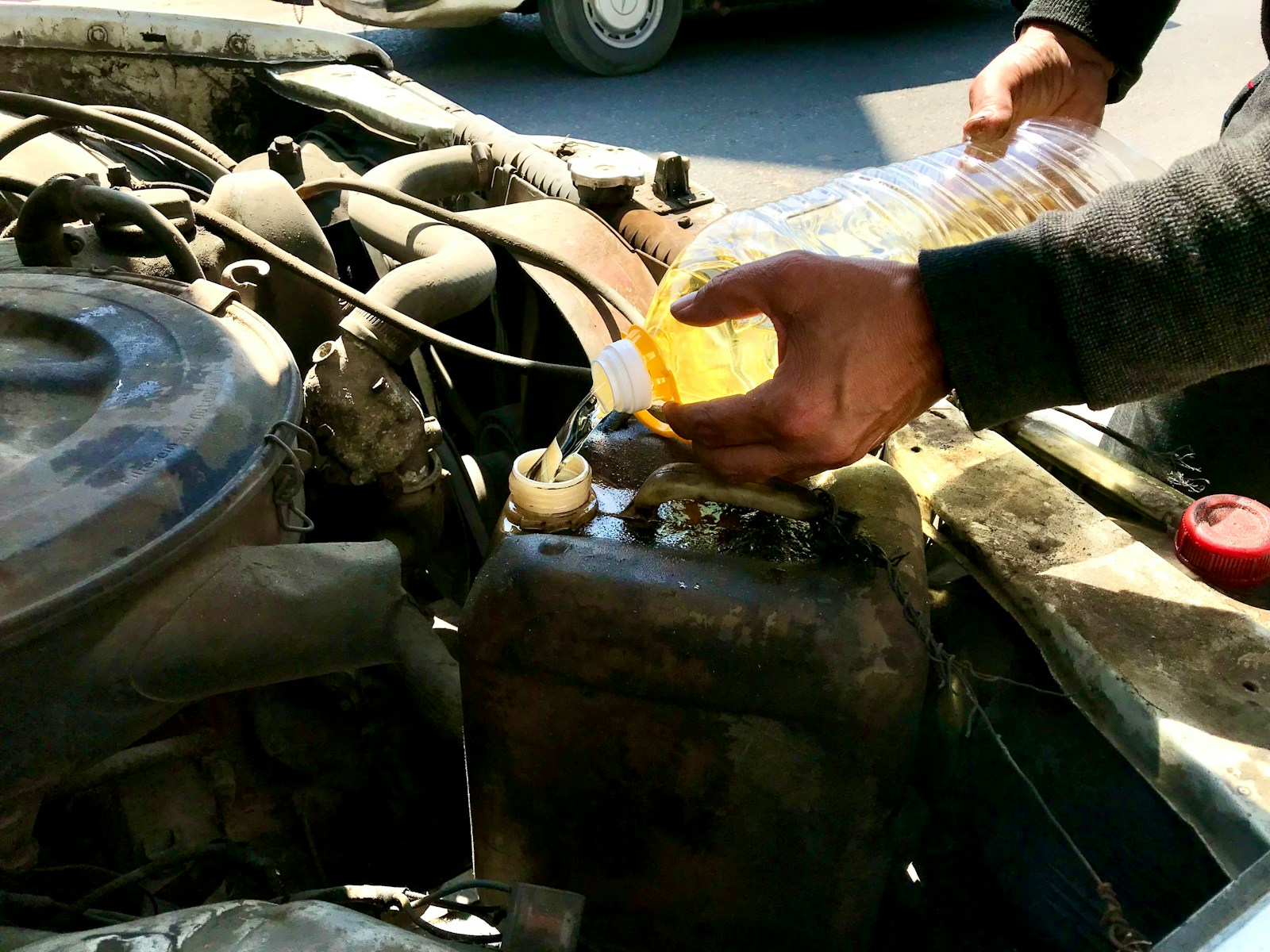
The foreman was walking past when he saw the tech reach for a bottle—then stop and set it down like he’d remembered something. Instead of grabbing the sealed quart, the tech leaned over to the workbench where the shop kept a beat-up drain pan and a couple of half-used funnels. He did this casual little scan around the bay first, like checking if anyone needed him, and then he dipped the funnel into the drain pan like he was scooping soup.
The foreman didn’t say anything at first because his brain tried to make it make sense. Maybe it was clean oil in the pan. Maybe the tech had just drained something and was transferring it. But the pan looked like every other shop pan: dark, metallic, with a thin rainbow sheen on top and tiny grit settled at the bottom.
Then the tech walked right over to the car and poured it into the engine like it was normal. Not rushed, not sneaky, just… practiced.
“What the hell are you doing?”
The foreman’s voice came out sharper than he meant, and it snapped the whole bay to attention. The tech froze mid-step, funnel still in his hand, and for a split second his face had that blank look people get when they’re caught doing something they’ve already justified to themselves. The kind of look that says, “We’re really doing this right now?”
The foreman walked over, took the funnel, and smelled it. You could tell he was trying to be calm, because he didn’t start yelling. He just held it up and stared at the tech like he was waiting for the punchline.
The tech tried to play it like it wasn’t a big deal. He muttered something about “it’s just a top-off” and “it’s basically oil,” the way people talk when they’re hoping the other person will accept a lazy explanation and move on. That’s when the foreman pointed at the drain pan and asked why there was sludge in it and why it looked like it had been sitting out all day.
There was a pause, and it got quiet in that way shops get quiet when everybody is pretending they’re not listening. The tech finally shrugged and said he’d “skimmed the clean stuff off the top.” Like the problem was only that the foreman didn’t understand his process.
The drain pan on the bench wasn’t an accident
Once the foreman’s brain caught up, he started noticing details he’d ignored before. The drain pan wasn’t down by the waste oil tank like it should’ve been; it lived on the bench, within easy reach, like a tool. There was a specific funnel next to it that looked older than the rest and had that permanent brown stain that never really washes out.
The foreman asked him straight up if he’d done this before. The tech didn’t answer immediately, which was an answer on its own. Then he said something like, “It’s not like I’m pouring coolant in there,” as if the defense was that he’d picked the least insane version of an insane choice.
The foreman told him to stop what he was doing and step away from the car. He popped the hood himself, pulled the dipstick, and you could see the oil was now a weird shade—darker than it should’ve been for a top-off, with that thin, watery look that used oil gets when it’s been heat-cycled to death. He stared at the dipstick a second too long, like he was trying to decide whether to be furious or disgusted.
Then came the worst part: the foreman asked how long. The tech shifted his weight, glanced toward the office, and said, “A while.” When the foreman pressed, the tech finally admitted it had been going on for about six months.
Six months of “efficiency” starts looking like sabotage
Once that number hit the air, the whole bay felt different. Suddenly “efficient” didn’t mean talented; it meant cutting corners so hard the corners disappeared. It explained why he never seemed to run out of quarts, why his trash didn’t have as many empty bottles, why he could knock out quick-lube style tickets without stopping at the parts counter.
The foreman did that slow, controlled thing where he asks very specific questions because he already knows the answers are going to be bad. Was it only for top-offs? Was it only on older cars? Did he ever do it on oil changes? The tech insisted it was just top-offs, just a splash, just when customers “didn’t want to pay.”
But it wasn’t the customers deciding to be cheap; it was the tech making that decision for them. A top-off is still a service, still something that ends up in an engine, still something the shop’s name gets attached to. The foreman pointed that out, and the tech’s face tightened like he’d been accused of something unfair, which was wild considering what he’d just admitted.
Someone from the next bay finally broke the tension with a quiet, “Dude,” the kind that’s half anger and half disappointment. The tech snapped back that everybody cuts corners, and the foreman immediately shut that down. “Not like this,” he said, and it wasn’t a speech—it was more like a warning to the whole room.
The scramble: paperwork, phones, and the customer in the waiting room
The shop manager got pulled in, then the service writer, and the office vibe went from chaotic to panicked. The customer was still sitting in the waiting area, sipping burnt coffee, thinking they were about to get their keys back. Nobody wanted to be the person who walked out and said, “So, your engine just got a shot of whatever was floating in our drain pan.”
They moved the car off the lane like it had become contagious. The foreman ordered an immediate drain and refill, new filter, the whole thing, and he made sure it was documented as a corrective service—not a “freebie,” not a quiet fix. The tech stood there watching, arms crossed, like he was being punished for being resourceful.
The service writer ended up doing the uncomfortable conversation with the customer, but you could hear the tone shift through the glass. There’s a specific cadence to “We need to redo something,” where it starts polite and becomes carefully vague. The customer’s head tilted, then they stood up, and the foreman could tell from their posture alone that “vague” wasn’t going to hold.
They didn’t get into a screaming match in the lobby, but it was close. The customer asked what happened, the service writer tried to keep it general, and the foreman finally stepped in and told the truth in plain words. The customer’s face went tight, like they were doing math: What did that do to my engine, how do I prove it, how many times has this happened to other people, and why should I trust anything you say now?
The tech’s last stand and the problem nobody wanted to name
Back in the bay, the tech kept trying to frame it as harmless. He argued that used oil is still oil, that modern engines can “handle it,” that the pan fluid was mostly clean on top, and that he wasn’t trying to hurt anyone. The foreman didn’t bite; he just asked why he didn’t use fresh oil like everyone else.
The tech finally said the quiet part out loud: he didn’t want to “waste” product on freebies, and he didn’t think the shop tracked it closely anyway. Which wasn’t just gross—it was a direct hit to how the whole place ran. If a tech is treating customer engines like a dumping ground for leftovers, then the shop isn’t a shop; it’s a liability machine with lifts.
By the time management told him to pack up his box, the tech was angry, not ashamed. He acted like he was being scapegoated for a culture problem, like everyone else was just lucky they didn’t get caught. And maybe that’s what made it so tense: he wasn’t entirely wrong that shops have gray areas, but this wasn’t gray—it was black sludge in a funnel.
The foreman stood there after the tech left, staring at the bench where that drain pan had been sitting like a normal tool. Six months meant dozens of cars, maybe more, and there was no clean way to count them. The mess wasn’t just one engine and one tech; it was the sick feeling that the shop’s “efficient guy” had been quietly poisoning trust for half a year, and now every bottle of oil on the shelf looked like a question nobody could answer with confidence.