

He found the listing on a Thursday night, the kind of post that reads like a dare: “Mechanic special. Runs… kinda. Bring a trailer.” The photos were a little too artsy for a truck ad—sunset glare, tall grass up to the rocker panels, a front end that looked proud of surviving a few lives. The price was $8,000, which was either hilarious or suspicious depending on how deep you’d been in the used-truck trenches.
The buyer wasn’t looking for perfect. He wanted a work truck, something older and simple enough that you could actually reach parts without removing a plastic maze first. And the seller had the right story: “Been sitting a while. I started it last year. It’ll go with fresh gas.” That “a while” turned out to mean four years in a field, which the buyer only pieced together later, like a plot detail that should’ve been underlined.
He brought cash, a buddy, and a battery booster, because that’s what you do when you’re about to buy a vehicle that’s been used as an outdoor storage unit. The seller met them at the edge of a property where the grass was taller than the tires and the truck sat at an angle, like it had settled into the earth and decided it was staying. The buyer walked around it slowly, doing that thing where you pretend you’re calm while your brain is already adding up repairs.
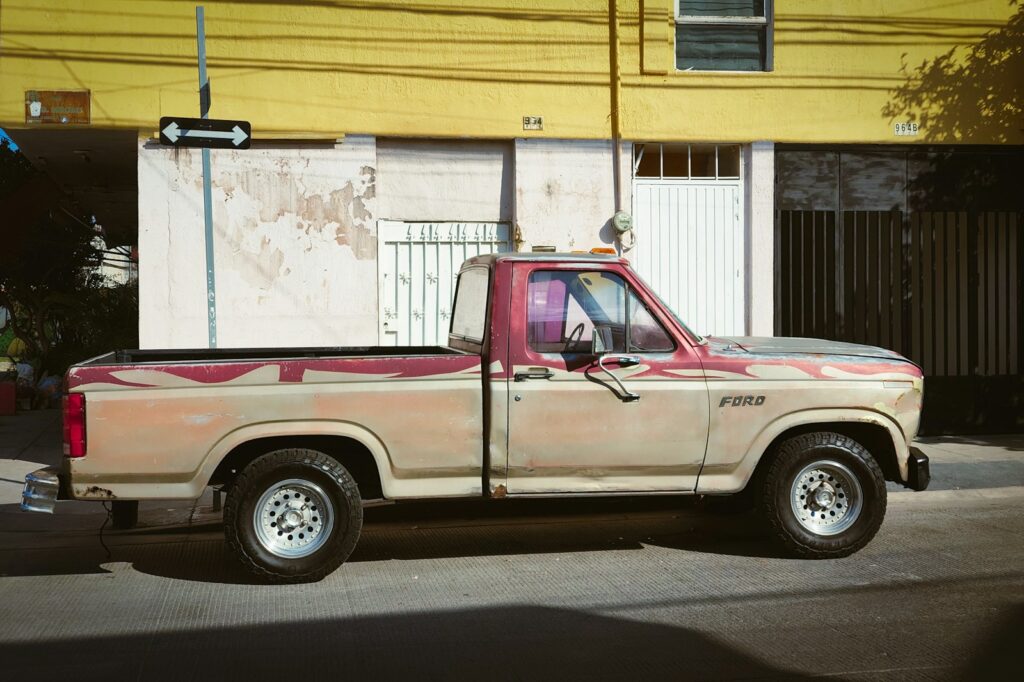
The “It’s Just Been Sitting” Walkthrough
The seller talked fast, in loops. The truck “ran when parked,” the title was “clean,” and the only reason it was being sold was “I’ve got too many projects.” He kept saying “easy fix” while pointing at big problems: a cracked mirror, a sagging rear leaf, a tire with sidewall checks like dried riverbeds.
The buyer did the usual checks—oil looked dark but present, coolant wasn’t chocolate milk, transmission fluid didn’t smell like a campfire. The cab smelled like old vinyl and mouse pee, but that’s not uncommon when something sits. What did feel off was how the seller hovered near the hood, like he didn’t want it open for too long.
They got it to crank with the booster, and after a few coughs it stumbled into an idle that sounded like it was chewing gravel. The seller immediately started talking louder, as if volume could smooth out the misfire. The buyer heard it too, but he also heard the dollar signs in his head and started negotiating with himself: if it’s just plugs, just coils, just old gas… maybe.
The deal went down in the awkward way these deals always do. The buyer counted out bills on the tailgate while the seller pretended not to watch. They shook hands, the buyer loaded it up, and by the time he drove away he had that sinking feeling that the seller looked a little too relieved.
Getting It Home and the First Bad Signs
In his driveway, the buyer did what he should’ve done in the field: he slowed down and started really looking. The battery tray had corrosion that looked like it had its own ecosystem. Under the bed, there were remnants of something shredded—insulation, paper, maybe a grocery bag—caught in places the wind couldn’t reach.
He vacuumed the cab, pulled out a handful of acorn shells from under the seats, and found the kind of brittle, pale droppings that don’t come from a dog. When he turned the key again, the idle wandered, and every time he blipped the throttle the engine hesitated like it had to think about it. The check engine light stayed on, steady and confident.
His buddy suggested the obvious: start with air and spark. The buyer popped the hood and stared at the intake tubing, already dusty and sun-faded. It was one of those moments where the truck’s history felt physical, like you could trace the last four years by the layer of dirt on every surface.
He unclipped the air box, expecting maybe a dirty filter, maybe some leaves. He even joked about finding a mouse. Then he lifted the lid and stopped talking.
The Air Box That Shouldn’t Have Had Weight
The first thing was the smell—stale urine, must, and that sharp, sweet rot you get when organic stuff breaks down in a sealed space. The second thing was the material: shredded paper, dried grass, insulation, and bits of fabric packed in so tightly it looked intentional. The air filter wasn’t just dirty; it was gone, or at least it was buried somewhere under a compressed mattress of nest.
He reached in with gloved hands and pulled. Nothing gave easily. Whatever had been living there hadn’t built a casual nest; it had built a bunker. The pile kept coming out in slabs, like he was excavating a weird, fibrous brick.
After a few minutes, he was standing over a growing heap on the concrete, and the cavity inside the air box still looked full. He grabbed a flashlight and shined it down through the intake path, and that’s when he realized the headline detail that makes people wince: it wasn’t a few inches of debris. It was deep. Two feet deep, packed down, reaching into places that should’ve only ever seen clean air.
It didn’t feel like “rat’s nest” as a phrase anymore. It was a whole rental property, built and expanded over seasons. The buyer kept pulling material out and it kept replenishing, like the truck had been hollowed out and filled with someone else’s plan.
The Fight Between “Project” and “Problem”
Once the shock wore off, the buyer’s brain did that rapid-fire math it does when you’ve already handed over money. If the intake was packed, what about the throttle body? The mass airflow sensor? The vacuum lines? And the nightmare question: did anything make it past the filter area and into the engine?
He texted the seller a photo of the pile on his driveway, because it was impossible not to. The seller responded with the kind of message that tries to be casual and fails: “Oh wow. Yeah, it sat out there a while. Didn’t think they got into that.” No offer to help, no “let’s make it right,” just a shrug translated into punctuation.
The buyer pushed back, pointed out that the truck had been described as “just needs fresh gas,” and asked how long it had really been sitting. That’s when the story got more specific, like the seller finally stopped improvising and picked the truth he could defend. Four years, he admitted, give or take. It had been parked when a “small issue” popped up, then life happened, then it became a lawn ornament.
The buyer felt that specific kind of anger you get when you realize you didn’t just buy a broken thing—you bought someone else’s avoidance. He wasn’t mad that it needed work; he’d agreed to that. He was mad that “mechanic special” had been used like a blanket to cover up “wildlife condo inside your intake.”
He called the seller and got a conversation that went nowhere. The seller leaned hard on “as-is,” like saying it enough times could rewrite the earlier promises. The buyer tried to keep it civil, but you could hear the restraint slipping—because $8,000 is not pocket change, and the truck was now a question mark with a title.
Cleaning, Diagnosing, and Realizing How Deep It Goes
Over the next day, the buyer kept tearing down. The air box came out, then the intake tubing, then the throttle body, which had a paste of grime and nest dust baked into the edges. He found chewed wiring nearby—little tooth marks in the harness insulation that made his stomach drop, because that’s the kind of damage that doesn’t announce itself until you’re chasing ghosts for weeks.
He could get the engine to run, but it didn’t run right. It would idle, then surge, then stumble, and every time he thought he’d solved it, something else appeared: a vacuum line cracked from age, a connector corroded, a sensor reading nonsense. The truck wasn’t one problem; it was a stack of problems, some mechanical, some biological, and some just plain neglect.
The buyer started gathering receipts and taking photos like a person building a case. Not because he had a clear legal plan, but because the act of documenting made him feel less helpless. He had that impulse to send the seller an itemized list, like accountability could be invoiced.
But the seller stayed on the same track. No refund. No partial. Just variations of “you looked at it” and “it started.” The buyer’s frustration shifted into that colder, quieter zone where you stop arguing and start deciding what you can live with: eat the loss, dump it, or go all-in and rebuild until the truck finally becomes what you thought you were buying.
And that’s where the story lingered, in the messy middle. The truck sat in the buyer’s driveway, hood up, air intake parts laid out like organs on a table, and the seller went back to his life as if four years in a field was a minor detail. The buyer didn’t have a triumphant ending yet—just a pile of nesting material on the concrete and the uneasy feeling that he hadn’t even found the worst of what had been hiding inside.
More from Steel Horse Rides: