

He thought he was doing a small, family-sized favor. One car, tucked along the side of the yard for “a couple weeks,” while his cousin figured out a new apartment situation. That was the pitch: a single vehicle, keys left with the cousin, nothing leaking, nothing loud, nothing that would get the neighbors interested.
The man’s place wasn’t some sprawling rural property where you can hide a scrapyard behind a tree line. It was a normal house with a normal-sized yard, the kind where you mow and wave at the guy two doors down and try not to become “that house.” Still, he had a patch of gravel by the fence and figured it wouldn’t kill him to let one car sit there for a bit.
He went out of town for work not long after, which made it even easier to say yes. “I’ll be gone, you won’t even see me,” his cousin told him, like that was supposed to be reassuring. When he came back, it wasn’t the original car that caught his eye first—it was the fact that his driveway looked like someone had started building a car from memory and given up halfway through.
The “one car” agreement
Before any of the chaos, there was an actual conversation, and that’s what made him feel like he wasn’t being reckless. His cousin called him in that practiced, breezy tone people use when they already know they’re asking for something they shouldn’t. The car had “nowhere to go,” the landlord at the cousin’s place was being “weird,” and the cousin “just needed a little time.”
The man laid down the obvious boundary: one car, no working on it, no parts, no bringing buddies over, no late-night wrenching. The cousin agreed so quickly it should’ve been suspicious. He even said something like, “I’m not trying to turn your place into a shop,” which sounded like a line he’d used before.
They did the handoff on a weekday evening. The cousin rolled in, parked the car where he was told, and walked around it like a realtor showing a house—“See? Clean. It’s fine.” The man noticed the trunk didn’t quite close right, but he let it go, because family favors are always made of tiny swallowed objections.
Coming home to a junkyard
He got back from his trip late, tired enough to be on autopilot. Pulling onto his street, he noticed a silhouette near the fence that wasn’t there before—something boxy and low. Then his headlights hit a trailer, angled like it had been backed in fast and left wherever it landed.
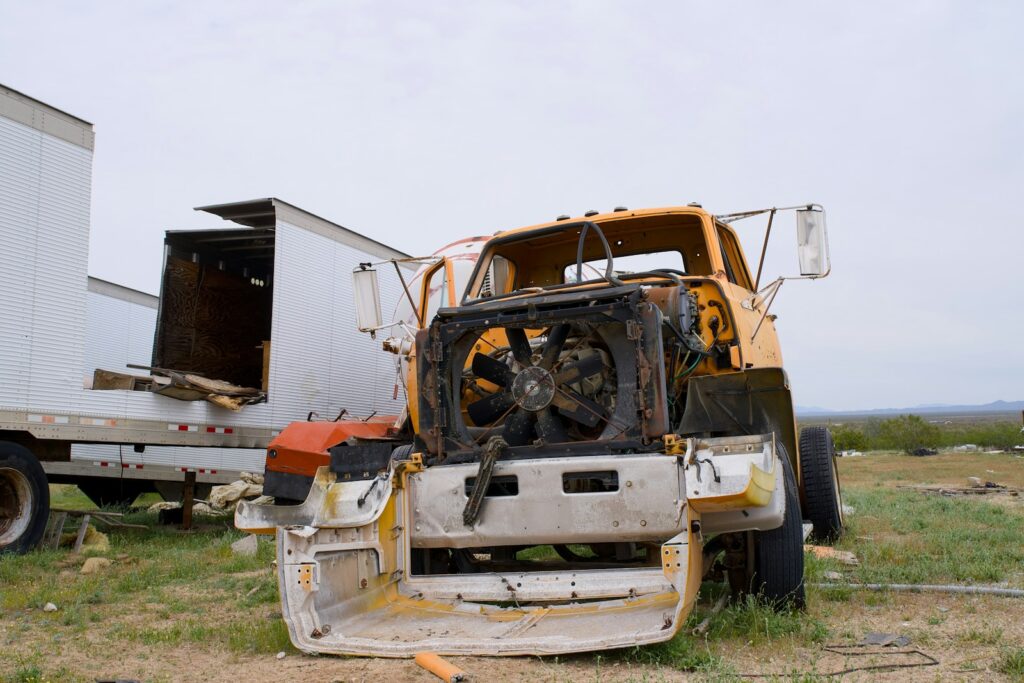
By the time he parked, the scene started to resolve in his mind into individual problems. The “one car” was there, but it wasn’t alone. There were two more cars—well, “cars” in the sense that they were arrangements of metal in the general shape of a car, missing panels and wearing different-colored doors like borrowed clothes.
He walked out into the yard and realized he was looking at three parts cars, not three intact vehicles. One had its hood removed and leaning against the fence like a billboard. Another had no wheels and sat on mismatched blocks, the kind you wouldn’t trust under a birdhouse, let alone a car.
Then he saw the engines. Two of them, sitting like heavy punctuation marks in the grass, with oily cardboard shoved underneath in a halfhearted attempt at responsibility. The trailer was full of junk—rims, a cracked bumper, bags of mystery bolts, a couple of seats, what looked like a radiator, and a pile of trim pieces that could’ve belonged to any decade.
The cousin’s “it’s temporary” logic
He called his cousin right there, standing in the yard like a guy who’d just discovered termites. The cousin answered on the third ring with a little too much cheer, like he’d been expecting the call. When the man asked why there were “multiple vehicles and engines” on his property, the cousin didn’t even pretend to be confused.
It was all framed as if the man was being dramatic about a technicality. The cousin said the original car “kind of turned into a project,” and the other cars were “donors.” In his mind, it was still one car—just spread out, temporarily, across the yard in a way that required three VINs and a trailer to accomplish.
The man reminded him of the agreement: one car, stored, not worked on. The cousin responded with that slippery, family-argument phrasing where each sentence is an attempt to move the goalposts without admitting it. “I’m not really working on it,” he said, while also explaining that the engine swap “had to happen” because the first engine “was trash.”
He promised he’d “clean it up this weekend,” which sounded like a promise he’d made to multiple people before. He also threw in a guilt angle—how hard things had been, how he was “just trying to get back on his feet.” It was the kind of speech that makes you feel cruel for wanting your lawn to remain recognizable as a lawn.
Neighbors, boundaries, and the slow boil
The next day, the man got the first neighbor interaction, and it wasn’t subtle. The neighbor from across the street made a point of walking over while he was outside and staring a little too long at the trailer. He didn’t yell or accuse; he just asked, “Everything okay over here?” in that way that means, Are we about to have a problem?
That’s when the man’s anger sharpened into something more specific. It wasn’t just about clutter or inconvenience—it was about reputation, property, and the fact that he was the one who would get the complaints. His cousin wasn’t the one who’d be cornered on garbage day or have to worry about a code enforcement notice taped to the door.
He texted his cousin a deadline: everything gone by Sunday evening. The cousin replied with a thumbs-up and “Got you,” which somehow made it worse. Sunday came, and instead of the pile shrinking, it looked like it had been “organized,” meaning the cousin had moved some junk from one side of the yard to the other like that counted as progress.
There were signs of active tinkering now, too. A jack handle left out. A drip trail that wasn’t there before. A greasy rag stuffed into the fence slats like the yard was a workshop with storage.
The confrontation and the awkward math of family
On Monday, the man didn’t call—he drove to where his cousin was staying and confronted him in person. The cousin tried to do it in public, outside, leaning against a porch rail like it was a casual chat. The man didn’t match the vibe; he asked, flat out, whether his cousin was planning to remove the cars or just keep expanding the pile until the yard was unlivable.
The cousin’s tone changed once it was face-to-face. He got defensive and started counting favors like receipts. He reminded the man of times he’d helped with a move, a borrowed tool that was returned late, a ride to the airport years ago—anything that could turn this from “you lied and dumped a scrapyard in my yard” into “you owe me patience.”
The man didn’t argue those old debts. He just repeated the boundary and added a new one: if the cars and trailer weren’t removed by a specific time, he was calling a tow company. That’s when the cousin tried the last move—acting hurt, like he’d been betrayed. He asked, “You’d really do that to family?” as if family was supposed to mean unlimited storage and zero accountability.
The man pointed out that family was also supposed to mean not taking advantage and not creating a problem someone else has to solve. The cousin stared at him for a long second and said he’d handle it, but his face had that look people get when they’ve decided they’re the victim no matter what happens next. The argument ended without a neat resolution, which was its own kind of exhausting.
The messy aftermath in the yard
Back at home, the man did what people do when they realize “a couple weeks” is turning into a lifestyle. He started documenting everything—photos of the engines in the grass, the trailer’s license plate, the cars in their current state, the oil spots, the text messages. It wasn’t about revenge; it was about finally accepting that he might need proof to make the problem go away.
He checked local towing rules and found out it wasn’t as simple as pointing at a car and making it disappear. Some places require notices, some require proof it’s on your property without permission, some require a waiting period. The cousin had effectively turned the yard into a legal inconvenience, too, a little hostage situation made out of rust and missing bumpers.
Midweek, the cousin did show up, but not with a plan that felt like an actual plan. He arrived with one friend and the kind of confidence that suggests they were going to “make a dent” and then get distracted. They moved a few items from the trailer into the trunk of one parts car, like that was a meaningful step, and talked loudly about what they’d do “once they got the right tool.”
The man watched from the porch, arms crossed, feeling that weird mix of relief and rage you get when someone finally responds but still isn’t respecting you. The yard still looked like a junkyard; it just looked like a junkyard with activity. And the cousin kept acting like the man should be grateful for the effort, instead of furious that this was effort that never should’ve been required.
By the time the week ended, the cars were still there, the engines were still there, and the trailer still squatted in the grass like it belonged. The cousin was still talking in maybes—“tomorrow,” “after I get paid,” “once my buddy’s truck is free”—and the man was stuck in that brutal family limbo where enforcing boundaries makes you the villain and tolerating disrespect makes you the fool. The most unsettling part wasn’t the junk; it was realizing his cousin had managed to turn a simple favor into an ongoing test of how much he’d put up with before he finally snapped.
More from Steel Horse Rides: