

She’d only gone in for something boring. A quick tire swap, a little balancing, maybe a polite upsell attempt on wiper blades, and then back to the rest of her day. The kind of errand you barely remember, except for the receipt crumpled in your cupholder and the faint smell of rubber clinging to your car for a few miles.
The shop had that familiar vibe: loud air guns, a TV mounted in the corner playing something nobody was actually watching, and a front counter where you can hear the mechanics more clearly than the person talking to you. She waited, paid, nodded through the standard “you’re good to go,” and drove off believing the whole thing was handled by people who do this all day.
Then, not long after, the car started doing that subtle-but-wrong wobble. At first it felt like the road was uneven, like she’d hit a patch of grooved pavement. But it didn’t go away, and it didn’t feel like a normal “new tires” sensation either—it felt loose, like something was lagging behind the steering wheel.
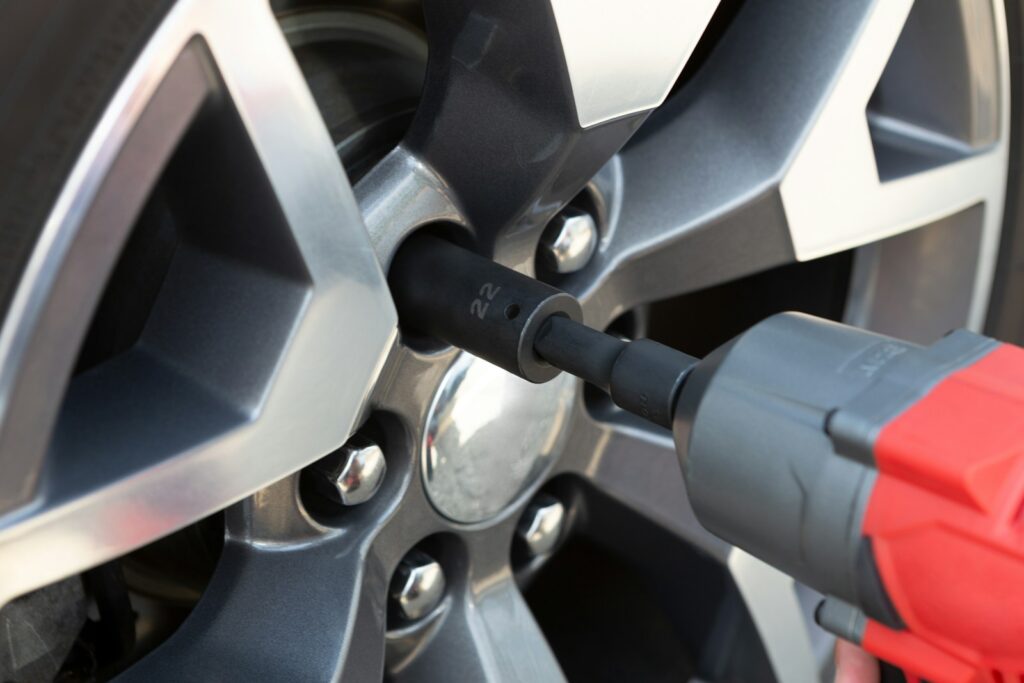
The first signs something was off
She slowed down and tried to convince herself it was nothing. Maybe the tires needed to “settle,” maybe the balance was a hair off, maybe she was just hyperaware because she’d just spent money and was waiting to be disappointed. Still, the shaking got worse when she braked, and the car started pulling like it had a mind of its own.
When she finally pulled over, she did the thing a lot of people do when they’re not car experts but they’re not helpless either: she got out and looked. Nothing dramatic at first glance—no flat, no obvious damage, nothing visibly flapping. But when she crouched near the front wheel and looked closer, her stomach sank.
The lug nuts didn’t look right. Not “dirty” or “old,” but visibly not seated the way they should be, like they’d been started and never fully tightened. She touched one and it moved with a little nudge, the kind of movement that tells you it wasn’t torqued down with anything more serious than a lazy wrist.
At that point she didn’t try to drive it back like a hero. She called for help—tow, roadside, a friend with a stronger stomach for car nonsense—and just stared at the wheel like it was a magic trick she didn’t want to see the ending of. This was the exact nightmare scenario every tire shop promises won’t happen because “we torque everything to spec.”
The wheel actually comes off
The ending didn’t take long to show up. By the time she was getting the car moved—whether it was a short roll, a repositioning, or that last little bit before it was fully secured—the wheel finally gave up on the idea of staying attached. It came loose in the most humiliating way possible: not with a cinematic explosion, but with a heavy, ugly drop that made it instantly obvious how close she’d been to disaster.
It’s one thing to feel a vibration and worry you’re being paranoid. It’s another thing to watch your own wheel separate from your car like it’s choosing a different career path. The kind of thing that makes you replay the last few minutes in your head—every lane change, every brake tap, every moment you were next to someone else’s family in a minivan.
She was rattled, embarrassed, furious, and also weirdly focused. Because there’s a clean, simple explanation for this kind of failure when it happens right after service: somebody didn’t tighten the lug nuts. And if that’s what happened, it wasn’t just a mistake—it was a mistake with a body count attached to it if the timing had been even slightly different.
So she did what any reasonable person would do. She contacted the shop, told them exactly what happened, and expected at least the basics: concern, accountability, maybe a “don’t drive it, we’ll send someone,” even if it was paired with some defensive corporate language. What she got instead was the kind of response that makes your jaw go slack.
“Probably a coincidence”
The shop’s first move was to treat it like a mystery with no suspects. She told them the wheel came off shortly after they’d worked on it, and she’d noticed the lug nuts weren’t tight. Their reaction wasn’t panic or apology—it was a shrug disguised as customer service voice.
According to her, someone actually suggested the wheel falling off was “probably a coincidence.” Not in a “we need to inspect it first” way. In a way that implied wheels just decide to detach sometimes, like it’s seasonal or caused by mercury in retrograde.
And that’s where the tone of the whole thing shifted. A wheel falling off isn’t a bad coffee order or a scratch on a rim. It’s the kind of issue where you want the business to sound scared, because scared means they understand what could’ve happened.
Instead, she got the vibe they were trying to nudge her toward self-doubt. Like maybe she’d hit something. Like maybe she’d messed with it. Like maybe the universe simply plucked her lug nuts loose for no reason right after she left their bay.
The awkward escalation at the shop
She pushed back and, from what she described, the conversation turned into that infuriating loop where the customer is talking about reality and the business is talking about liability. They asked questions that sounded less like troubleshooting and more like building a case file. When did it happen? How far did she drive? Did anyone else touch the wheel?
What made it worse was that the timeline wasn’t fuzzy. She’d been there, she’d paid, she’d driven off, and the problem showed up immediately. This wasn’t a wheel coming off six months later after a pothole-laden winter, it was practically still under the scent cloud of their tire machine.
She went in person, because sometimes people get braver on the phone and quieter when you’re standing in front of them with a receipt. In the lobby, everything was normal—customers waiting, the same buzz of tools—except now she was carrying a story nobody wanted to be part of.
Staff members gave her that careful, measured attention that isn’t quite concern. The kind where they’re listening, but also watching to see how loud you’ll get. Someone offered to “take a look,” which is a perfectly fine first step, except it came wrapped in the same vibe: maybe this wasn’t their fault, maybe it was just one of those things.
And the whole time she’s thinking: what do you mean “take a look”? The wheel came off. There isn’t a hidden diagnosis here. There’s “you tightened it” or “you didn’t.”
Damage control, denial, and the receipt in her hand
Once the initial shock wears off, the conflict becomes about something messier than the wheel. It becomes about being taken seriously. She wasn’t walking in asking for a freebie; she was walking in trying to get someone to acknowledge that a basic safety step may have been skipped.
The shop, on the other hand, seemed determined to keep everything in the realm of ambiguity. If they admitted it was their fault, it’s not just a redo—it’s towing costs, potential body damage, potential claims, and the bigger question of whether this happens to other customers who aren’t lucky enough to notice the wobble before the wheel commits fully to leaving.
So she held onto the hard facts. The service was recent. The symptoms were immediate. The lug nuts were visibly loose. A wheel doesn’t sheer itself off out of spite, and lug nuts don’t back out in the span of a few miles unless they were never tightened properly in the first place.
And still, the word “coincidence” hung in the air like an insult. It wasn’t just dismissive—it was a quiet accusation that she was exaggerating or misunderstanding what she saw. Like she didn’t know what a lug nut is, even as she’s staring at the consequences of them not being tightened.
By the time she left that interaction—whether with the car still immobilized, or with plans for an inspection, or with a promise of a call back—she wasn’t just stressed about repairs. She was stressed about the feeling that she’d stepped into a familiar script: a customer saying something dangerous happened, and a business trying to sand down the story until it sounds like nobody’s fault.
The part that sticks isn’t even the wheel on the ground, as horrifying as that is. It’s the casualness of “probably a coincidence,” like the line was picked from a menu of phrases designed to make a problem feel smaller than it is. Because once you’ve had a wheel come off, you don’t just worry about your own car—you start wondering how many other people drove away trusting the same hands, and how close they got to learning the hard way that “coincidence” can weigh about forty pounds and bounce.
More from Steel Horse Rides: