


By the time her ex started showing up in the frozen foods aisle, she’d already talked herself out of being paranoid three separate times. The first “coincidence” was him popping into her work lobby with a coffee in his hand, acting like he’d just been in the neighborhood. The second was him pulling into the same grocery store parking lot she uses even though it’s out of his way, waving like they were still friendly.
She’d broken up with him months earlier, and it wasn’t one of those “we’ll always be friends” splits. It was the kind where you block numbers, change a few passwords, and tell your friends you don’t want updates. So when he kept “randomly” appearing where she was—work, the store, her friend’s house—she started doing that thing people do when something feels wrong: making excuses for it, then immediately feeling stupid for making excuses.
She tried to keep it casual at first, like maybe he was just being annoying instead of dangerous. But the pattern got tighter, the timing got cleaner, and his explanations got flimsier in that confident way that made her skin crawl. He didn’t look surprised to see her anymore; he looked like he’d expected her, like he’d arrived a minute early.
The “small world” phase stops feeling small
At the beginning, his drop-ins were easy to write off because they were public and brief. He’d stroll up with that fake-friendly smile and ask how she’d been, like they were catching up at a party instead of in a fluorescent-lit checkout line. If she got cold, he’d switch to wounded, like she was being rude for not appreciating his “maturity.”
Then it started getting weird in the way that makes you check your mirrors more than you should. She’d leave work and notice his car idling two rows over, or she’d see him across the street when she stopped for gas. He never did anything that screamed crime drama—no shouting, no threats—but he kept appearing in her orbit like a magnet she couldn’t pry off.
She told a coworker one afternoon after he’d shown up at her workplace again, this time with a casual “I was meeting someone nearby.” The coworker did that careful face people make when they don’t want to freak you out but also don’t want to lie. “How would he even know you’re here right now?” she asked, and the question landed harder than it should’ve.
He finds her at her friend’s house, and she stops playing dumb
The moment that snapped it from “annoying” to “I need to take this seriously” happened on a regular weeknight. She’d gone to a friend’s house after work, the kind of low-key visit where you’re in sweats, eating leftovers, and decompressing. She hadn’t posted anything, hadn’t texted anyone about it besides that friend, and her car was parked down the street because the driveway was full.
They were mid-conversation when her phone buzzed with a message from an unknown number. It was him: “Didn’t know you were over here.” No context, no greeting, just that, like he’d caught her doing something wrong.
Her friend looked out the front window and went quiet. His car was parked across the street, lights off, the silhouette unmistakable. Not pulling up, not driving by—parked, waiting, like he’d been there long enough to get comfortable.
She didn’t go outside. She didn’t answer. She sat on the couch trying to keep her breathing normal while her friend whispered, “That’s not normal behavior,” like she needed permission to believe her own instincts.
The “Find My” alert opens a door she didn’t want to open
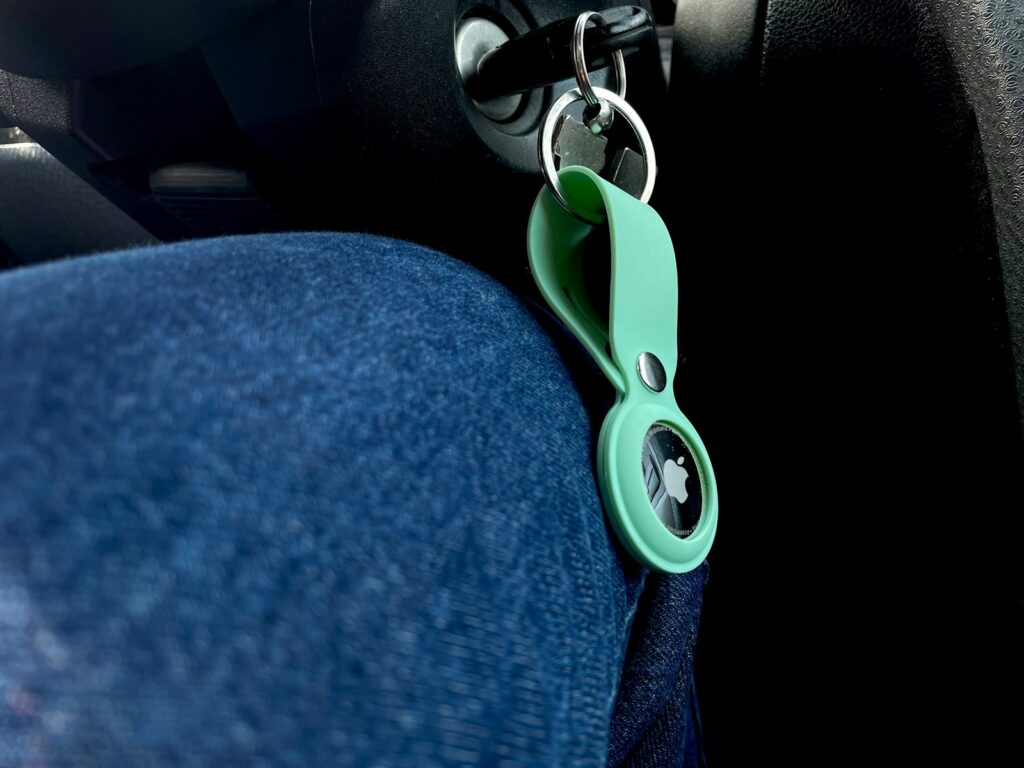
The next morning, she got the alert on her phone: an AirTag had been detected moving with her. It wasn’t one of those vague notifications people ignore about Bluetooth headphones; it was specific, the kind that tells you something has been traveling with you for a while. The timing was almost insulting—like the universe finally got tired of her trying to rationalize things.
She tapped through the prompts with that shaky, focused calm that happens when fear turns into action. The phone showed a map of recent locations, dotted with places she’d been: work, the grocery store, the friend’s house. It even listed time stamps, making the “coincidences” look less like a pattern and more like a schedule.
Her first instinct was to tear her car apart right there in the parking lot. Instead, she drove to a busier area and sat in her locked car, scanning the instructions about making the AirTag play a sound. She hit the button, waited, and heard it—faint at first, then clearer—like a tiny electronic chirp coming from somewhere she couldn’t immediately see.
She got out and crouched, leaning down near the wheels, feeling ridiculous and exposed. And then she spotted it: tucked up under the car, stuck in place in a way that wasn’t accidental. It was the kind of detail that makes your stomach drop, because it means someone spent time down there with their hands on your vehicle, deciding where to hide a tracker so it wouldn’t fall off.
When she confronts him, he doesn’t even pretend well
She didn’t call him right away. She took photos, multiple angles, close-ups of the AirTag where it was hidden, and a shot of her phone screen showing the alert. She called a friend first, because saying it out loud made it real: “There’s literally a tracker under my car.”
Then she called the non-emergency line, because she wasn’t sure what else to do and because she didn’t want to be alone with that knowledge. The officer she spoke to didn’t sound shocked—more like weary—which somehow made it worse. They told her to keep the device, not destroy it, and to document everything: sightings, messages, times, locations, anything that established a pattern.
It was only after that, once she’d done the responsible steps, that she sent her ex a message. Not a dramatic paragraph, just: “Why is there an AirTag under my car.” She added a photo, because she didn’t want him wriggling out of it with word games.
His response came fast, like he’d been waiting. First he went with denial—“What are you talking about?”—then anger—“Are you accusing me of something?”—then a weird pivot into concern. “You should be careful, someone could be stalking you,” he wrote, as if he hadn’t just accidentally proven he knew exactly what was going on.
When she didn’t bite, he shifted again into that slick, minimizing tone. He claimed it must’ve been a mistake, that he had AirTags and “maybe one fell out” and “you know how technology is.” The problem with that line was simple: AirTags don’t climb under cars and stick themselves in hidden spots.
Fallout: locking everything down and realizing how much he knew
Once the AirTag was out, she expected to feel relief. Instead she felt exposed, like the tracker had just been one symptom of a bigger issue: how easily he’d inserted himself into her life without her consent. She started replaying little moments from the breakup—him asking odd questions, him suddenly “remembering” errands near her job, him mentioning streets she never remembered talking about.
She changed routines immediately. Different grocery store, different commute, no more predictable gym times, and she asked her boss if security could walk her out for a while. She also had that uncomfortable conversation with friends: if he asks where she is, if he tries to fish for details, don’t give him anything, not even casually.
Her friend group did what friend groups do in a crisis: they got practical fast. Someone offered to check her car for other devices, someone else suggested getting her locks re-keyed, someone dug up screenshots of his past messages where he’d hinted at “keeping an eye on her.” The more they compiled, the more it stopped looking like one impulsive mistake and started looking like a plan.
And he didn’t stop being himself just because she’d found the AirTag. He sent waves of texts that swung from apologetic to furious, sometimes within the same hour. One minute it was “I just miss you,” the next it was “You’re trying to ruin my life,” like her finding a tracker on her car was an attack on him.
The part that stuck with her, the part she couldn’t shake, wasn’t even the device itself. It was the calm certainty he’d had when he showed up places, like the world was still arranged around him getting access to her. Finding the AirTag didn’t wrap the story up; it just proved she wasn’t imagining the pattern—and it left her staring at a new, uglier question: if he was willing to crawl under her car and plant a tracker, what else had he already done that she hadn’t found yet?
More from Steel Horse Rides: