

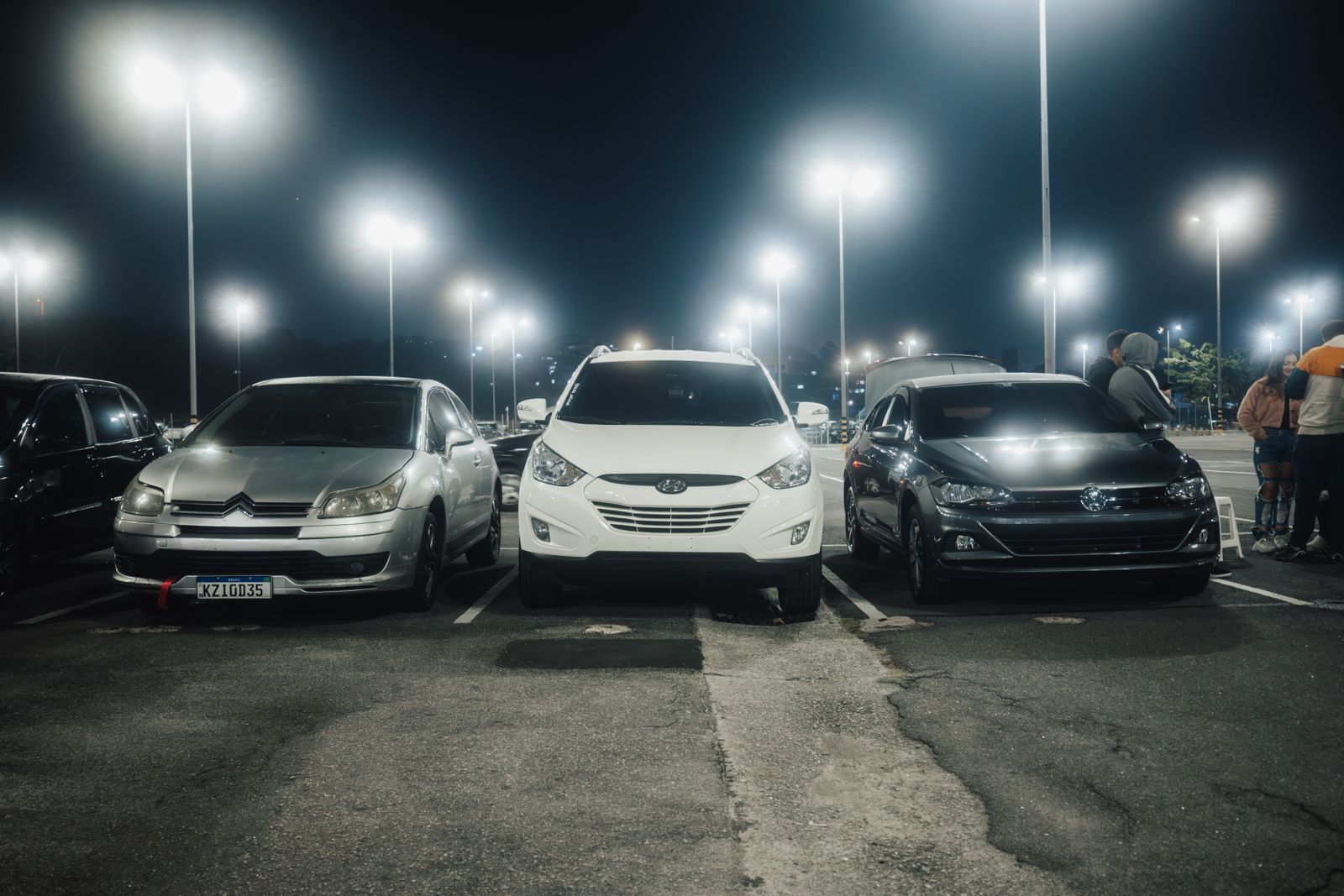
She noticed it before she even hit the lock button. The car looked… off, like one of the lines didn’t match the way it always did. At first she thought it was just the harsh parking lot light catching the paint weird, but then she saw the scuff: a long gray smear across the rear bumper, the kind that only comes from someone else’s car dragging along yours while they pretend they’re “just squeezing out.”
It had been a normal errand run—quick stop, in and out, nothing dramatic. She’d parked a little farther from the entrance on purpose because she was tired of door dings and people swinging bags into her panels like the universe owed them a dent. So standing there with her key still in her hand, looking at a fresh scrape that absolutely hadn’t been there earlier, she did the slow, annoyed scan of the surrounding cars like maybe the guilty one was still sitting there, engine warm, driver pretending not to notice her.
Then she saw the paper tucked under her wiper. For half a second she actually felt relief, because a note meant responsibility, right? A decent person leaves a note. She pulled it out, unfolded it, and read something along the lines of: “So sorry! I hit your car. Please call me.” Underneath was a name and a phone number written in a rushed, slightly shaky hand.
The note that almost worked
She stood there and called the number immediately, because that’s what you do when you’re trying to keep things simple. It rang once, twice, and then went to a voicemail that didn’t sound personalized—no name, no “you’ve reached,” just the generic automated prompt. She hung up, tried again, and got the same thing, that small sinking feeling starting to creep in.
She texted too, a straightforward message: “Hi, you left a note on my car. Can you call me back about the damage?” She included a photo of the bumper because she figured it would cut down on the inevitable “it wasn’t that bad” minimizing. The message stayed on “delivered” long enough to feel like a human might see it, but nothing came back.
That’s when she actually looked at the note like it might contain a clue instead of just an apology. The handwriting was real enough, not printed, not obviously fake. The paper was torn from something cheap, like a receipt or an old notebook, and the ink was darker in some spots where the pen had pressed harder.
Still, there was something about it that nagged at her—like it was trying to perform responsibility rather than actually be it. And once that thought landed, everything about the parking lot felt different. It wasn’t a “wow, someone owned up” situation anymore; it was “someone wants me to think they owned up.”
When the number turns out to be a dead end
She gave it a little time because sometimes people are driving, or in a store, or just flustered. She went inside, finished her errand, and checked her phone again. No response. She called again while walking back to her car, and that voicemail answered like a brick wall.
Back at home, she tried one more time from a different number—her partner’s phone—because she wondered if she’d been blocked already. Same result, same automated voice. At that point, she did the thing everyone does now: she searched the number online to see if it was tied to anyone, or if it was one of those obvious throwaway numbers that show up in scam reports.
Nothing. No name, no carrier info that made sense, no “this number belongs to…” just emptiness. That’s when it clicked that the note wasn’t a lifeline; it was a prop. Whoever hit her car hadn’t left contact information—they’d left a distraction, a little paper alibi to make themselves feel less like a villain while still disappearing.
She went back out to the car and took a full set of pictures: close-ups of the scrape, wide shots showing the parking space, the angle, the surrounding area. The damage wasn’t catastrophic, but it was the kind of cosmetic hit that makes you grind your teeth because it’s expensive enough to matter and petty enough to feel insulting.
Trying to reconstruct an invisible driver
The most frustrating part was how ordinary the whole scene had been. There wasn’t shattered plastic everywhere or a pile of debris that screamed “major collision.” It looked like a slow, careless bump—someone turning too tight, misjudging their distance, or backing out while staring at their backup camera like it’s a substitute for actually looking.
She drove back to the parking lot the next day, not because she expected the culprit to return like a guilty ghost, but because she remembered there were cameras. Some lots have them aimed at entrances or cart returns, and sometimes that’s enough. She went inside and asked the manager, trying to keep her voice calm and not sound like she was about to accuse every customer in the building.
The manager did the sympathetic face first, then the corporate face. Yes, there are cameras, but they mostly monitor the storefront. No, customers can’t view footage. Yes, police can request it, but it depends on the time stamp and whether it actually shows anything useful.
And of course, she didn’t have an exact time. She had a rough window—an hour, maybe an hour and a half—because she’d done two stops. That’s the kind of uncertainty that turns “let’s check the tape” into “we can’t reasonably comb through everything,” and you could tell from the way the manager’s patience tightened that this was a conversation they’d had a hundred times.
The awkward dance with insurance and the police
She filed a police report anyway, because her insurance company told her to. Not because the police were going to launch a detective hunt for the Great Parking Lot Bumper Bandit, but because having a report helps establish that it was a hit-and-run. The officer who took the information sounded tired in that specific way that says, “I believe you, but I also know how this usually ends.”
The note became its own weird exhibit. She read the number out loud and spelled the name, and the officer wrote it down like it might matter, even though you could tell both of them were thinking the same thing: if it’s fake, it’s fake. She offered the paper itself, and he told her to keep it in case insurance wanted it, which felt like being handed back a puzzle piece from a puzzle no one was going to finish.
Insurance was a different flavor of frustration. They asked for photos, asked for the report number, asked if she had any witness information. When she said she had a note, you could practically hear the adjuster perk up—until she explained the number went nowhere, and then the conversation slid back into the familiar territory of deductibles and estimates.
She got a quote from a body shop that confirmed what she already suspected: even “minor” bumper damage can turn into a few hundred bucks fast, more if there’s hidden damage under the paint. The shop guy did that gentle shrug people do when they don’t want to say “that’ll be pricey” too bluntly. It wasn’t an emergency repair, but it was a constant reminder every time she walked up to the car.
How the fake note makes it personal
If the other driver had just vanished with no note, she said she’d be mad, but it would be the kind of mad you swallow because there’s nothing to grab onto. The fake note changed the whole emotional texture of it. It wasn’t just carelessness; it was someone taking the time to stage a little performance of decency.
She kept replaying it: a person hits a parked car, pauses long enough to write an apology, and then—what? Scribbles a wrong digit “by accident”? Or intentionally writes down a number that can’t be traced because they’re hoping the note itself will calm their guilt? She started noticing how many people in parking lots seem to operate on this unspoken belief that if the damage is “not that bad,” it doesn’t count.
And then there was the paranoia spiral that always shows up in these stories: maybe the person watched her from inside their car while she read the note. Maybe they were parked across the lane, waiting until she left. Maybe they told themselves, “I did the right thing,” and drove away without a second thought while she stood there holding their little paper lie.
She didn’t have the license plate. She didn’t have a color match, beyond a smear that could’ve been any dull gray sedan or SUV. All she had was that note and the feeling that someone had tried to outsmart her in the laziest way possible.
By the end of it, the scrape on the bumper was almost the least aggravating part. The unresolved part—the part that stuck—was knowing the other driver had enough awareness to know they’d caused a problem, and enough cowardice to turn “sorry” into a dead number and a disappearing act. Every time she looked at that crumpled paper on her kitchen counter, it didn’t feel like an apology anymore; it felt like proof that someone out there can hit your car, fake their way through accountability, and keep going like nothing happened.