

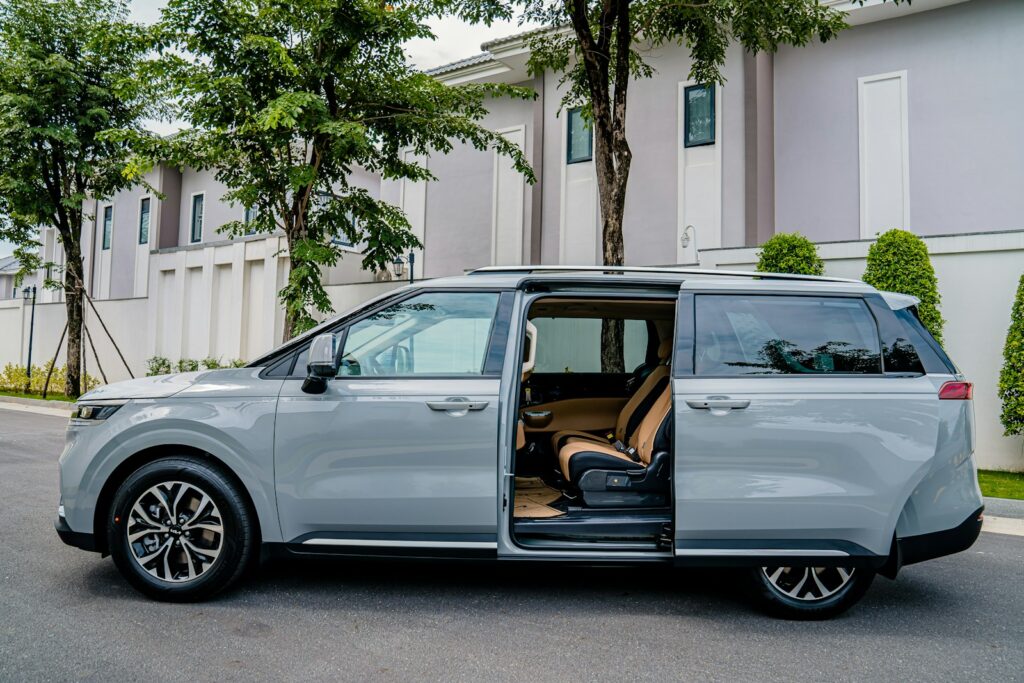
She’d been driving that minivan for years, the kind with the stubborn sliding door and a faint smell of crushed crackers baked into the floor mats. It wasn’t sexy, but it was theirs—paid off, reliable, and set up like a tiny rolling command center for a family that always seemed to be carrying something. Car seats, groceries, science fair projects, soccer gear, the dog’s muddy towel in the back. The van was the one thing in their life that didn’t come with a monthly payment attached.
On a Tuesday that started like any other, she took her husband’s older sedan to work because the minivan needed an oil change and he’d offered to “handle it” while she was gone. It was one of those small, almost sweet divisions of labor that makes a marriage feel functional: she’d work her shift, he’d take the van in, everybody wins. She even left the insurance card and the service coupon in the cup holder like a helpful note to the universe.
She got through her day, answered emails, dealt with a cranky customer, and checked her phone at lunch to see if he’d texted an update. Nothing. When she finally clocked out and pulled into their driveway that evening, what she saw sitting in the spot where the minivan normally lived didn’t look like an oil change had happened. It looked like her husband had swapped their entire life out for a monster truck.
The driveway surprise
It was a lifted truck, towering and shiny, the kind with oversized tires that looked like they belonged on a different planet. It had a ladder-like step rail under the door and windows tinted dark enough to reflect her own confused face back at her. She sat in the sedan for a full minute, staring at it, trying to make her brain line up the facts.
When she walked inside, he was in the kitchen like it was a normal Tuesday, humming and scrolling his phone with the casual ease of someone who hadn’t just detonated their household. She asked where the van was. He didn’t even look up at first—just said, “Oh, I traded it in.”
She laughed once, involuntarily, like her body was trying to reject the sentence. Traded it in. Not “took it to a different shop,” not “it’s going to be ready tomorrow,” not even “it’s in the driveway but you didn’t see it.” He finally looked up and nodded toward the window, as if the new truck outside was a perfectly logical substitute for the vehicle that had hauled their kids to every appointment and practice for years.
“More useful” according to him
Her first question was basic: how. The minivan was in her name, she was the one who’d pushed to pay it off early, and she kept the title in a folder because she was the family member who remembered where important documents lived. He had a story ready, delivered with that odd blend of confidence and vagueness that people use when they’ve decided details are optional: he “handled the paperwork,” the dealership “made it easy,” they “just needed her insurance info.”
Then he hit her with the line that made her stop listening to the logistics and start feeling the heat rise in her face. “The family needed something more useful,” he said, like he’d solved a problem she’d been too emotional to recognize. He gestured broadly, already selling the fantasy: a truck would be better for “projects,” for hauling things, for “getting ahead,” for all the theoretical tasks that sounded like they belonged to a man who spent weekends watching home renovation videos.
She reminded him—calmly at first—that “useful” in their actual life meant room for two car seats, space for groceries, and a trunk that didn’t require a rock-climb to reach. She pointed out that she was the one who drove the kids most days, the one who did daycare drop-off, the one who could slide into tight parking spots at school without sweating. He nodded like he understood, but his expression had that stubborn set that said he’d already decided the conversation was just a formality.
The money part he tried to gloss over
That’s when she asked the question that always turns these arguments from emotional to concrete: how much. He hesitated just long enough to be noticeable. Then he admitted there was a loan.
Not a small one, either. The van had been paid off, meaning their monthly budget had finally gotten some breathing room, and now there was a fresh payment sitting in its place like an ugly new roommate. He’d rolled taxes and fees into it too—because, of course he had—and the interest rate was “fine,” which in this context meant he didn’t want to say it out loud.
She asked what they got for the trade-in. He started talking about “market value” and “what they offered,” and she could tell by the way he kept drifting into dealership-speak that he was trying to make the number feel inevitable. In the end, it wasn’t the exact amount that wrecked her; it was the fact he’d made a major financial move without even warning her, like she was a passenger in her own marriage.
He tried to soften it with perks. The truck was “safer,” he said, because it sat higher. It would “last forever.” It had a touchscreen. He said this like those were the reasons families stay solvent, like a touchscreen mattered more than the reality that they now had a loan because he got bored with a paid-off vehicle.
The first time she tried to drive it
They went outside because she needed proof this wasn’t a surreal prank. Up close, the truck was even more ridiculous—clean enough to look unused, lifted enough that she had to grab the steering wheel to hoist herself in. It smelled like that aggressive new-car scent that clings to your clothes after ten minutes.
She adjusted the seat, tried to find a comfortable position, and immediately realized she couldn’t see the hood in a way that made her feel remotely in control. The side mirrors felt like they were a mile away. When she looked back, the bed was empty—no tools, no lumber, no evidence of this “usefulness” he’d declared essential.
He stood there with his arms folded, smiling like a proud kid next to a science project, waiting for her to admit it was awesome. She turned the ignition, felt the engine rumble, and all she could think about was the daycare parking lot and the way other parents already drove like they had something to prove. She put it in reverse, backed up carefully, and the truck’s backup camera beeped at a leaf. A leaf.
She pulled back into the driveway and shut it off without saying much. The silence was the kind that doesn’t cool anything down; it just moves the heat into a different room. He started again with, “Once you get used to it—” and she cut him off with a simple question: “Where are the kids going to sit when your brother asks us to help move a couch?”
What made it worse than a car
The fight that night wasn’t just about the truck. It was about permission and respect, about how he’d acted like her contribution—the van payments she’d made, the errands she ran, the ways she kept the family running—was interchangeable with his impulse. She told him it felt like he’d erased her without even checking if she’d mind being erased.
He didn’t apologize so much as defend the decision on repeat. He said he’d been “thinking about it for a while,” as if private thinking was the same thing as joint planning. He said he “knew she’d say no,” and somehow presented that as evidence he was acting boldly, not evidence he understood he was crossing a line.
Then she asked for the title and the paperwork, and he went weirdly tense. He said it was “in the glove compartment,” except it wasn’t—just a stack of dealership forms and a temporary registration that had his name all over it. When she asked how he even signed the trade-in documents without her there, he got defensive and vague again, saying the dealership “didn’t make it complicated,” which did not reassure her in the slightest.
By the end of the night, she wasn’t even yelling. She was too busy mentally running through the list of what else he might decide was “more useful” one day. Their savings. Her schedule. The way she spent her time. The whole thing sat in her chest like a heavy object she couldn’t set down.
The truck stayed in the driveway, looming, looking expensive and proud in the porch light. She slept on the edge of the bed, staring at the ceiling, hearing him breathe like he could actually relax. And the part that kept looping in her head wasn’t the loan or the dealership or even the minivan itself—it was the ease with which he’d made a life-altering choice and then tried to sell it as a favor, like she was supposed to thank him for taking the steering wheel out of her hands.
More from Steel Horse Rides: