

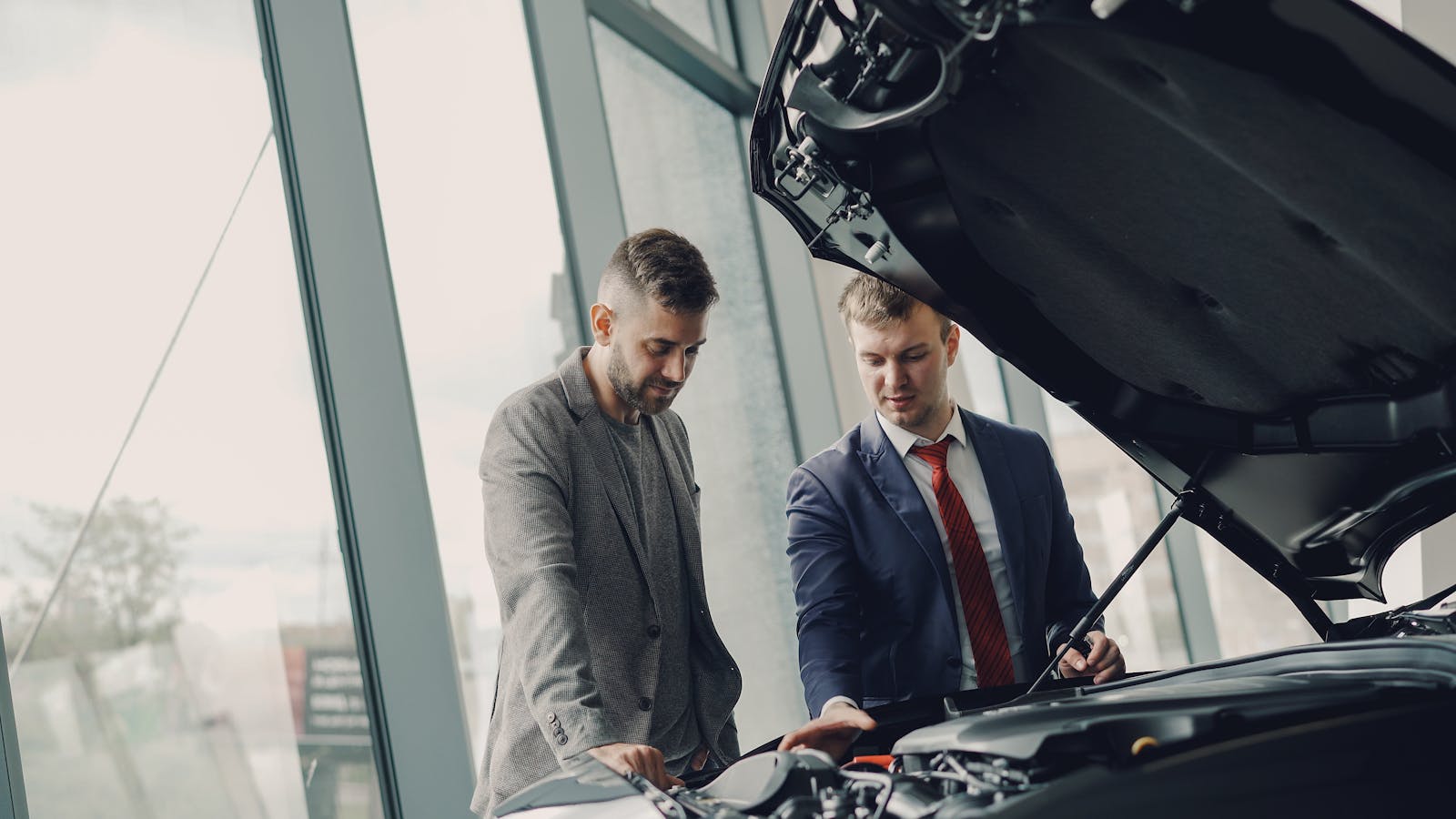
By the time she realized they weren’t just “stopping by to look,” she was already trapped in the glass-and-fluorescent world of the dealership, clutching her purse like it could anchor her. Her husband had been oddly upbeat all morning, the kind of cheerful that comes with an agenda. He kept saying it would be “fun” to check out the new trucks, like it was a little weekend errand instead of something with consequences.
She wasn’t anti-truck. She just didn’t need one, and more importantly, she didn’t want a car payment again. Her SUV was paid off—completely—after years of careful budgeting, extra payments, and the occasional “no” to things they could’ve had if she’d been willing to finance her life. The SUV wasn’t flashy, but it was hers in the quiet, adult way that mattered: a title with no lien, freedom from monthly bills, the ability to breathe.
So when a salesman walked up and greeted her husband by name, and then casually asked, “So are we trading in the SUV today?” she felt her stomach drop like she’d missed a step on a staircase. Her husband didn’t even flinch. He just smiled and said, “Yep, we’re ready.”
The SUV That Was Finally “Done”
She’d bought the SUV before they were married, or right at the beginning—depending on whose timeline you believed, because he liked to blur that part. Either way, she’d been the one making sure the payments got made, the maintenance stayed on schedule, and the insurance didn’t lapse. When the last payment cleared, she’d told him they should celebrate with dinner, something small to mark the moment they stopped owing someone else for a basic necessity.
He’d congratulated her, sure, but he also didn’t hide that he thought it was kind of boring. He was always looking at bigger vehicles online, always pointing out trucks with towing packages they’d never use and off-road tires that would spend their whole lives on asphalt. Sometimes he’d talk about how a truck would be “better for the family,” even though their “family” at the moment was just the two of them and a dog that hated car rides.
Over time, she’d learned that “better for the family” was his way of selling himself on a want without admitting it was a want. The SUV worked. It was reliable. It fit groceries, luggage, friends, and the occasional awkward home improvement project. It didn’t leak money, and that was kind of the point.
The Dealership “Errand” That Wasn’t an Errand
On the day it happened, he’d pushed the dealership visit like it was spontaneous. “We’re in the area,” he’d said, even though the dealership was on the other side of town. He’d insisted she drive the SUV—her SUV—because, as he put it, “They’ll want to see it anyway.” That phrasing sat weird with her, but she didn’t catch the full shape of it until later.
Inside, everything moved too fast in that slick, practiced way dealerships have. The salesman didn’t introduce himself like it was a fresh conversation; he acted like they were picking up where they left off. He had papers ready, a clipboard, and that easy confidence of someone who knew the answer to questions she hadn’t asked.
She started asking the normal questions—price, financing, trade-in value—trying to force the conversation into a place where her opinion mattered. Her husband kept answering over her, using “we” like a shield. “We’ve been looking at this model.” “We like the towing capacity.” “We’re thinking about what works long term.” The more he said “we,” the more alone she felt standing there.
“Wait, What Do You Mean Trade It In?”
The moment she actually said out loud, “Wait—what do you mean trade it in?” the air shifted. The salesman looked between them, that tiny flicker of discomfort crossing his face before he buried it. Her husband did that thing where he tried to laugh a serious moment into being harmless, like she was misunderstanding something simple.
“Babe, it’s fine,” he said, too casual. “The SUV’s worth decent money, and it’ll go toward the truck. It’s basically what we talked about.” She told him they hadn’t talked about trading in her paid-off vehicle. They’d talked about him “maybe” getting a truck “someday,” in the same way people talk about maybe remodeling a kitchen—abstract, not a contract.
That’s when he started getting irritated, like her confusion was an inconvenience. He reminded her they were married, and he said the line that would later repeat in her head like a bad song: “It’s our money.” The way he said it made it sound like she was being childish for thinking anything belonged to her alone.
She tried to pivot to practicality. If they traded in the SUV, what would she drive? The truck was his dream, not hers, and it wasn’t exactly an easy daily driver for her job and errands. He shrugged and said they’d “share,” like that was a solution instead of another way for her to end up without a car.
Papers, Pressure, and the Slow Realization
She asked to see the numbers, hoping the math would save her. But the paperwork was already halfway alive—printouts on the desk, trade-in appraisal underway, her VIN typed into a system. She realized he hadn’t just been browsing online; he’d been planning. There had been calls, maybe emails, maybe an appointment.
What made it worse wasn’t even the truck itself, but how coordinated the surprise felt. The salesman kept using polite language like “your vehicle” and “your trade,” but his eyes kept darting to the husband for cues. When she said she didn’t consent, the salesman’s smile tightened in a way that said he’d seen couples do this dance before and didn’t want to be in the middle of it.
Her husband tried to pull her aside, like he was the adult taking the kid out of earshot. He lowered his voice and told her she was embarrassing him, that they were “already here,” that it was a good deal. She asked him, flatly, if he’d already signed anything. He avoided the question, which is its own answer.
At some point she started crying—not in a dramatic, cinematic way, but in that stunned, humiliating way where the tears show up before you can negotiate with them. She kept wiping her face and trying to speak clearly, while her husband acted like the problem was her emotions, not what he’d done. The dealership suddenly felt too bright, too public, like every person walking by could see her life being rearranged without her permission.
“It’s Our Money” Turns Into “You’re Overreacting”
Once she was visibly upset, he shifted tactics. First it was “our money,” then it became “you’re overreacting,” then “this is why I didn’t want to make it a big discussion.” He framed the whole thing as him being decisive and her being difficult, as if she’d just refused to pick a restaurant.
She asked him why he didn’t talk to her first, why he didn’t say, “Hey, I really want this, can we plan for it?” He said he knew she’d say no. And that, right there, was the raw truth sitting under everything: he didn’t bring her in as a partner because he didn’t want a partner’s answer. He wanted compliance, and the dealership was supposed to corner her into it.
She told him she wasn’t signing anything. He snapped back that he didn’t need her to sign if the finances were joint. That line made her stop crying for a second, like her brain hit a wall. Because it wasn’t just about the SUV anymore; it was about whether he believed consent existed inside a marriage.
The salesman, sensing an explosion, tried to retreat into “policy.” He asked whose name was on the SUV title. That question hung in the air like a lifeline. If the SUV was only in her name, the whole plan might grind to a halt. If it was both, or if he had access to the documents, things got murkier fast.
And that’s the part that made her feel sick: she wasn’t even sure, in that moment, how protected she was. She knew she’d been the one paying, but paperwork has a way of not caring about your feelings. Her husband had always been the “handle the forms” type, which she used to appreciate. Now she wondered how many things she’d signed without looking closely because she trusted him.
She walked out to the parking lot to breathe, leaving him inside with the salesman and the half-finished deal. Sitting in the SUV—still hers for the moment—she realized how quickly a paid-off car could turn into a bargaining chip for someone else’s fantasy. And she realized something else, colder and more permanent: if he could do this with her vehicle, in public, while she cried, he could do it again with something bigger.
By the time she went back inside, her face was blotchy and her voice was steadier. She didn’t negotiate; she drew a line. No trade. No signatures. No “sharing” a truck that would quietly become his. Her husband looked at her like she’d ruined his birthday party, but she wasn’t there to manage his disappointment.
The dealership didn’t resolve the marriage part, of course. It just revealed it. Even if the SUV stayed in the parking lot that day, the trade had already happened in a different way—her trust for his judgment, his respect for her autonomy, the basic assumption that “ours” meant mutual agreement instead of one person taking and the other person adapting. And as they drove home in tense silence, the unpaid question wasn’t about the truck anymore; it was about what else he thought he could take and call “ours.”