

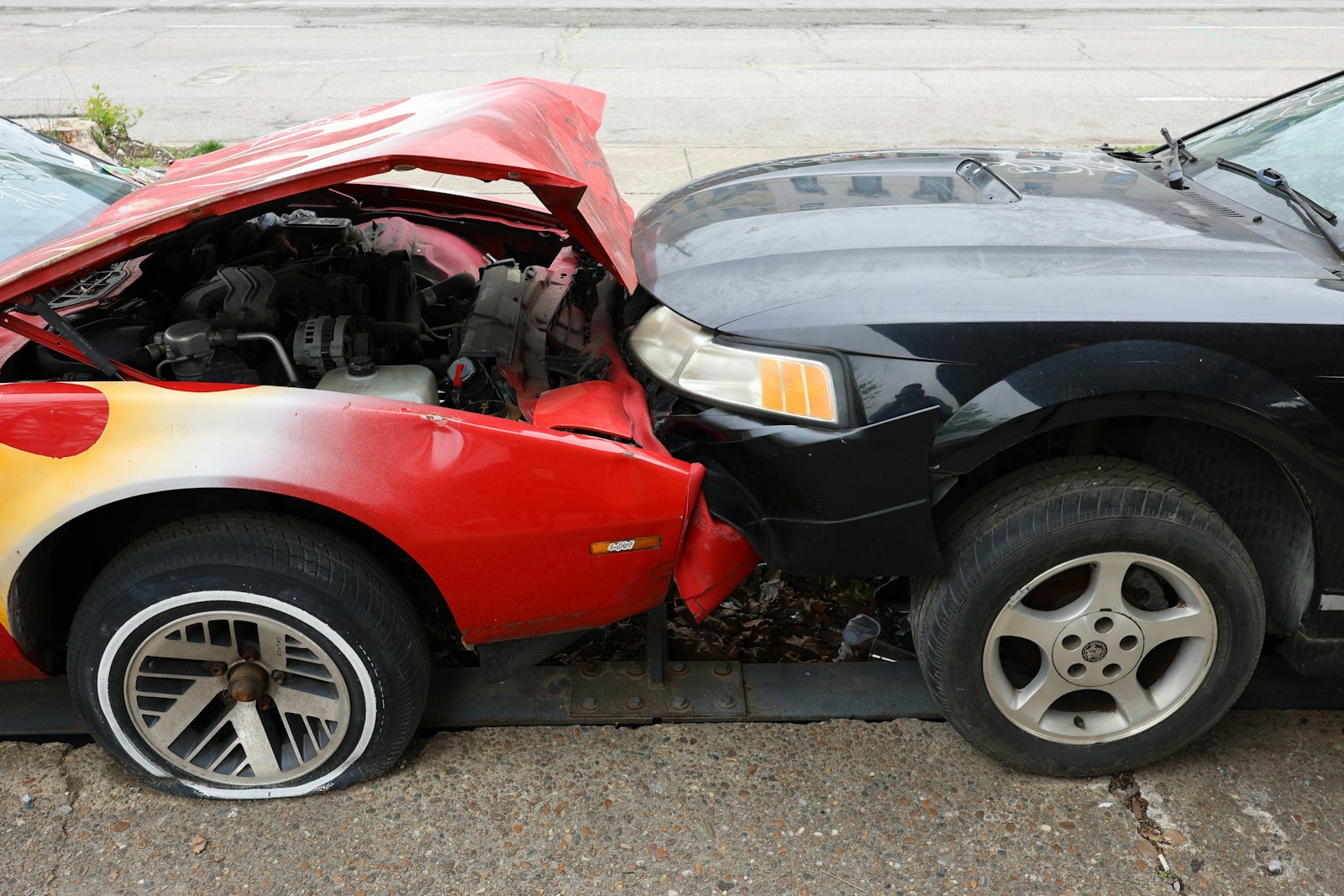
It started as one of those mundane, brain-off drives where nothing is supposed to happen. Late afternoon, dry roads, that pale golden light that makes every windshield look like it’s been smeared with fingerprints. The driver in this story—let’s call her Maya—was rolling through a familiar stretch near a grocery plaza, doing the mental math of “do I need milk” and “why is everyone in such a hurry.”
She’d just cleared an intersection and was easing into the right lane because her turn was coming up. The traffic was moving, not flying, but steady enough that nobody should’ve been doing anything sudden. And then, in the space of a breath, there was a blunt jolt and that ugly plastic-on-plastic crunch that turns your stomach before you even understand what happened.
Maya’s car lurched forward like it had been kicked. She remembers her hands going tight on the wheel, the way her whole body did that involuntary brace. In her rearview mirror she saw a white SUV too close, nose dipped, driver’s face pinched like he’d just realized he’d messed up.
The roadside apology that felt… almost too easy
They both pulled into the nearest parking lot, the kind with faded arrows and random shopping carts marooned in islands. Maya got out, phone in hand, doing that cautious half-walk where you’re not sure if you’re about to have a normal adult exchange or a weird confrontation. The SUV driver was already stepping out, palms up, a little frantic in his movements.
Before she even got a full sentence out, he started talking. He said something like, “That’s on me—I didn’t see you slow down,” and then, as if that wasn’t enough, he added, “I looked down for a second.” It wasn’t poetic, but it was clear, and it was the kind of admission people usually don’t hand you unless they’re panicking.
Maya did what people always do now: she took photos of everything. Bumper angles, skid marks (or the lack of them), both plates, the intersection behind them, the little scuffs that look minor until you remember how expensive “minor” can be. The guy watched her take pictures and didn’t protest, which made it feel, for about three minutes, like this might be the rare painless fender bender where everyone acts like a grown-up.
He even offered his insurance card without a fight. He kept repeating versions of “I’m sorry” and “it’s my fault,” and he asked if she was okay like it mattered. Maya wasn’t exactly calm, but she filed it in her brain as: admission made, documentation done, move on.
The small details that started to feel important later
What Maya didn’t know yet was that the clean little exchange at the scene was the part that would make everything messier. In the moment, she noticed small things and didn’t assign them meaning. Like how he kept glancing at his phone sitting in the SUV’s cupholder, screen still lit, like it had been in use.
Or how he didn’t want police involved, not aggressively, just with that “we can handle it ourselves” tone. Maya wasn’t hurt and the cars were drivable, so she didn’t push for a report. She figured insurance would sort it out the way it always supposedly does in commercials.
They swapped info, and the guy—let’s call him Trent—said again, clearly, “I rear-ended you. It’s on me.” Maya even remembers the exact posture: shoulders rounded, face red, a guy trying to get through an embarrassment. If she’d been collecting evidence like a prosecutor, she would’ve asked him to repeat it on video, but nobody thinks like that when they’re still hearing the crunch in their head.
She drove home with that hollow feeling you get after an accident, where everything is normal but slightly off. The bumper looked mostly fine until you saw the panel gap and one taillight that didn’t sit quite right. Maya told herself it would be annoying, not life-consuming.
When the insurance call turned into a magic trick
A couple days later, she got the call from Trent’s insurance adjuster. Maya expected routine questions: where were you, what time, any injuries, any witnesses, send photos. She was ready to give the boring timeline and move on with her life.
But the adjuster’s tone was weirdly cautious, like she was already holding an invisible folder labeled “dispute.” She asked Maya to walk through it again, and then she said, almost casually, “Our insured is reporting that you came out of nowhere.”
Maya actually paused, because it was such a ridiculous phrase for a rear-end collision on a straight road. “Came out of nowhere” makes sense if someone sprints into a lane without looking, not if you’re already in front of someone long enough for them to hit your bumper. She told the adjuster, carefully, that Trent had admitted fault at the scene—multiple times—and that he’d said he looked down.
The adjuster didn’t argue, but she didn’t sound convinced either. She asked if Maya had a dashcam. Maya didn’t. She asked if Maya had a witness. Maya didn’t. And you can hear, in that moment, the way reality shifts from “what happened” to “what can you prove.”
The new story: “She cut me off,” dressed up as “I didn’t have time”
When Maya pressed for specifics—because how do you even respond to “out of nowhere”—the adjuster explained Trent’s updated version. He claimed Maya had “suddenly changed lanes” in front of him and then “slammed on the brakes.” The impact, in his telling, wasn’t him failing to stop; it was her creating an impossible situation.
It was the same crash, but now it was a different moral universe. In the parking lot, Trent was the guy who’d messed up and owned it. On the phone, he’d apparently become a defensive driver ambushed by a reckless stranger.
Maya replayed the scene in her head like a clip on loop. She remembered the lane change being gradual, not a dive. She remembered there being plenty of space, and she remembered the SUV closing that space too quickly. She also remembered his phone, lit up, sitting right there like an uninvited extra in the shot.
And here’s the part that made her angrier than the money: Trent hadn’t just changed a detail. He’d swapped roles. He’d taken the most basic thing—rear-ending someone—and tried to hand it back to her like she’d dropped it.
Scrambling for proof in a world that runs on paperwork
Maya started doing what people do when the story gets rewritten: she tried to reconstruct reality with receipts. She pulled her photo timestamps, took screenshots of her call log from that day, and typed out everything she remembered Trent saying while it was still fresh enough to feel real. She called nearby businesses to ask, awkwardly, if any of their exterior cameras faced the road.
The answers were a depressing mix of “we don’t keep footage that long” and “it only shows the parking lot.” One store manager told her they could only release video to police with a report number. That’s when Maya realized how the “no need for police” suggestion at the scene wasn’t just convenience—it was a strategic little door quietly closing.
She contacted her own insurance and filed a claim, because now it wasn’t just about getting Trent’s insurer to pay. It was about protecting herself from being labeled at-fault for a crash she didn’t cause. Her insurer sounded sympathetic but practical, the way they always do: they’d go after Trent’s insurance, but without independent proof, it could turn into a “word vs. word” situation.
Meanwhile, the body shop estimate came back higher than she expected. The bumper wasn’t just scuffed; there were broken clips, hidden damage, and a sensor bracket that had shifted. It wasn’t catastrophic, but it wasn’t “buff it out,” either—and every day it dragged on, the whole thing felt more like a slow leak in her life.
The conversation nobody has at the scene: what you’ll say later
Maya kept thinking about that parking lot moment, the way Trent’s apology had seemed so straightforward. She remembered how he’d stood close enough to be heard over the traffic, voice low like he didn’t want anyone else listening. If she’d known she’d be dealing with a rewritten story later, she would’ve asked a different set of questions: “Can you text me that you’re at fault?” “Can you say that again while I record?” “Can we call police just to document?”
But in the real world, people don’t do that because it feels paranoid and hostile, like you’re escalating something that might resolve peacefully. Maya didn’t want to be that person with the phone shoved in someone’s face. She’d assumed a basic level of honesty would carry through from the scene to the claim.
And maybe that’s what stung the most. Not just that Trent changed his story, but how normal it was for him to do it—like he’d gone home, sat with the embarrassment, and decided he liked a different version better. A version where he wasn’t the guy who looked down at the wrong moment.
Now she’s stuck in that frustrating limbo where nothing feels resolved, just argued. Insurance adjusters trade statements, repair costs sit on hold, and Maya’s left watching her own memories get treated like they’re negotiable. The crash was quick; the aftermath is the part that keeps happening, every time the phone rings and she wonders which version of reality she’s going to have to defend next.