

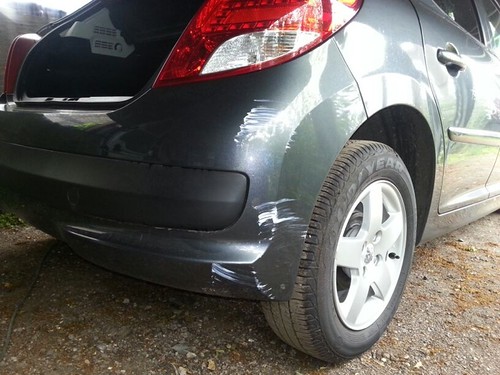
It started the way these nights always start: someone dressed a little nicer than usual, running a few minutes late, pulling up to a restaurant that’s clearly decided “parking” is part of the experience. The valet stand was doing that practiced chaos thing—whistles, hand signals, tickets tearing, keys jangling—while cars stacked up at the curb like a slow-moving conveyor belt.
The driver this happened to—let’s call him Daniel—hesitated for a second because he actually likes his car. Not in a “showroom princess” way, but in a “I paid too much for this and I know every little ding on it” way. Still, the curb was a mess, his dinner reservation was in ten minutes, and the valet was already opening the door with the confidence of someone who’s done this a thousand times.
Daniel handed over the keys, did the quick mental snapshot of the front bumper and passenger side, and got the little paper claim ticket like it was a receipt for trust. He watched the valet swing into the driver’s seat and roll forward into the garage entrance, taillights disappearing into the fluorescent gloom. Then he turned toward the restaurant, figuring the stressful part of the night was over.
The scrape nobody wanted to claim
The first hint that something was off came when Daniel got back out front after dinner and noticed his car wasn’t in the “ready to go” line. It wasn’t a huge wait—ten minutes, maybe—but the valet station had that low-level tension where everyone’s smiling while quietly panicking. Daniel stood there holding his claim ticket, watching valets jog in and out like they were trying to beat a timer.
When the car finally rolled up, he saw it before the valet even stopped. The passenger-side rear quarter panel had a pale, chalky smear across the paint, and the edge of the wheel arch looked slightly buckled, like something had pressed into it and dragged. It wasn’t catastrophic, but it was unmistakably new damage—fresh enough to still look dusty.
Daniel pointed at the scrape and didn’t even raise his voice, just did the calm, “Hey, what happened here?” The valet who brought it up blinked like he’d never seen the side of the car before, then glanced toward the garage entrance. That quick look—half a second—was the kind of body language that makes your stomach drop, because it reads like “I know exactly what this is.”
The valet tried to go with the classic: maybe it was already there, maybe someone hit it in the garage, maybe it happened on the street. Daniel asked for a manager, and suddenly there were three people standing in a semicircle, all talking in gentle voices like they were negotiating with a skittish dog. The manager kept repeating, “We take these things very seriously,” while not actually taking anything seriously enough to write it down.
The garage pillar and the awkward silence
Daniel walked around the car and ran his finger along the scrape, picking up a faint white residue that looked exactly like concrete dust. He said that out loud—“This looks like concrete”—and the manager’s face did something subtle, a flicker of recognition that disappeared as fast as it came. Daniel asked if there were pillars in the garage, and the manager said yes, of course, it’s a garage.
Then Daniel asked a question that should’ve been simple: “Can we check the camera footage?” He wasn’t trying to be dramatic; he just wanted to see what happened and who was driving. The manager paused, too long, like someone stalling while they search for the right script.
She told him they had cameras, but the footage was “for internal use.” Daniel said he wasn’t asking for a highlight reel, he was asking for the few minutes between drop-off and parking. She did the customer-service thing where she nodded sympathetically while saying no, and it somehow made the refusal feel even sharper.
In the background, another valet—older, more experienced-looking—kept watching the conversation with tight lips. At one point, Daniel turned his head and caught him looking at the damage, then quickly looking away. That tiny exchange didn’t prove anything, but it added a layer of, “Okay, someone here knows exactly which pillar did this.”
“Internal property” becomes the magic phrase
Daniel asked if they could at least review the footage and confirm what happened. The manager said they could “look into it,” but wouldn’t let him see it, wouldn’t let him record it, and wouldn’t give him a copy. When he pushed—politely, but firmly—she repeated the same phrase like it was legally enchanted: the footage was internal property.
He asked for that in writing, and the manager’s tone changed. Not angry, exactly—more like the moment when someone decides you’ve become a “problem” and stops trying to be charming. She said if he wanted to make a claim, he could fill out a form, and the valet company would “investigate.”
Daniel asked what the investigation involved if the only people allowed to see the footage were the people who would be blamed by the footage. The manager didn’t answer that. She just kept sliding the paperwork toward him like it was a peace offering.
He took the form anyway, because not taking it would’ve meant walking away with nothing. He wrote down the time he arrived, the approximate time he got his car back, and a description of the damage. The manager scribbled her name, but didn’t give him a business card, and when he asked for one, she said they were out.
The slow pivot from apology to defense
The next day, Daniel called the restaurant and got bounced between the host stand and a general manager who sounded slightly offended to be involved. The GM said the valet was a third-party service and the restaurant “didn’t control” the garage operations. Daniel pointed out that the valet stand was branded with the restaurant’s name and stationed at their front door, and the GM responded with the verbal equivalent of a shrug.
Then came the part that really set Daniel off: the valet company told him they had no record of an incident. No report from the driver, no note in the system, nothing. Daniel read that as a decision, not an oversight—because if the car came in clean and left scraped, the only way there’s “no record” is if nobody felt like creating one.
Daniel asked again about video, and the restaurant doubled down. They wouldn’t release it, wouldn’t even confirm whether that specific area of the garage was covered, and wouldn’t tell him how long footage was retained. They kept saying “privacy” and “policy,” like the camera was filming state secrets instead of a valet maneuvering around a concrete pillar.
At this point, he did what a lot of people do when they realize politeness isn’t going to get them anywhere: he went through his insurance. He filed a claim and gave the adjuster every detail, including the refusal to share video. The adjuster asked the obvious question—had Daniel taken photos at pickup?—and thankfully, he had, with timestamps and a shot that clearly showed the concrete transfer on the paint.
The uneasy waiting game
Insurance moved in that frustrating, methodical way where everything is urgent to you and procedural to them. Daniel got an estimate from a body shop, and the shop pointed out the damage wasn’t just superficial; the panel had a slight crease that would need either careful repair or replacement. The cost climbed fast, which made the restaurant’s calm “fill out a form” attitude feel even more insulting in hindsight.
Meanwhile, Daniel kept thinking about the footage like it was a locked drawer with his name on it. He wasn’t even obsessed with seeing someone mess up; he wanted the clean chain of responsibility. Instead, he got this fog of corporate language where everyone was sorry something happened but nobody could confirm that anything happened at all.
He asked the valet company directly if they’d be willing to review footage in front of him. They said no, they could only share information with “authorized parties.” He asked who counted as authorized. They said law enforcement or legal counsel, and the way they said it made it clear they were betting he wouldn’t bother.
And maybe that was the most infuriating part: the damage itself was fixable, but the whole experience left him feeling like he’d been politely hustled. A stranger had taken his keys, scraped his car against something that looked a lot like a garage pillar, and then the business attached to the whole arrangement treated the evidence like it belonged to them, not to the person paying for the consequences.
The last thing Daniel had, before it slipped into the hands of insurance adjusters and “claims departments,” was that moment at the curb when the valet glanced toward the garage and the manager paused just a beat too long at the word “footage.” That’s the kind of pause that sticks with you—not because it proves anything in a courtroom, but because it feels like the exact second everyone decided the easiest solution was to out-wait him until the video rolled over and disappeared.